

In today’s intense world where alternative facts masquerade as truthful statements … where Executive Orders bring confusion and fear … where outrage is commonplace … where inner peace is quickly disappearing … where concerns and fears about compromised health, terrorism, disasters, broken relationships, economic crises, political harangue and other stressors bring confusion, frustration, anger, and fear, a Spirituality of Play may seem to be a curious matter.
But, more than ever, I believe that a Spirituality of Play” is an attitude that needs to be cultivated in society, in educational systems, in families, by seniors and adults and by children and youth so they can become adults who live balanced lives where laughter, joy and hope are intrinsic throughout their adult life.
And that brings up the subject of today known by many as April Fool’s Day. Where did that begin and what’s it all about? Some link it to the 1564 adoption of the Gregorian calendar which moved New Year’s Day from late March/early April to January 1st and those who clung to the original date were mocked as ‘April fools’ (poisson d’avril in French, meaning “April fish,” a symbol of gullibility). Before that, the Roman Hilaria and the Hindu Holi festival (spring equinox) involved pranks and revelry, and Medieval Europe’s Feast of Fools featured role reversals and mischief.
From the Greek word selig (which means blessed) comes the English word silly. I like to think that there is something sacred about the ability, to be silly, to play, to laugh, to be child-like.
Many faith traditions (Christian and Hasidic storytellers, Zen masters, Taoist sages) encourage us not to take ourselves too seriously. These prophets have an important role in the spiritual life because they espouse the spiritual practice of play. Ralph Waldo Emerson wrote “It is a happy talent to know how to play.” Author Margaret Guenther wrote “When we play, we also celebrate holy uselessness. Play, in its disinterestedness and self-forgetting, can be fruitful.”
When we play … when we enjoy the fullness of life with its curiosities, frivolities and insensibilities … when we don’t take ourselves too seriously, play (like prayer), can be healing: healing to the body, mind and soul.
Interesting fact — when Hindus speak of the creation of the universe, they don’t call it the ‘work’ of God, they call it the ‘play’ of God … ‘play’ being sacred and holy.
When we play, we leave behind the daily stressors and allow our spirit to breathe and re-create. Literature, the arts, various traditions and holidays remind us of the importance of play of giving ourselves permission to be silly and foolish. And Russian artists from the 15th century often featured the yurodivy, a kind of “holy fool” in their paintings.
April Fool’s Day is a day for laughing, for playing gentle jokes and for trying to trick friends. For example, in some places in Europe, paper fish (poisson d’avril) images are put on people’s backs and play pranks on one another … in the UK, Ireland, the US and Canada, people play pranks until noon shouting “April Fool”, stopping their pranks at noon because after that is considered to be bad luck … in Scotland, there’s the two day tradition of “Hunting the Gowk” – sending people on fake errands … in Brazil, there’s Dia da Mentira (“Lie Day”) with the telling of jokes and fake news … Japan adopted western-style pranks in the 20th century … and in Iran, Sizdah Bedar (April 1–2) involves outdoor picnics and playful deceit. On the last day of the nature festival ‘The Hill’ in India, people have fun by sending friends on impossible errands such as finding a stick with only one end … in Native American traditions, Coyote is the Trickster … while in the Aztec tradition, Coyote is referred to as ‘God’s Dog’ … and in Hollywood, Wil E. Coyote always played tricks on the Roadrunner.
Modern twists on April Fool’s Day have brought media and brands embracing the tradition of hoaxes along with social media which seems to have an increase in memes for fun and play, not for real.
A Spirituality of Play helps us live with mystery, paradox and absurdity. It can open doors of flexibility, intuition, vulnerability, and doors of child-like innocence and spontaneity. If we can believe that the Creator created anteaters, duck-billed platypuses, giraffes clownfish, pink flamingoes, and us (!), surely it’s not surprising that the Creator has a great sense of humour and encourages us to laugh – and play!
It’s true – age creeps up, surprises us, reminds us of our mortality. Chronological aging is one thing. And growing old is another thing.
Perhaps many grow old because they stop playing? Play comes in many forms: laughter, dancing, doodling, board games, running with the dog along the beach, playing bridge, engaging in a sport, playing an instrument, creating anything … a shed, a dress, a poem, a painting, a piece of calligraphy, a meal, a book, a piece of pottery, a magazine article, a computer program, a piece of sculpture, a photograph, a monogram, a garden, a scrapbook, a bookcase …
I may be aging more quickly than I would like, and my body may be showing its age a bit more every day, but I refuse to grow old. Even if it’s only a bit each day, I try to play a little each day. This week I’ll be playing with paper products to create a handmade card for a friend who is unwell. When it’s cooler outside, I’ll be playing in the garden. And then there’s the recipe book I borrowed from the library that is inviting me to play in the kitchen and try out some new recipes. I suppose I could look at these three ‘play’ activities and see them as ‘chores.’ But I don’t. Perhaps ‘attitude’ is an important role in the aging process?
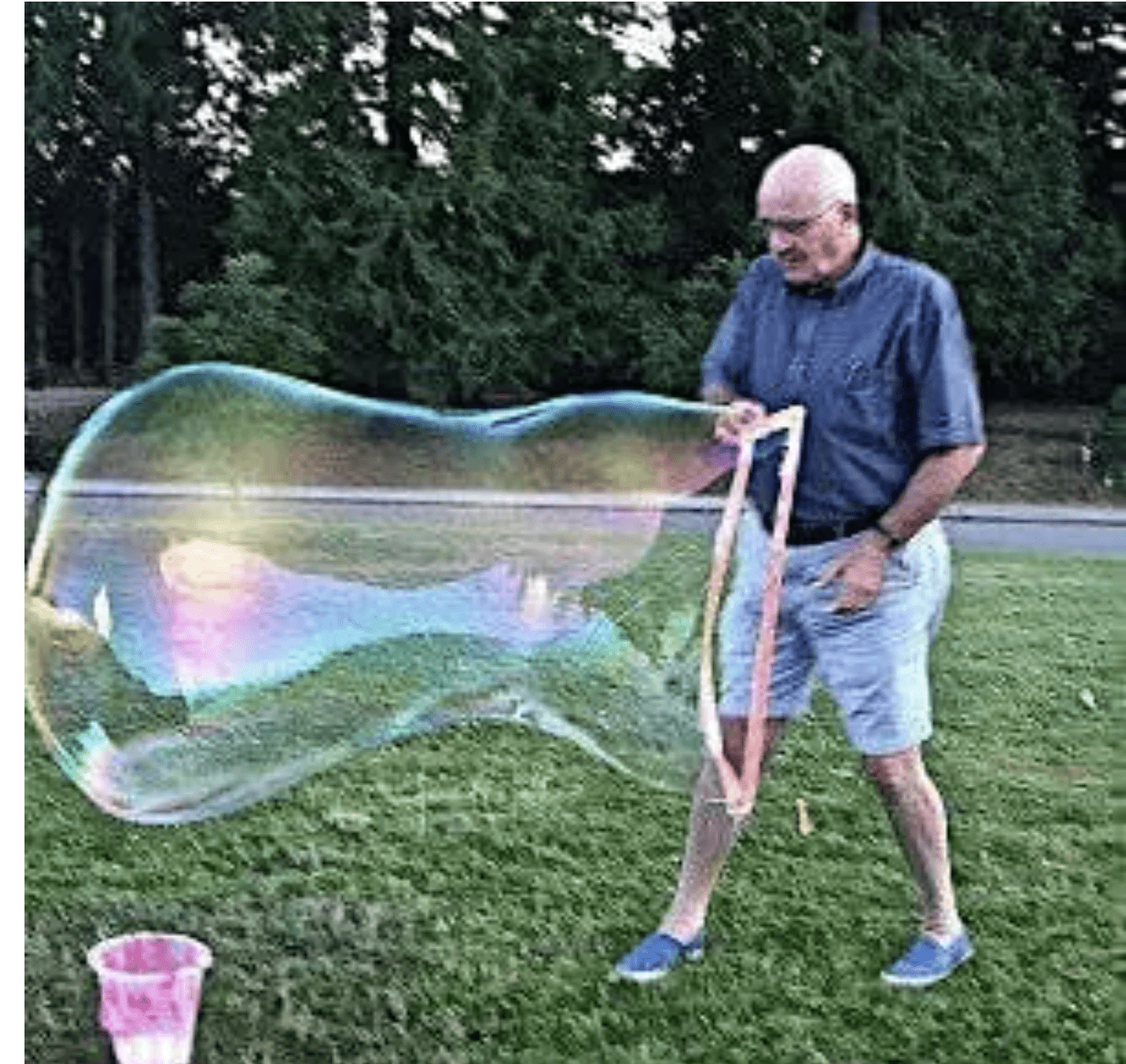
My beloved husband, Hans, was 85 (!) years young when I took this photo of him playing with bubbles in a local park. Hans was a pen and ink artist, calligrapher, retired engineer – a serious intellect who spoke many languages, read, discussed, imagined. Truly a Renaissance man. In his later years, he grew to understand the importance of incorporating a Spirituality of Play in his life and joined me in a daily mantra “Each day, I ‘age’, but I don’t ever want to ‘grow old.
If I reach Hans’ age, I want to still be incorporating a “Spirituality of Play” every day, in some way.
What about you?
********************************

© Photo & Text: June Maffin
https://soulistry.com/blog
www.facebook.com/junemaffin
Thank you. June. I love all of this. Play is so important and I love the reminder of how important it is as we grow older. I’ll keep playing!
Thank you June for such a joyful and uplifting article ❣️ and such a wonderful picture of Hans 😊 I wish I had known him. Love Sandra 💞
Wow! That’s quite the bubble! A quote from your reflection – “Perhaps many grow old because they stop playing?” So true. When the men who come to our annual rocket party are out in the January cold with their rockets, I imagine all of them as young boys. All of them know how to play. I start my day by snuggling and playing with my sweet Annie, and I start to smile. “Let a smile be your umbrella and you’ll never grow old.” A great song, just a bit schmaltzy and sung in Bing Crosby’s inimitable voice is a good mantra, don’t you think? I, too, make play a part of my day. It helps to keep my glass half full sometimes full to the brim. Happy Easter, Dear June.