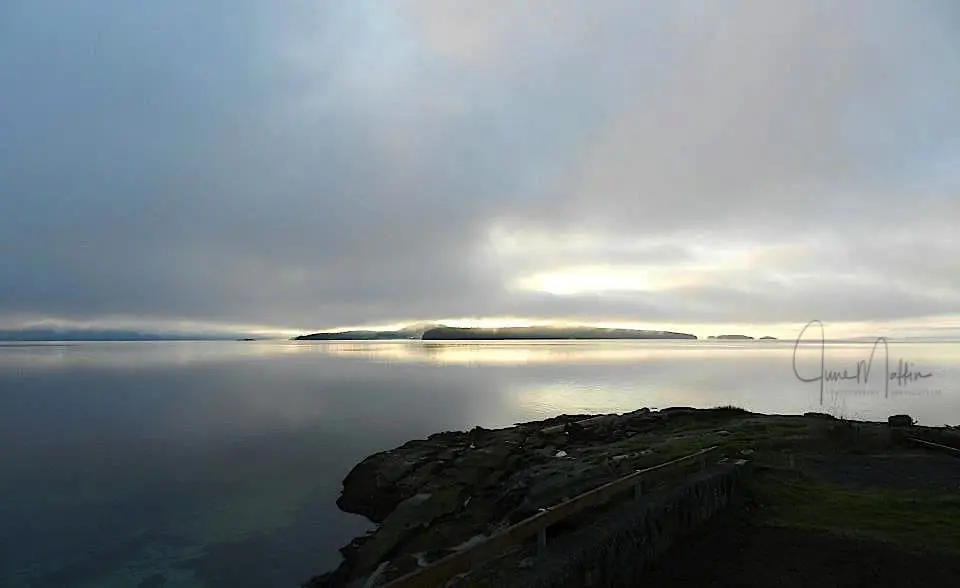
It’s been well over a year since most of us have travelled beyond our own town, city let alone our own Country.
I’ve missed travelling. I’ve missed seeing places I’d only read about in books. I’ve missed connecting with family and friends. I’ve missed exploring beyond where I live. I’ve missed the anticipation, the excitement, the adventure, the learning. I’ve missed the making of memories of it all.
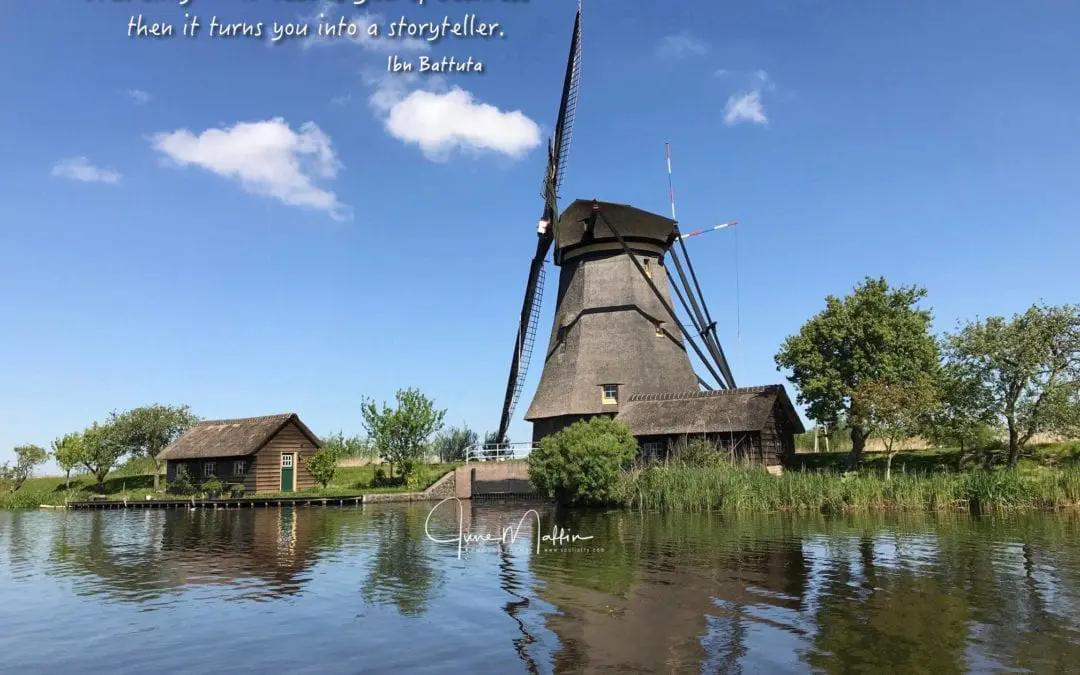
My last ‘trip’ was to the Netherlands to visit family of my late husband, Hans van der Werff. It was a bittersweet trip where my camera captured images of windmills, tulips, cobblestone streets, picturesque villages, family birthday parties, historic buildings and oh, so much more. And where my heart captured images of previous visits, grief, beauty and healing.
This past year, travel has continued – in spite of the pandemic. Travel happened in front of my computer on ZOOM. I’ve zoom-travelled to India and Japan, Croatia and China, Russia and Australia, Singapore as well as many provinces in Canada and states in the United States. I’ve zoom-travelled with one or two others and zoom-travelled with many others – taking classes, visiting museums, experiencing European cities. I’ve zoom-travelled to listen to speeches, to exercise, to take classes and workshops. It’s been quite the year of travel!
And the cost? Time. That’s it. Just ‘time’.
I’ve not filled the gas tank – haven’t stood in lines at the airport – didn’t need to go through security – wasn’t frustrated when travel arrangements were changed.
I slept in my own bed – ate my own food – got up from the computer and made a hot cuppa. I’ve learned a lot. Seen a lot. Made new friends. Developed new interests. Uncovered hidden dreams of exploring the streets of Paris and Venice becoming real. I’ve become familiar with different time zones – discovered accents I didn’t know existed – gone on a safari and oh, so much more.
Medieval scholar, writer and traveler (travelled more than any other explorer in pre-modern history), Ibn Battuta wrote: “Traveling – it leaves you speechless, then it turns you into a storyteller.”
When I have travelled to and worked in Sri Lanka, the Philippines, Uganda, as well as various parts of Canada, the United States and Europe, I was left ‘speechless” and the memories of the experiences of those trips continue to bring blessings my way. Stories – oh the stories I could tell. 🙂
The same thing has happened since I’ve been zoom-travelling … blessing upon blessing, making memories. And yes, stories – oh the stories I could tell.
Until I find it safe to travel beyond my own province/country, I’ll be very grateful for and content with, zoom-travel. This week, I am travelling to a four day international conference – via zoom. I suspect that when it is all over, I will have stories to tell. 🙂
Ibn Battuta was right … when we travel, we are left speechless … and we have stories to tell. 🙂
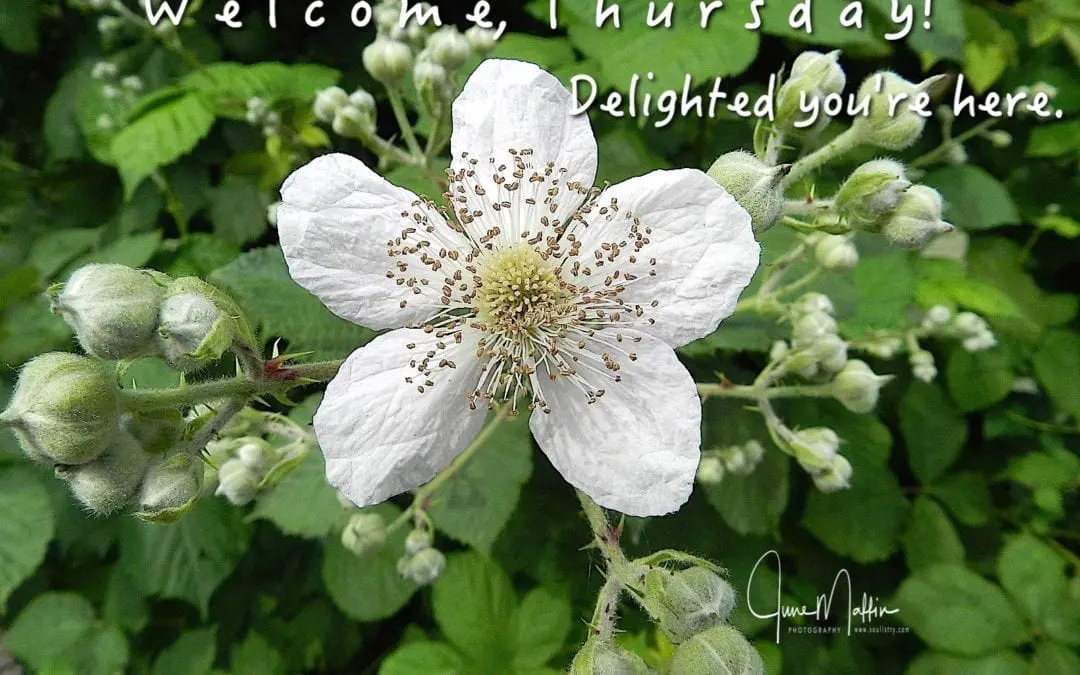
Whenever you find a Thursday that is sad Whenever you find a Thursday that is lonely Whenever you find a Thursday that is difficult in any way How about welcoming it?
How about letting it know you’re delighted it is here?
How about expressing gratitude that you’re here?
Because you are here, Thursday
It’s not another day of the week It’s Thursday. And as Annie sang “the sun will come up, tomorrow.”
See you “tomorrow” – Friday for another in the Soulistry “Day of the Week” reflection series: www.soulistry.com/blog
You have set before us many hours. What will we do with those hours?
Choices. There are choices to be made.
Some choices bring change … in our relationships … in our work environments … in our education … in our health … in our decisions
Some choices bring results in our attitude. … Will I see this day as a day to dread? … Will I see this day as a day to consider possibilities? … Will I see this day as a day to anticipate?
Will this day bring … joy to my heart? … peace to my soul? … life to my intellect?
It’s up to me. Each day.
This day I choose … Joy: work in the garden with the earth and seeds and the sunshine … Gratitude: deal with some paperwork so there’s a beginning sense of order in the “to be filed” box. … Creativity: play with with pen and ink and coloured markers for an hour or so.
So today I celebrate you and thank you for the opportunity of yet another Monday on Planet Earth to evolve, learn, feel, experience, reason, breathe, walk, blog, play, eat, laugh.
Hello Monday – and thank you! It’s good to see you again. May we meet again in seven days.
These days, there seems to be a daily reminder that peace is elusive: news of the pandemic’s “numbers” rising quickly; its variant strains complicating matters; vaccine appointments slowing down in some areas; political goings-on; on top of difficult economic times; how/when/where to grieve the loss of a loved one; increasing sense of abuse happening in relationships; teachers, ferry workers, bus/transport drivers who see their jobs as ‘essential,’ but the government doesn’t see it that way, so they’re not on any vaccine list.
Peace is not just elusive for some. Peace is elusive for a growing number of people around the world and as a result, stress and mental health issues are on the rise.
While we sometimes experience ‘stress’ as “eustress” (from the Greek “eu” meaning “good”), according to the endocrinologist Hans Selye, eustress is the kind of stress that is healthy and gives a good, positive feeling.
However, more often than not, the stress that is experienced is “distress” (from the Latin prefix “dis” meaning “having a negative force”). Distress describes unpleasant/negative feelings or emotions that impact the level of functioning. Sometimes the stress is related to work. Sometimes the stress is related to relationships. Sometimes the stress is related to health or finances or lack thereof. Sometimes the stress is related to busyness or needing to be perfect or organized or … Sometimes the stress is related to grief. Sometimes the stress is related to fear … fear of the known … fear of the unknown. Sometimes the distress is a combination of several of the above.
S e r e n i t y. We want it. We want to exhale fear and inhale peace. P e a c e. We need it
But fear, busyness, worries, grief, physical pain, guilt, sleepless nights, and those everpresent “what-if’s” creep into our minds. And then there are the actions of bullies (at work, school, cyberspace), politicians, media, conspiracy theorists who further propel thoughts away from experiencing any sense of peace.
And yet … and yet … serenity and peace are available. We only need to be aware of them in the gift of our breath in the gift of words, spoken in the silence of hearts to one another, and to ourselves. Like these words, this prayer, this Celtic spirituality-based prayer this whispered hope … bring some semblance of peace this night.
Circle me. Keep protection near And danger afar. Circle me. Keep hope within. Keep doubt without. Circle me. Keep light near And darkness afar. Circle me. Keep peace within. Keep evil out. <adapted from the work of David Adam)
Blessings to you, my friends. And, peace. May the nourishment of the earth be yours, May the clarity of light be yours, May the fluency of the ocean be yours, May the protection of the ancestors be yours. <John O’Donohue>
A Facebook friend posted this comment: “Today I will stop giving so generously and freely
… I close my heart.” I was sad.
Guard her heart?
Of course.
Do self-care?
Of course.
But close her heart?
No.
Please, no.
There will always be people who will do what they can (consciously / unconsciously)
… to take us down.
There will always be people who don’t like us
… not everyone will like us.
But, that’s not a reason to close our heart.
Maybe the reason some people don’t like us is because of our religion.
Maybe it’s because of our gender or sexual preference or language or skin colour or …
Maybe it’s our choice of partner/spouse.
Maybe it’s our personality, or our clothing, or our food choices, or our history, or …
Maybe it’s because of who we support politically.
It could be any number of things.
The bottom line is that not everyone will like us.
Sometimes, we are
… Just … Not … Liked.
No identifiable reason.
When I learned that stark reality,
I also learned that ‘others not liking me’ is not my problem.
It’s their problem.
In that discovery, came another learning.
As long as I do my best each day.
As long as I love and take care of myself, I can be myself
and in so doing, life can become more gentle, more fun, more enjoyable and more loving.
I never want to close my heart.
The consequences of such a decision are too tragic to consider.
What about you?
Have you ever thought of closing your heart?
Sadly, in today’s political and pandemic climate,
more and more are echoing the words “I close my heart”
and it seems that as hearts are closing,
minds are closing even more
bringing beyond-difficult consequences
for our world.
I hope you have not closed your heart,
but … if you have,
I hope that you realize that as long as you do your best each day,
as long as you love and take care of yourself, you can be yourself.
And in so doing, life can become more gentle,
more fun, more enjoyable and more loving.
May we follow the lead of our pet friends …
they never close their hearts.