Balance is important for us and important for tulips, too.
Too much sun and they die prematurely. Not enough rain and same thing happens. But when Mother Nature provides a lovely balance of sunshine and rain … ahhhh, beauty.
Today, a rainy day and the tulips are loving every single drop. Capturing this almost-blossoming-tulip in the back yard, seemed to serve as an illustration of this Soulistry blog about balance.
When the busyness of life grabs us, or when we think we have no time, energy, creative juice or zest for life, perhaps it is time to ask ourselves “Where’s the balance?” Maybe we don’t allow ourselves to simply “be” and instead, we focus on ourselves as a “human do-ing” rather than a “human be-ing.”
Instead of doing things which drain us to the point that the passion-to-create or the desire to spend quality time with self/family/close friends is no longer paramount (or maybe even existent) in our daily activity, maybe it’s time to give ourselves the gift of Presence … a time when we nurture our Spirit … are gentle with ourselves … breathe in calm, peace and healing … breathe out anxiety, fear and pain.
Maybe it’s time to recognize that we don’t have to “do it all” … that saying “no” or “not at this time” is exercising wisdom … that acknowledging our vulnerability isn’t weakness, but strength in self-awareness.
Giving the gift of Presence to ourselves can become the catalyst for the precious balance s o necessary to a life where the spirit grows, personhood evolves and healing, health and wholeness can emerge.
May we give ourselves the Gift of Presence this coming week.
When life hits unexpectedly, it hurts. and when it hurts, it can wound
… not just physically
… not just emotionally
… not just spiritually
… not just intellectually
sometimes … all four.
When life hits unexpectedly and pain results … when life brings exhaustion beyond imagining … when the rain of sadness is in our heart what then?
Hopefully
… the Holy One of Compassion will be with us,
holding us close when we are weary, hurt, alone. (May Holy Compassion be with us)
… the Holy One of Mercy will be with us, forgiving those who have caused pain, forgiving ourselves, forgiving Holy Other. (May Holy Mercy be with us – you / me)
… the Holy One of Gentleness will be with us,
caressing us with sunlight, rain and summer winds
and shining through us to all who hurt and are lonely. (May Holy Gentleness be with us)
… the Holy One of Wonder will be with us,
delighting us with sunrises, daisies, songs, baby’s laughter,
enchanting our senses, filling our hearts, giving us wide-open eyes. (May Holy Wonder be with us.)
… the Holy One of Simplicity will be with us,
opening us to a clear vision of what is truth
and dealings with others will be marked by honesty, which is simplicity. (May Holy Simplicity be with us.)
… the Holy One of Patience will be with us,
waiting with outstretched arms
and encouraging us to “be still, deep within ourselves.” (May Holy Patience be with us.)
… the Holy One of Love will be with us,
listening, drawing us close as we tremble, lighting fires of faith and hope in hearts. (May Holy Love be with us.)
… the Holy One of Tenderness will be with us,
enfolding us with the desire to bring warmth
to those who are dis-eased in body, mind or spirit. (May Holy Tenderness be with us.)
… the God of Strength will be with us,
holding us close, on eagle’s wings
and we will be the sacrament of God’s strength to others. (May Holy Strength be with us.)
… the God of Peace will be with us,
stilling the heart that hammers with fear or doubt or confusion,
bringing the warm mantle of peace cover those who are troubled or anxious. (May Holy Peace be with us)
… the God of Joy will be with us,
thrilling us with holy nearness,
filling our heart to fullness, and our soul with an awe that is profound. (May Holy Joy be with us)
… and hopefully, the God of Forgiveness will be with us,
encouraging us with strength, peace, and love. (May Holy Forgiveness be with us)
… so that “when life hits”
we have a sense
that we are not alone.
Amen. So be it. Amen.
This prayer can be adapted for personal use by using the word “me” or “you” in place of “us”
St. Patrick’s Day (March 17th) is a day that brings forth the ‘wearing of the green’, stories of leprechauns and shamrocks, wonderful Irish music, and gentle reminders of Celtic spirituality in many parts of the world.
Celtic spirituality transcends institutionalized religion and encourages people to consider aspects of the essence of life … like sleep. But sleep can be the elusive pimpernel of the night for many.
Night time, for many, seems to be a time when … minds seem to worry more … pain seems to hurt more acutely … grief seems to be more intense … fear seems to escalate
Many have been, are, experiencing sleepless nights.
– When COVID spread its tentacles in every continent, countless people became isolated, got sick, died. Anxiety grew as new strains of the virus emerged. Vaccines weren’t available to all people. And growing numbers of people refused to get vaccinated.
_ Increased concern about climate change has brought dramatic discussions about climate-refugees.
– A growing number of countries around the world continue to live in unbelievable conflict and the rest of the world holds its breath, fearful about the possibility of biological and nuclear warfare being unleashed.
– As prices rise due to tariffs, countless are deeply concerned about their savings, health care for themselves/their families, and fear about the future if democracy coming to an end.
– People “take sides,” alienating people in neighbourhoods, worship, work, community groups/organizations, families.
Worry, stress and global tension are having a serious negative effect on sleep patterns.
We need sleep – good sleep.
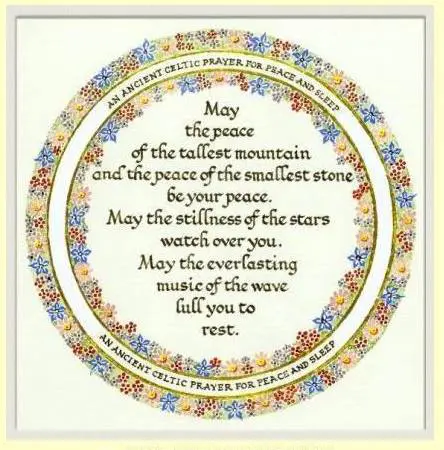
On St. Patrick’s Day, the Ancient Celtic Prayer for Peace and Sleep seems to be most fitting. It is a prayer. It is a wish. It is a hope. It is a need.
May this night, and all nights to come, be blessed with sleep and safety for this world and may this ancient prayer bring a gentle night of sleep for us all.
THE ANCIENT PRAYER FOR PEACE AND SLEEP May the peace of the tallest mountain, and the peace of the smallest stone be our peace. May the stillness of the stars watch over us. And may the everlasting music of the wave lull us to rest. Amen. So be it. Amen.
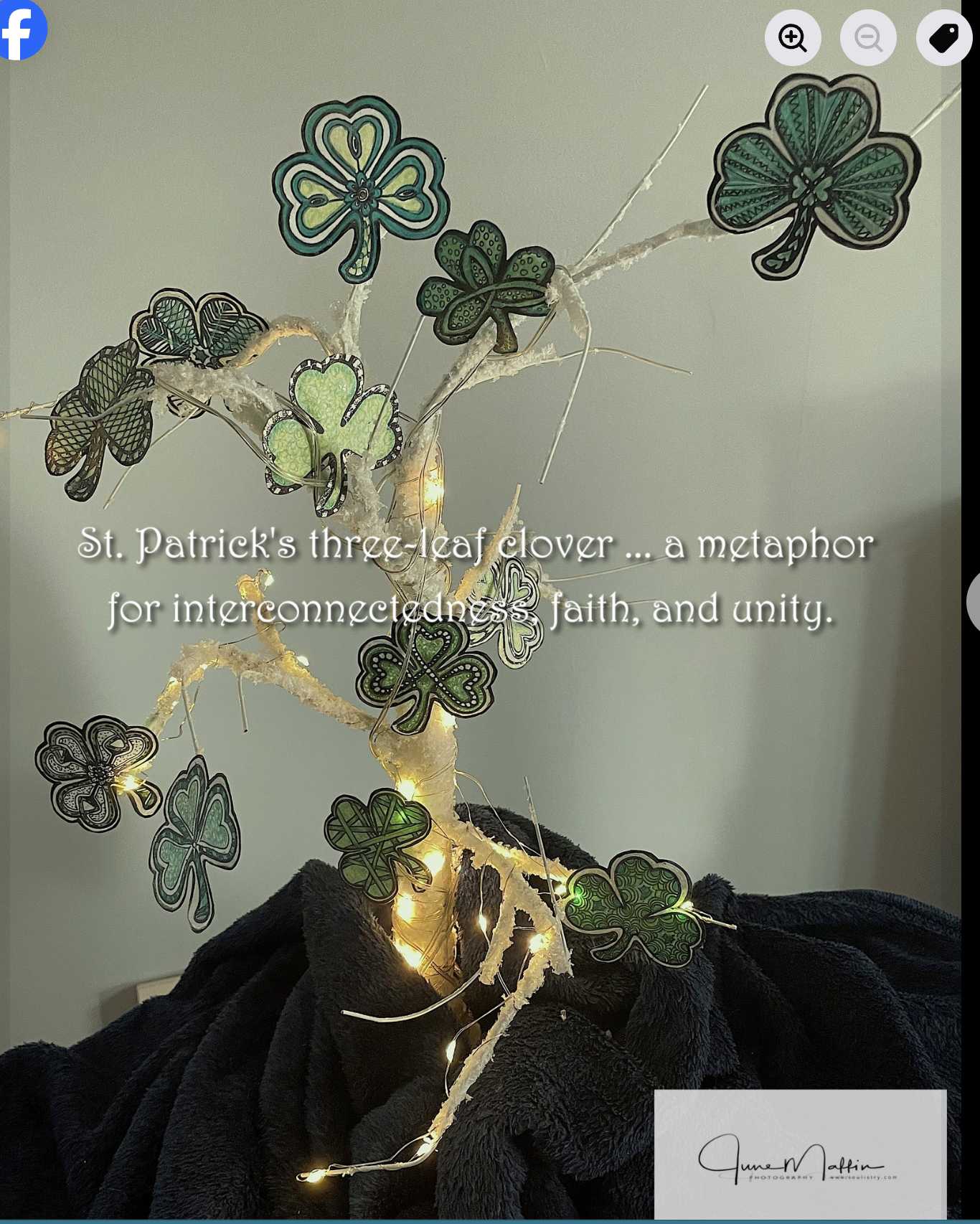
*********** Calligraphy: George Simpson Poet: unknown member of a Celtic spirituality community. Many Celtic prayers, including those for sleep and protection, originate from oral traditions and were later compiled in collections like “The Carmina Gadelica”, a 19th-century collection of Gaelic prayers, hymns, and blessings compiled by Alexander Carmichael. Zentangled Shamrocks: are part of a series of zentangled images for my indoor seasonal tree. January had stars for Epiphany; February had hearts for Valentine’s Day; March has shamrocks for St. Patrick’s Day; April will have butterflies for Easter – and the fun will continue as I remember to play and create in some way, in spite of DJT and the evil wrought by him and his minions.
“May the road rise to meet you. May the wind be always at your back.” Traditional Irish Blessing
“I’m scared – afraid – terrified. J’ai peur.” These are words the world is hearing every day on the news, around the office, on social media, in our own heads.
For centuries throughout the world, there have been hurricanes, landslides, earthquakes, tornadoes, floods, fires, etc. that have struck fear in the hearts of people.
Cancer, Covid and other medical diagnoses have shaken and continue to shake people to the core.
The January 6th attack on the capitol of the U.S. terrified people who thought that civil unrest would be followed by civil war – or maybe WW111.
The unimaginable earthquakes killing over thousands of people are soul-wrenching and foreboding for those living on earthquake faults.
The Chinese balloon and unknown object that were shot down over the U.S., sparked frightening images of espionage and evoked the fear that nothing is private anymore.
Russia’s ongoing assault on the people of Ukraine, a daily reminder that if Ukraine falls, other countries will not be safe and neither will democracy.
The bombing of Iran by the US and Israel … the killing of the children/staff at the Iranian school … the killing of sailors in international waters … the death of US armed forces following orders in Iran …
And then there’s DJT, JDV, EM, the minions of Project 2025 and the daily decisions made and the horrifying consequences paid by others who have done nothing wrong except … looked different … spoke with an accent … were in the wrong place at the wrong time … somehow got onto a ‘list’ … didn’t vote the way DJT wanted them to vote …
Anxiety seems unrelating and fear is rising. Feelings of helplessness, abandonment, and lack of control overwhelm. Breathing becomes shallow. Hearts race. Minds won’t stop thinking.
Images seem everpresent: images of the children; the elderly; the disabled; the farewells; the frigid weather; the explosions; the baby buggies at the train station; the line-ups for food and water; the babies born in bomb shelters; the demolished hospitals / schools / churches; the bodies; the families running to escape the fires … the images haven’t stopped. Neither has the fear.
What to do in the midst of experiencing fear that is “gut-wrenching / can’t explain / keep-me-awake” type of fear that is being felt as the horror of evil surfaces and spreads? What to do if God seems absent? Is there anything we can do to allay the fear, or at least not have such fear so present all the time?
Perhaps there is … sometimes. And sometimes is often the only thing to hang on to.
Sometimes – admitting our fear to ourself, to another … helps. Admitting our fear can help move the darkness out and bring healing.
Sometimes – naming the evil … helps. There is power in naming the evil. The man known as Jesus did that … often. Sometimes – something as simple as saying, praying, thinking, whispering the word ‘peace’ as we gently, and slowly, literally inhale a second of peace into our body, mind and spirit – helps.
Sometimes – saying, praying, thinking, whispering the word ‘fear,’ as we literally exhale the consequences of that fear from our body … – helps.
Sometimes – reminding ourselves that though we may be experiencing God as absent, others are experiencing the presence of God in different ways: the selflessness of volunteers and community/social organizations; the plants/shrubs/flowers, the spontaneous laughter of a child; the medical and scientific miracles that continue to emerge and surface; the courage of reporters and journalists who speak the truth in spite of threats of job loss; the indefatigable decisions being made by Judges who are making rulings counter to what is expected by DJT; the peaceful protests …
Sometimes – creating something in the kitchen, garden, shop, studio, on the computer, in our Journal – helps.
Sometimes – repeating Dame Julian of Norwich’s words (“All shall be well. All shall be well. And all manner of thing shall be well”) can help and using our breath to say them: … as we inhale, say / think / whisper / pray / sing “all shall be well” … as we exhale, say / think / whisper / pray / sing “all shall be well”; inhale “and all manner of thing”; exhale “shall be well” – helps
Sometimes – remembering that somewhere in the world, every minute of every day, someone is meditating, inviting peace for other; sitting cross-legged and chanting; saying the Rosary; receiving Communion; reciting the Shema; praying the Daily Office; thinking / sending / praying / whispering good thoughts for the world; holding those experiencing fear in their heart, mind and spirit; thinking a comforting thought – helps
Each of these contribute to an energy force that is more powerful than negativity.
We can admit to saying/thinking “J’ai peur … I’m afraid” when we feel frightened, for when we release the fear in simply acknowledging its presence somehow, it doesn’t have the same power over us as it did before we admitted the fear within us.
Yes, I admit … “J’ai peur … I’m afraid.” But I refuse to let fear stifle my ability to speak out/speak up … I refuse to let fear paralyze me into social isolation … I refuse to let fear stop me from continuing to be informed, knowledgeable about the truth of what is happening … and I refuse to let fear tell me that there is no future.
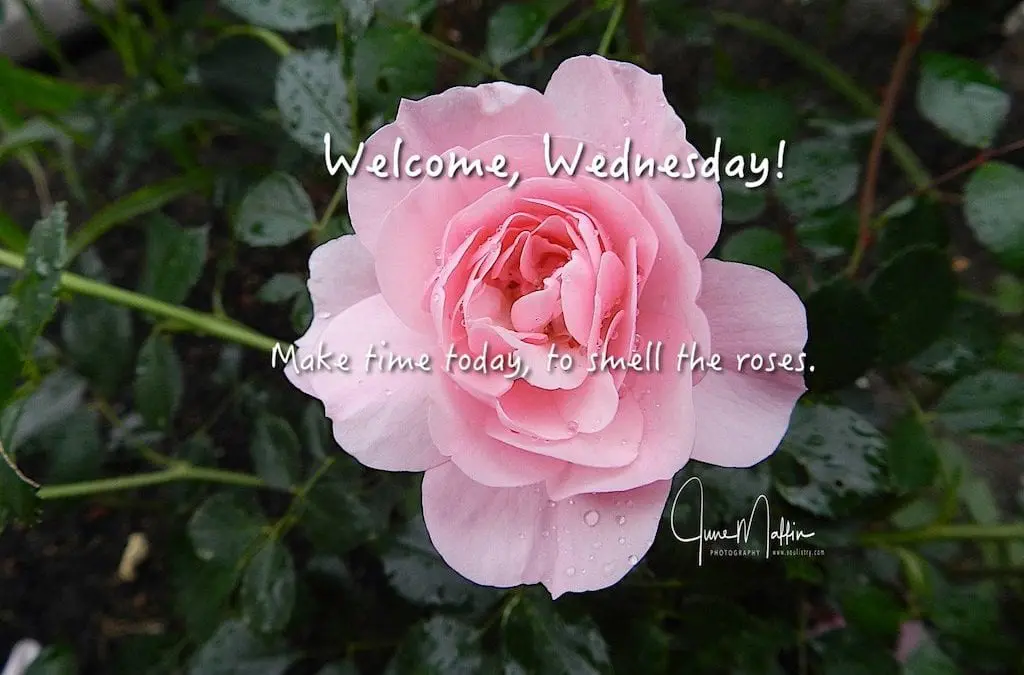
Welcome Wednesday. You are a gentle reminder to “make time to smell the roses.”
“Make” time not just “take” time but make time to … work at our relationships with cherished family and friends … play and create … be intentional about our health: physical, emotional, intellectual, spiritual … wonder and ponder and be in awe … be aware of the negative effect social media is doing to our body, mind and spirit and disengage from it more than engage with it.
In other words, may we make time this day, this Wednesday to “smell the roses” … of activities that offer joy … of people who encourage hope … of thoughts that bring positive memories … of things that are keeping us alive and active like our breath, vision, hearing, mobility, pumping heart, and other organs and …
Welcome Wednesday. May we find ways to give thanks for this day.
I’m getting “up there” in the chronological age listing. Naww, let’s face it, I’m “up there!” Some of my friends are up here too – or are close by ,and they’re anxious. They’re anticipating all sorts of unpleasant things that are ahead, especially in matters of health, finances and overall well-being – from wrinkles to mobility/hearing/vision/dental/limb issues/loss of friends and more. I hear them say things like “I’m almost 70 or 75 or 80 or …” As if a particular age were a hurdle to “get over.”
The additional matter of the world feeling uncertain, (economically, politically, socially (feeling ‘heavy’ as some of my friends put it), it’s true. Responsibilities multiply. Losses accumulate. Personal disappointments surface. Business setbacks become reality. Family tensions, spiritual doubts can arise. Yet I’ve come to believe that aging gives something powerful: CONTEXT. As seniors, we recognize patterns; we remember other storms that passed. Context.
Aging has much to give. It can … teach self-acceptance: the urgency to prove oneself can soften into the focus on living truthfully … provide steadiness in decisions: shaped less by impulse and more by long-view judgment … expand a sense of compassion: as we understand that everyone is navigating their own unseen struggles … offer opportunities for self-reflection, humility and trust: showing growth in faith / spiritual life.
To be sure, aging doesn’t remove difficulty. Instead, it can strengthen our capacity to hold difficulty without being undone by it. In so doing, we realize that strength is patient and grows.
It’s true – there are seasons when change hits us in the face, feels unwelcome and is painful: when roles evolve, health shifts, long-held plans have to be revised. But change can also invite re-invention … opportunities to consider ‘possibilities’ as we learn to be intentional about holding on to what matters, and shedding what no longer seems to matter. And that includes downsizing material possessions.
Aging is, in a nutshell, an opportunity to continue ‘becoming.’ It’s not always easy. But it is meaningful. And surely ‘meaning’ (more than youth) is what sustains a life well-lived?
My late husband was a calligrapher and penned our favourite saying … “Age is a matter of mind. If you don’t mind, it doesn’t matter.” <Mark Twain>. Hans was a lot older than I, but that didn’t stop him (or me), from playing. It’s true, as George Bernard Shaw wrote “We don’t stop playing because we grow old; we grow old because we stop playing.” As much as I love Twain’s words, I love Eleanor Roosevelt’s words on this subject even more: “Beautiful young people are accidents of nature but beautiful old people are works of art.”
I like the thought that I’m a work of art – you’re a work of art – each of us, privileged to live into our senior years – are works of art! So I continue … facing the issues ahead, personally and politically … and believing, as CS Lewis said, “You are never too old to set another goal or to dream a new dream.” One of my goals is to continue writing these ‘Soulistry: Artistry of the Soul’ reflections. Not having Hans by my side anymore, there is no one close by to share such reflections, so I write – “journal” in my blog.
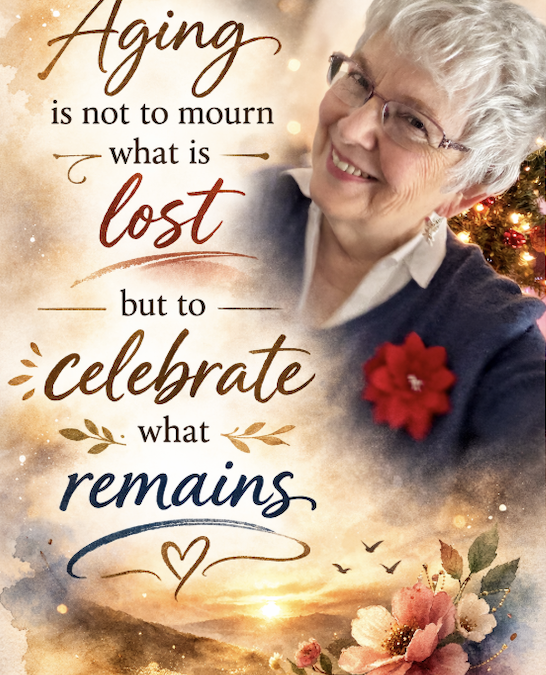
What goal / dream are you setting? How are you a work of art? What ways are you dealing with what life hands you, with an attitude, a spirituality of playfulness? May we all remember that “Aging is not to mourn what is lost, but to celebrate what remains.”(unknown author)