Death. Many don’t want to talk about it. And yet, in these days of COVID19, death is in the news. Daily.
Whether death happens at (or close to) a birthday, at Christmas, Hanukkah, Kwanzaa, Valentines’ Day, Mother’s Day, Father’s Day, Easter – at any time – the subject of death is the proverbial ‘elephant in the room’ at home, work, a social gathering, on the phone, in social media.
When family, friends, pets we love, die, the elephant has walked into the room. Phrases like these come our way. I’ve heard them all – and more. “It’s just been a week/few weeks. You’ll feel great in three/six/twelve months.” “It’s been almost a year. It’s time to get over it and move on.” “It’s just a dog/cat.” “You’ll be fine once this holiday is over.” “He didn’t deserve what he went through, so God gave needed rest. God’s garden must be beautiful. He only takes the best.” “You only knew them through Facebook. How can you grieve someone you never met in person?” “You knew it was coming.”
What to do if someone says something similar to these to you? Ignore their comments. You know the truth. Love cannot be defined by anyone other than the parties involved.
While grief never ends, it changes. Grief is a passage, a journey, not a place. Grieving isn’t a sign of weakness, or a sign of lack of faith. Grief can begin even before death arrives. And, grief can be cumulative.
Sometimes, the death of someone brings forward negative memories … of abuse, victimization. Seek help. Find ways to release that person’s hold on your life.
Sometimes, death can bring forward thoughts of guilt … we “didn’t do enough” … we weren’t “there when they were dying.” In these COVID19 days, being with our loved ones may be impossible and guilt surfaces. Seek help.
No matter what the circumstances – let us be gentle with ourselves as we grieve.
Let us remember those who have died … and where possible, remember them with joy in our heart, with gratitude that our paths connected.
May we acknowledge that our loved ones will always be with us in some way in our hearts, minds, memories. Death ends a life, not a relationship.
May each person who has died, rest in peace.
When the “Trigger Moments” of grief show up, and they do show up often in the most unexpected times and places, ‘Trigger Moments’ might be of encouragement: www.soulistry.com/trigger-moments
Remembering this day, April 26th, Hans van der Werff (April 29, 1929 – June 26, 2016), beloved husband. Rest in peace dear Hans. Rest in peace.
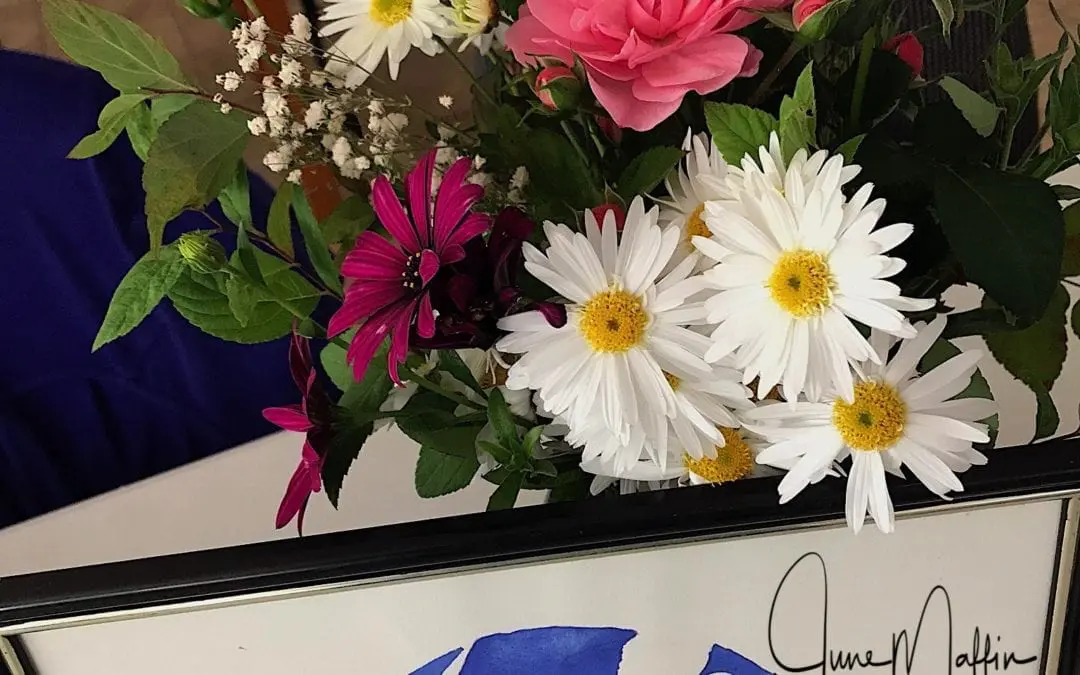
The framed work of the phrase “Death Ends A Life, Not a Relationship” was created as part of a teaching series for the “Seeing With New Eyes” calligraphy workshop which I taught when workshops were happening in person. These days, it’s ZOOM workshops, and I haven’t yet decided whether or not to step into that new teaching mode. Btw, the flowers are from the back yard – grown from seeds that were volunteered by birds flying by. 🙂
Author: Bonnie Henry Dr. Bonnie Henry is a Canadian physician; the Provincial Health Officer for the Province of British Columbia, Canada; has worked internationally including with the WHO/UNICEF polio eradication program in Pakistan and the World Health Organization to control the Ebola outbreak in Uganda; and is an associate professor at the University of British Columbia, Faculty of Medicine.
SOUL-QUESTIONS The words “Be kind, be calm and be safe” echo throughout the Province of British Columbia, Canada and far beyond during these days of the COVID19 pandemic. Dr. Henry’s words are a gentle reminder of the importance in any difficult situation that is out of our control, we must do what we can to be calm, kind and safe.
1. Reflect on a moment in your life when you encountered a difficult situation that was out of your control (e.g. a personal situation, COVID19) and you began to panic. – Were you able to regain a sense of control – of peace – of calmness? – If so, how did you do that? – If not, can you identify what kept you in the state of panic?
2. Reflect on another (or the same) moment in your life when you encountered a difficult moment and you felt unsafe. – Were you able to do something to regain a sense of security? – Did you ask/call for help? – Did others help? – If so, how? – If you still feel unsafe, what are some things you can do to move to a position of safety?
3. Reflect on a moment in your life when someone expressed unasked-for kindness to you. – What feelings did you experience as you received such kindness? – Did you express those feelings to the person who offered that kindness?
4. Reflect on a moment in your life when you were unkind to another human being … someone in your family … a neighbour … a stranger … a friend … and animal … the environment. – If you were aware you were being unkind but did/said what you did/said anyway, what feelings did you experience as you were unkind? – If you were aware you were being unkind, did you express that to anyone? … share with the person? … share with a counsellor? … share with a clergy person? … write in your Journal about it? – If so, which? – If not, why not?
******************** How to use “Soulistry Soul-Questions” You may want to begin a Journal so your responses are all in one place.
From time to time, a quotation will appear along with accompanying Soul-Questions. Write the quotation. Add the first question and write your response.
Take your time in writing your replies. This is your time – these are your answers.
Then at your leisure, add the second Soul-Question and respond and continue on. Btw, it helps to put the date after each Soul-Question response.
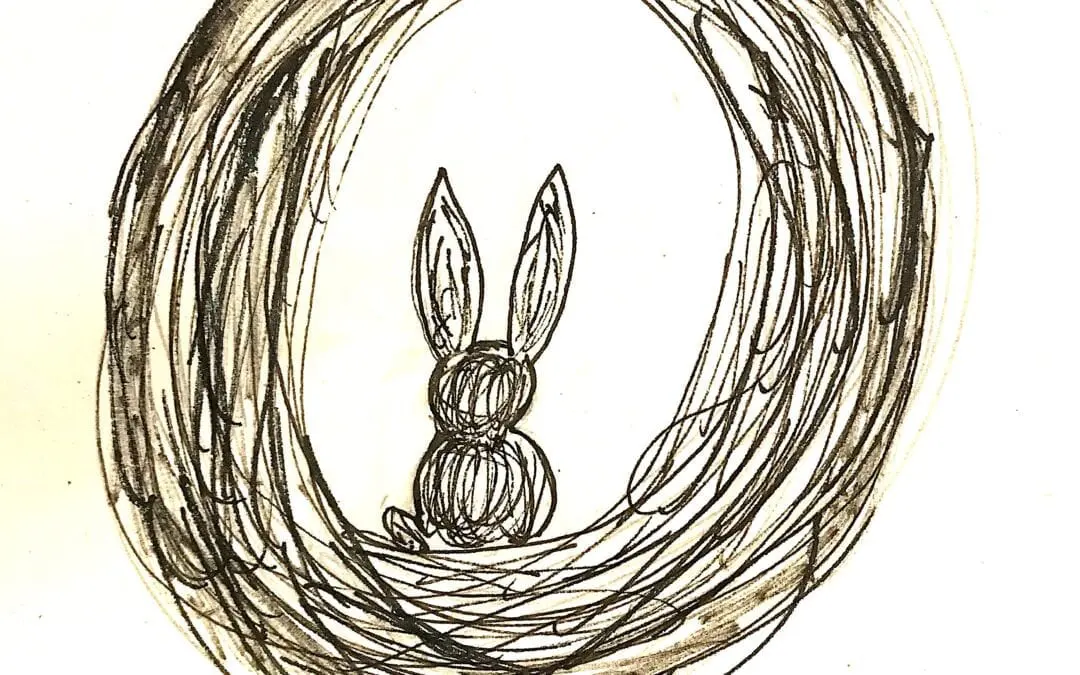
I cannot – and will not – allow my mind or soul to go down the rabbit hole – even after the President of the United States’s threat. If I do, it will only lead me to a state of hopelessness and I refuse to do that to myself.
Instead, I will pray and speak up and speak out and vote and write and … hope … so that I can live.
And in that living, I will be a sign and symbol that in the midst of hopelessness, there *is* hope.
The youth and children of this world depend on my (and our) generation to at least do that.
Quote “When you look at your neighbour’s work, you see it for what it is. When you look at your own work, you see it for what it isn’t.”
Author: Peter Thornton A full-time professional calligrapher and artist for over forty years, Peter Thornton is a Fellow of the Calligraphy and Lettering Arts Society (C.L.A.S.) with an international reputation as a gifted teacher and calligrapher. His lighthearted wit and playful approach to teaching brings students eager to learn from him in workshops he has offered throughout the world. He has authored several books and is known for his exploration of the visually and acoustically exciting world of ‘musicalligraphy’ – a combination of sound and letters.
Soul-Questions
1. Have you ever looked at your own work, art, project, business, life and seen “what it isn’t”? * In your journal, reflect on some moments in your life when you’ve compared your work, art, projects, efforts in sports activities, hobbies etc. with another; seen perfection in their work, but saw nothing like it when you’ve considered your own.
2. Do you put pressure on yourself in other areas of your life, relationships?* If so, consider an example and write about it in your journal.
3. Do others see you as a perfectionist? * Are they accurate?
4. If they are accurate, does your perfectionism interfere with any of your relationships? * If so, how?
5. Are you comfortable with this aspect of your personality? * If you are not comfortable being a perfectionist, what might you do to ease up on yourself so that you can spend less time being self-critical?
6. When someone expresses appreciation of your work, art, efforts, are you able to reply with sincerity and say “thank you”? Or is your response apologetic, self-deprecation? * In your journal, reflect on your response.
7. If you find it difficult to reply with just a simple “thank you,” for whatever reasons,in your journal, reflect on what steps you might take to otherwise reply the next time someone appreciates your art, your friendship, the gift you made them … or expresses appreciation of you.
******************** How to use “Soulistry Soul-Questions” You may want to begin a Journal so your responses are all in one place.
From time to time, a quotation will appear along with accompanying Soul-Questions. Write the quotation. Add the first question and write your response.
Take your time in writing your replies. This is your time – these are your answers.
Then at your leisure, add the second Soul-Question and respond and continue on. Btw, it helps to put the date after each Soul-Question response.
The “Soul-Questions” group on Facebook can be found www.facebook.com/groups/soulquestions
The “Soul-Questions” website and individual quotes/soul-questions can be found www.soulistry.com/soul-questions-blog-posts
Quote “Hope is the thing with feathers that perches in the soul and sings the tunes without the words and never stops at all.”
Author A prolific American poet, Emily Dickinson (1830 – 1886) was considered to be an eccentric by local neighbours, living much of her life in isolation.
Soul-Questions 1. Dickinson makes a connection between ‘hope’ and the ‘soul’ … a spiritual connection. Do you relate to hope as a spiritual connection? * If so, how? * If not, how do you relate to hope?
2. In the past, when you’ve gone through a personal situation that begs the “where is the hope?” question, how/where did you find hope?
3. In situations such as COVID19 and its consequences, who/where do you turn for guidance, counsel – hope?
4. Are you someone who asks for / seeks guidance, counsel, encouragement, hope in difficult times or do you struggle alone? * If the latter, why? * If the former, what prevents you from reaching out / seeking help/guidance
5. Are you open to being a hope-filled / hopeful person? * Are you being open to hope? * If not, what could you do to become open?
******************** How to use “Soulistry Soul-Questions” You may want to begin a Journal so your responses are all in one place.
From time to time, a quotation will appear along with accompanying Soul-Questions. Write the quotation. Add the first question and write your response.
Take your time in writing your replies. This is your time – these are your answers.
Then at your leisure, add the second Soul-Question and respond and continue on. Btw, it helps to put the date after each Soul-Question response.
A Facebook friend wrote, echoing the unspoken words of so many: “I just don’t know what to think. I am so confused. I see people standing by our fence, drinking, laughing, celebrating. No masks. No distancing. I see graduates being visited by friends inside their home, sitting close together, hugging. No masks. No distancing. I see friends at the park shoulder to shoulder laughing, touching. No masks. No distancing. Photo after photo on my feed. Big smiles. Feeling good. Is this over, the pandemic? Can we really go back to doing what we did before? I guess all these people I see are young and maybe have no compromising conditions, so contracting the virus won’t be a big deal. I guess their children will be safe, too. I guess the people at the grocery store will be fine. Maybe they have all been tested or recovered and they know for certain they are not spreaders. I don’t know. So maybe I should mind my own business.I guess we’re all going to be fine. And if not, well, that’s the way it goes. Too bad for me. I’ll just have to suck it up.
I read and reread those words and prayed and replied.
I share that reply in the hopes that it may address the confusion others may be experiencing.
**************** You ask: “Is this over, the pandemic?” Answer: “No!”
You ask: “Can we really go back to doing what we did before?” Answer: “No!”
You write … “I guess all these people I see are young and maybe have no compromising conditions, so contracting the virus won’t be a big deal. I guess their children will be safe, too. I guess the people at the grocery store will be fine.” Response: “No!” Contracting the virus WILL BE a big deal. Their children may not be safe. The people at the grocery store may not be fine.
Then you write: “Maybe they have all been tested or recovered and they know for certain they are not spreaders.” Response: “No!”
And then you write: “maybe I should mind my own business.” Response: “No!” What is happening IS your business. Just watch and see what happens in two weeks from now — numbers will explode.
And then you make an assumption: “I guess we’re all going to be fine.” Response: “No!” We’re all NOT going to be fine. We’re not all fine now. We’ve not all been fine the past two months.
And finally you wrote: “And if not, well, that’s the way it goes. Too bad for me. I’ll just have to suck it up.” Response: “No!” You don’t have to suck it up. Keep wearing your mask – keep asking the questions – be using your brain to sort this thing out – keep learning from the scientists – keep caring for yourself – keep on keeping on.
I’m so sorry, my friend … sorry that there are people around you who don’t get it … don’t believe it … don’t use their commonsense … don’t listen to the scientific and historical evidence … don’t wear a mask … don’t practice social distancing. I’m sorry for all of us who are in similar situations.
We must ignore the naysayers, conspiracy enthusiasts, selfish people who think the world belongs to them.
What can we do? We can take care of ourselves and our loved ones — wear our mask, practice social distancing, wash our hands often and well, cough into our elbow.
Btw, that’s not fear talking. That’s love talking. Keep talking love. Keep practicing love. We will get through this – together. June xox
An aside: This Iris is the first to bloom this year in the back yard. It speaks to me of love – of hope – of life!