These days, there seems to be a daily reminder that peace is elusive: news of the pandemic’s “numbers” rising quickly; its variant strains complicating matters; vaccine appointments slowing down in some areas; political goings-on; on top of difficult economic times; how/when/where to grieve the loss of a loved one; increasing sense of abuse happening in relationships; teachers, ferry workers, bus/transport drivers who see their jobs as ‘essential,’ but the government doesn’t see it that way, so they’re not on any vaccine list.
Peace is not just elusive for some. Peace is elusive for a growing number of people around the world and as a result, stress and mental health issues are on the rise.
While we sometimes experience ‘stress’ as “eustress” (from the Greek “eu” meaning “good”), according to the endocrinologist Hans Selye, eustress is the kind of stress that is healthy and gives a good, positive feeling.
However, more often than not, the stress that is experienced is “distress” (from the Latin prefix “dis” meaning “having a negative force”). Distress describes unpleasant/negative feelings or emotions that impact the level of functioning. Sometimes the stress is related to work. Sometimes the stress is related to relationships. Sometimes the stress is related to health or finances or lack thereof. Sometimes the stress is related to busyness or needing to be perfect or organized or … Sometimes the stress is related to grief. Sometimes the stress is related to fear … fear of the known … fear of the unknown. Sometimes the distress is a combination of several of the above.
S e r e n i t y. We want it. We want to exhale fear and inhale peace. P e a c e. We need it
But fear, busyness, worries, grief, physical pain, guilt, sleepless nights, and those everpresent “what-if’s” creep into our minds. And then there are the actions of bullies (at work, school, cyberspace), politicians, media, conspiracy theorists who further propel thoughts away from experiencing any sense of peace.
And yet … and yet … serenity and peace are available. We only need to be aware of them in the gift of our breath in the gift of words, spoken in the silence of hearts to one another, and to ourselves. Like these words, this prayer, this Celtic spirituality-based prayer this whispered hope … bring some semblance of peace this night.
Circle me. Keep protection near And danger afar. Circle me. Keep hope within. Keep doubt without. Circle me. Keep light near And darkness afar. Circle me. Keep peace within. Keep evil out. <adapted from the work of David Adam)
Blessings to you, my friends. And, peace. May the nourishment of the earth be yours, May the clarity of light be yours, May the fluency of the ocean be yours, May the protection of the ancestors be yours. <John O’Donohue>
A Facebook friend posted this comment: “Today I will stop giving so generously and freely
… I close my heart.” I was sad.
Guard her heart?
Of course.
Do self-care?
Of course.
But close her heart?
No.
Please, no.
There will always be people who will do what they can (consciously / unconsciously)
… to take us down.
There will always be people who don’t like us
… not everyone will like us.
But, that’s not a reason to close our heart.
Maybe the reason some people don’t like us is because of our religion.
Maybe it’s because of our gender or sexual preference or language or skin colour or …
Maybe it’s our choice of partner/spouse.
Maybe it’s our personality, or our clothing, or our food choices, or our history, or …
Maybe it’s because of who we support politically.
It could be any number of things.
The bottom line is that not everyone will like us.
Sometimes, we are
… Just … Not … Liked.
No identifiable reason.
When I learned that stark reality,
I also learned that ‘others not liking me’ is not my problem.
It’s their problem.
In that discovery, came another learning.
As long as I do my best each day.
As long as I love and take care of myself, I can be myself
and in so doing, life can become more gentle, more fun, more enjoyable and more loving.
I never want to close my heart.
The consequences of such a decision are too tragic to consider.
What about you?
Have you ever thought of closing your heart?
Sadly, in today’s political and pandemic climate,
more and more are echoing the words “I close my heart”
and it seems that as hearts are closing,
minds are closing even more
bringing beyond-difficult consequences
for our world.
I hope you have not closed your heart,
but … if you have,
I hope that you realize that as long as you do your best each day,
as long as you love and take care of yourself, you can be yourself.
And in so doing, life can become more gentle,
more fun, more enjoyable and more loving.
May we follow the lead of our pet friends …
they never close their hearts.
But it’s not easy to step back. So many are hungry or cold or thirsty for clean water
or scared or homeless or racist or uneducated or abused
or hurting or unwell or in pain or grieving
or unemployed or waiting as a loved one faces death
or are watching time slip by as their own death approaches.
The cumulative effect of it all
can drag us down or drain our energy or make us numb
or make us accident-prone or even become ill ourselves.
When we experience Soul-Fatigue
we *must* take care of ourselves. First.
We must love ourselves enough
to say ‘no’ and to let go.
We must remind ourselves
we are human *beings* not human *doings* and make time to simply ‘be’.
Make time to fill our own cup to show the compassion we show to others – to ourselves to inspire our heart to enjoy the arts listen to, look at and appreciate the simple things of life around us laugh and play and be carefree recognize and express gratitude or the blessings we often take for granted.
Because if we do not
we will become
unable to care for anyone else. Anyone.
This day and each day
we must take a sip
from the cup of kindness
for and to ourselves.
May we heed the wisdom of the ages
expressed in song and poetry and art
and prose and Scripture and drama
and airlines which remind us to first put our own oxygen mask before helping another put on their oxygen mask.
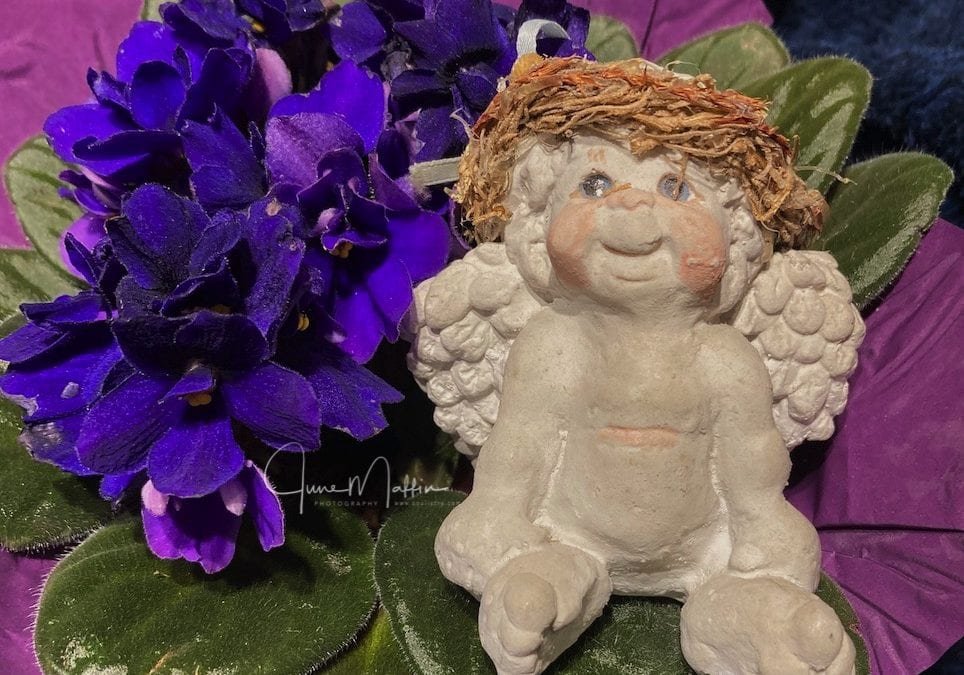
“Miss Pudgy Angel – it’s time for you to come and lift us out of the fear many are feeling these days.”
I wrote this blog four years ago. Tonight, a friend’s Facebook post began: “I was feeling a little … just a little bit paralyzed by fear today.” Her words echoed within me and I decided to share this again and add something personal at the bottom in the hopes that “Lifted Out of Fear” brings a bit of relief from the fear my friend is experiencing, that I am experiencing and that others may be experiencing.
***************************
Many are feeling fear these days … fear of “what next” when people watch the news … fear of flying … fear of a medical diagnosis … fear of aging … fear of an unknown future … fear of pandemics … fear about unemployment … fear of ‘what next’ …
I wish I could say that I’ve never been fearful, but …
I remember a terrifying plane ride when the plane heaved and starting falling, luggage began to come out of overhead bins, and people screamed. My hands were in a death grip on the arms of the seat. My breathing was shallow and swift as my mind raced through possible scenarios. I was scared … big time.
“God, help,” I heard myself whisper as the crying around me seemed to increase. And then, *she* appeared. Miss Pudgy Angel.
Well, that’s what I called her when I was given her as a gift many years earlier. She sat on my mantle for years and years and I delighted in her presence and in her sweet and gentle smile. Why I thought of her at that moment, I didn’t know, but I was grateful. Her image brought a smile to my face and for just an instant my concentration was on her … not on the fear.
I soon found myself imagining Miss Pudgy Angel with three of her pudgy angel friends: Miss Pudgy Angel was underneath the nose of the plane, two of her friends were under each wing of the plane, and one was under the plane’s tail. Each was working to stabilize the plane and help the plane climb back into its proper flying pattern.
The more I visualized Miss Pudgy Angel and her friends, it seemed that there was less and less space for the fear to take over my thoughts. Slowly, I realized that my breathing had slowed down … my grip on the armrest had lightened … and I was smiling! Those four pudgy angels were ridiculously funny! They huffed and puffed and pushed their pudgy arms into place. And as I continued to visualize the four of them under the plane, lifting it, stabilizing it, the more I became aware that the heaving of the plane had slowed and my fear was dissipating. Do I understand what happened in that moment in the sky? Not for a second.
Of course, there was no Miss Pudgy Angel or her pudgy-angel-friends underneath the plane.
It’s not surprising that giving serious attention to the existence of angels is difficult. If angels are part of the realm of the Spirit, that’s the realm of the unknown and the mysterious, and it’s not a world to which many can easily relate.
But in the Book of Job in the Old Testament, these words give rise to the possible reality: “God does speak. Now, one way. Now another, though we may not perceive it.” To believe that there is a Holy Other, Creator, By-Whatever-Name, to believe that such a Holy One speaks to us, and to believe that such communication happens through the form of an angel, well, that takes an openness – an openness to Mystery.
Do i believe in the possibility of angels? I did then. I do now. Many times since that moment-in-the-sky, I have uttered / prayed / whispered / thought words of gratitude. Were the pilot and co-pilot, crew, air traffic controllers, my Miss Pudgy Angel and her friends … angels that day? I don’t know.
I just know that for that brief terrifying moment, when I visualized Miss Pudgy Angel and her friends lifting the plane, as the pilot, co-pilot, crew and air traffic controllers were working hard to stabilize the plane and get it back on its flight pattern, I was being lifted out of fear.
This week, fear seems to be welling up inside me as dental surgery looms to extract a tooth revealed total decay underneath a Crown and the tooth (repaired decades ago with amalgam – mercury – which was standard practice at the time) was revealed.
Over fifteen years ago, when I received a devastating diagnosis of mercury poisoning. I lived with constant pain, helplessly watched as the muscles in my body and mind began to atrophy because of the poisoning and never returned to my place of employment. Unexpected, far-too-early retirement struck me in the face. I was told that while I wouldn’t die from the poisoning, there would be days when I wish I had. The specialist was right. He told me that I still had some amalgam in my teeth and the advice he gave me then and dentists have given me since over the intervening years was “if a tooth with amalgam becomes a problem, extract it. You can’t take the chance of exposure to it ever again.” That’s where I was last week at last week’s consultation. When the surgeon spoke the ‘there are complications’ words , the fear was overwhelming. My usual “go to” prayer is Dame Julian of Norwich’s “All shall be well. All shall be well. All manner of thing shall be well” and words from Scripture, but if my blood pressure was any indication, something more was needed. Nothing was helping.
And then tonight, reading my friend’s message on Facebook, I remembered Miss Pudgy Angel. I remember how she had lifted me out of fear long ago and decided to share the story and image with my friend and on the Soulistry blog for others.
This Thursday afternoon, when I am seated in the dental surgeon’s chair, I will pray Dame Julian’s prayer, along with Scripture passages, and envision Miss Pudgy Angel, lifting me out of fear.
To my friend whose words on FB this night sparked an addition to the original blog post about Miss Pudgy Angel, and to all who experience fear (of whatever form for whatever reason), find words that comfort, and recall an image that puts a smile on their face … even if only for a moment.
And if you can’t find such an image, feel free to think of Miss Pudgy Angel. That’s what I’ll be doing. 🙂
“All shall be well. All shall be well. And all manner of thing shall be well”
There are no promises in life but the words by Dame Julian of Norwich (c. 1342) can be of assistance when dealing with difficult moments difficult people difficult situations.
Used as … a prayer … a hope … a mantra … a wish the words can offer a snippet of reassurance that “everything is going to be okay.” And when we’re “in the trenches” of difficult moments, people, situations, even though Dame Julian’s words don’t say that things *are* okay, her words do say that all *shall be* well. And that’s a calming thought because when life gets to be more difficult than we think we can manage, surely a sense of calm is what is needed.
Whether or not Dame Julian’s words are whispered thought prayed shouted cried softly spoken sung let’s hold the words close to our heart this night and in the nights to come.
Who knows – they might bring a peace that is intangible … yet real a joy that is indefinable … yet palpable a hope that is unimaginable … yet possible.
“I believe,Tinker Bell and Green-Frog-peering-through-leaves. I believe” that “all *shall be* well in spite of the lies in spite of the fear in spite of the fraud. At some point in time “all *shall be* well.
An aside: tried to locate the creator of this image without success. If you know the creator, please let me know so appropriate accreditation can be provided.
It seems that my heart has been skipping a lot of beats lately. I’ve been gasping. And yes, while the air quality has been a major issue for my lungs, the ‘gasping’ is more than that. The gasping has been about the incredulity of words spoken by men in powerful positions the devastation caused by the force of Nature the unbelievable cruelty of human beings the “ism’s” causing hatred, violence, terrorism and more.
And none of it is stopping.
“Breathe, June. Just breathe” I’ve said to myself as history has continued to be made in recent days and weeks. “Breathe. Just breathe”
It’s not just me. Many seem to be having difficulty breathing deep, life-giving oxygen into their lungs especially when political situations seem overwhelming when health is compromised when fear escalates simply by watching/listening to the news when financial issues disrupt when grief overwhelms.
I remember a day long ago, when my breath was shallow and fast. I dreaded the thought of being strapped into the MRI metal tube with its loud noises and being unable to move. But, the test needed doing, so I took my own advice and focused on my breathing. As I did, I thought of my friend who, diagnosed with cystic fibrosis at the time, lungs barely functioning was in wait-mode for a double lung transplant.
It was a terrifying time for her. As I was trying to move beyond the panic that was settling in within me because of the claustrophobia I was experiencing in the MRI I intentionally breathed for, and with, my friend slow, deep, belly breaths over and over and over again trying to take the focus off of myself place it onto her and did some conscious breathing for us both.
When I find myself breathing short, shallow breaths because of the news or anything that causes stress within me, like visits to the dentist, I pray and I *belly breathe* slow, deep breaths from my belly gently expanding my belly, not raising my shoulders.
When I do that, oxygen begins to fill my body and mind, giving space for a sense of peace to enter my spirit.
I find a pattern of four breaths at a time helps … 1. As I breathe in, I am intentional about inhaling healing, wholeness, hope, peace, love. Sometimes I use the prayer of Dame Julian of Norwich and on each inhale, I think/whisper “All shall be well.” 2. As I breathe out, I am intentional about exhaling anxiety, pain, fear, grief, stress. Sometimes I use the next line of Dame Julian’s prayer “All shall be well.” 3. As I breathe in, I repeat the first breath’s focus and think/pray/whisper/say “And all manner of thing”. 4. As I breathe out, I repeat the second breath’s focus and think/pray/whisper/say “Shall be well.”
Dame Julian’s words don’t say things “are” well, but that they “shall be” well and that puts hope in my heart and mind and soul.
In – Out. In – Out. In – Out. In- Out. As I continue that pattern the results seem to be calming, healing, and soul-nourishing and surely in these days of more-than-unrest-and-fear we must do what we can to de-stress.
It’s not always easy to do especially in moments of crisis but there is a distinct difference in my stress level when I follow my own counsel.
We must remember to breathe consciously breathe gently, slowly, deeply so that our body can get the oxygen it needs.
No matter what lies ahead in our personal lives or in the world of politics we’re of no use to anyone if we aren’t able to get oxygen into our body so we can think rationalize distinguish between ‘real news’ and ‘fake news’ acknowledge the possibility of hope.
Breathe. Just breathe.
Each day regardless of what is happening in the world in the media in our personal ives we must remember to breathe and inhale goodness kindness thoughtfulness gentleness love joy peace self-control
A friend wrote “I know I am fading. I need help with fading. I will be staying at home for this part of the journey.”
A woman of gentle strength, courage, humility, wisdom, and hope, her post reminded me of this photo which for me, became symbolic of birth and death.
In it, I saw tall, strong trees standing on the edge of fresh running water that brings life. I also saw leaves from those trees falling to their demise as salmon swam upstream in the waters to their end.
Birth and death similar in a unique way.
When we are born, we change our address. We move “From Beyond” (where we grow in the care of our mother’s womb) to “This World” (where we grow through life’s lessons).
When we die, we change our address again … We move from “This World” (where we have grown through life’s lessons) to “Beyond” (where, like our time in our mother’s womb, we were oblivious about what is before us, but is a hope that we are not at our ‘end’).
Perhaps we might think of death as a beginning … another new beginning.
So many have died recently. They have changed their address.
So many are dealing with terminal illness and are dying. They are about to change their address.
When we were born, we made the transition “From Beyond” to “This World.”
When we die, we will make the transition from “This World” to “Beyond.“
And when that happens, it could be far more glorious than we can even anticipate or imagine!
I first heard the words from Sarah in a small northern Alaskan village.
The tiny, elderly, native woman spoke them slowly and carefully, all the while looking directly in my eyes. “How deeply you are connected to my soul, June.”
Deeply humbled by her words, I was thinking “this is not your common-ordinary-everyday conversation with a stranger.“ At that moment, I could feel the connectedness we shared and knew, even though we were cultures apart and our differences far outweighed our similarities, the ‘at-one-ness’ with each other was real. At that moment, our souls had connected.
One of the songs I learned in the tiny wooden building in that Alaskan bush long ago reinforced Sarah’s words: “How could anyone ever tell you that you’re anything less than beautiful? How could anyone ever tell you that you’re less than whole? How could anyone fail to notice that your loving is a miracle? How deeply you’re connected to my soul.”(Libby Roderick)
Though I was the stranger in her remote village, and our customs, language, traditions, life experiences were alien to one another, something indelibly linked us together.
And in that moment, I realized the possibility that two people who, on the surface have little in common with one another, could have a soul-connection.
It was then that the word ‘community’ took on a new meaning for me.
Yet when I watch and listen to the news, I hear the growing rhetoric expressed by politicians who don’t tell the truth, whose views and comments lead to an escalating almost-to-the-point-of-paralyzing fear. I see the growing intolerance and racism, misogyny and hatred, and can’t help but wonder and ask two questions: “Why can we not recognize the soul-connections around us? “Why can we not be community?”
I have no answers only more questions and wonder …
“When will it be time for those who speak or think ill of another – those who wound others with their words or thoughts – those who teach people to hate and fear – those who tear-down rather than build-up to recognize that we are all connected we are all part of the same community …the human community?”
Quote “We can work together for a better world with men and women of goodwill, those who radiate the intrinsic goodness of humankind.”
Author Wangari Maathai (1940 – ) is an environmental and political activist. Born in Kenya, she received the Nobel Peace prize for her contribution to sustainable development, democracy and peace. She was an elected Member of Parliament, founded the Greenbelt Movement which planted over thirty million trees in Kenya to help prevent soil erosion, was awarded the first PhD by the University of Nairobi, and increasingly active on both environmental and women’s issues.
Her husband divorced her, reputedly saying that she was too strong-minded for a woman and that he was unable to control her. After the judge in the divorce case agreed with her husband, she was put in jail for speaking out against the judge who then decreed that she could no longer use her husband’s surname. In defiance, she chose to add an extra “a” to her last name – changing, but not changing it. She experienced imprisonment and physical attack for demanding multi-party elections and an end to tribal politics and political corruption in Kenya.
Soul-Questions
1. What does “intrinsic goodness of humankind” mean to you?
2. How can “intrinsic goodness” be radiated?
3. How can spirituality be expressed in environmental, economic, political etc. activism?
4. How can you work with others who radiate the intrinsic goodness of humankind “for a better world”?
******************** How to use “Soulistry Soul-Questions” You may want to begin a Journal so your responses are all in one place.
From time to time, a quotation will appear along with accompanying Soul-Questions. Write the quotation. Add the first question and write your response.
Take your time in writing your replies. This is your time – these are your answers.
Then at your leisure, add the second Soul-Question and respond and continue on. Btw, it helps to put the date after each Soul-Question response.
The “Soul-Questions” group on Facebook can be found www.facebook.com/groups/soulquestions
The “Soul-Questions” website and individual quotes/soul-questions can be found www.soulistry.com/soul-questions-blog-posts