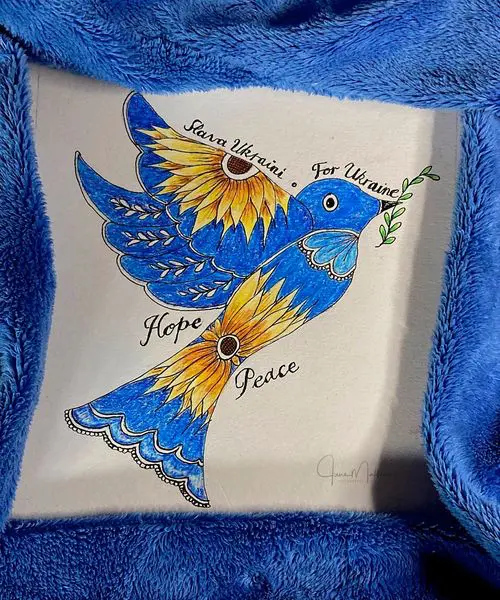
Friends have been diagnosed with cancer and they are dealing with the “c” news in a variety of ways.
Some are angry and are raging. Some are asking the “why me” question. Some are trying to understand the diagnosis because there is no genetic history in their family, because they have been active all their life and eaten healthy food and do what they can to keep stress as minimal as possible. Some are confused and bewildered. They don’t know what to do next. They feel helpless and some even feel hopeless.
The “c” diagnosis is a terror to hear, but when it meets people who face the terror and don’t bury their feelings, it discovers it is meeting a very strong Force – a unified force of good, positivity, hope and of love.
They are not alone.
That unified Force has many supporters, prayer warriors, hope-believers, energy-surrounders, love-givers around the world. You may know some of those people. There are others you may not. Some of those people may know you. Some of them may not. None of that matters because the energy and love of that Force is not dependent on “knowing” one another. Compassion is from the heart and we don’t need to “know” someone personally to feel compassion, express love, believe in hope.
If the “c” word has become part of your life, you know that there are days that are miserable and unless someone has walked in your exact path (which isn’t possible because every cancer is different as is every treatment), they can’t relate from an intellectual perspective. But they can relate from a heart-perspective.
Lean on the love and energy of that unified Force and feel the encouragement, love and hope coming your way.
Because, whether or not you can feel or sense it, it is there
~~~~~~~~~~~~~~~~~~~ As usual, you are welcome to share.
It was a Wednesday morning. Nothing unusual was happening in the classroom where I was teaching a class of high school students. Nothing unusual, except they were more attentive than usual. But, something was different. I couldn’t put my finger on it. Then a bell rang. Not the usual “time for the class to end” bell, but a different bell. Somehow the students knew what it meant. They slowly got out of their seats and headed in single file to the door, quietly. “Miss,” one of the students said, “We’ll be back once we’ve been to the chapel and had the ashes put on our foreheads.”
Just then the Principal came into the classroom and ushered the students out – apologizing that she’d not advised me about the interruption ahead of time. “The students will be back in the classroom in about half an hour” she said. And with that, she and the students left the classroom.
Three months earlier, I had turned twenty. This was my first teaching position. I was in a private school – a Roman Catholic school. At that time, my knowledge of Christianity, let alone Roman Catholicism, was limited. Very limited. Though I had been raised in a loving home, I had not been baptized nor exposed to a church that included rituals anywhere close to “Ashes on foreheads.” All of it was so new to me.
The school was quiet. No one was in the corridors. The only sound I heard came from the Chapel – quiet music, muted voices. When the students returned to the classroom, their foreheads had a black substance smudged on it. They were sombre, quiet. Something about them was different. But again, I couldn’t quite figure it out.
When I asked them to tell me what had happened in the Chapel, the students seemed to take delight in being my teacher! “Today is the day when we tell God we are very sorry for the times we’ve moved away and that we want to be better people.” But, I wondered, why the public display of the cross on their foreheads? “Ah, Miss, that reminds us that we’re all human and that we began as dust and will end as dust.”
Sounded to me like an ugly threat – “You’re going to die!” Well, I knew that one day I would die, but why would anyone want to go to church to be reminded, every year, that “from dust you have come; to dust you will go”? It seemed incredibly maudlin to me.
After school that day, I encountered Harry, one of the high school students I tutored. He was one of the few non-Christians at the private Roman Catholic school he attended and so was exempt from Chapel. But there he was, with a smudged sign of the cross on his forehead. He told me that his friends said they were going to receive the imposition of ashes and invited him along. He went, not because he wanted to, but because his friends had invited him and besides, he was curious about it all.
When he received the ashes on his forehead, he said that he felt that something had changed. He shared these words which he wrote in his journal … “As I received the ashes, all at once I realized in a whole new way, that it’s really true – “we are dust and we will return to dust when we diet.” He realized at that moment that life is transitory … and that he wouldn’t live forever.
In Christian churches around the world, people gather to receive the ashes on their forehead and hear the words “Dust thou art and to dust thou shalt return” on what is known as Ash Wednesday – the first day of the Season of Lent.Those words are certainly no one’s favourite words, but they represent a truth of which is important to remember from time to time – our own mortality. Sadly, September 11th did that. Tragically, January 6th, did that. People realized their own mortality.
Ash Wednesday is a sober reminder that we are mortal – not immortal. Acknowledging our humanity, our vulnerability, our mortality, helps us to live more fully. One way to do that, is to receive the imposition of ashes on our foreheads. That ritual is simply an outward symbol of what is hoped would happen internally and a commitment to be the best we can be.
Do we need to be a Christian to do that? No. Do we need to have experienced an Ash Wednesday service before? No. Do we need to be connected to a church to do that? No. All we need to do is accept our mortality, allow the ashes to be a sign that we recognize that our mortal life is a gift, and commit ourselves with the help of the Holy One, to use the rest of our mortal life to the very best of our ability.
Interestingly, the imposition of ashes, is not just a Christian tradition. It was an ancient Jewish tradition and was a public sign of an individual’s repentance. By the seventh century, the Christian church adopted it as part of the Church’s Lenten preparation before the Season of Easter.
Even during COVID, when churches were not open or people were reluctant to be among others during a pandemic, people found ways to receive the imposition of ashes. Churches became wonderfully creative!
Some supplied ashes for individuals/families so that they could sprinkle the ashes into the palm of their own or a family member’s hand and apply it themselves. Some encouraged the use of a cotton Qtip which could be dipped into the ashes and placed on the forehead that way. Other congregations gave members dirt, seed and water instead of ashes, acknowledging that from the dust of the world, new hope springs.
Other churches encouraged people to mark their hearts with the sign of a heart or the Cross as an outward and visible sign of their intention to turn their heart over to God and experience God’s unconditional love and forgiveness in a new way, saying the words “Dust I am and to dust I shall return.”
Many foreheads around the world are marking the beginning of the Season of Lent as people hear the words with those words.
I cannot stop thinking of the people in Ukraine, a year later, still living in terror as explosions deafen; food shortages become critical; the cold and snow gnaw at bodies; visible exhaustion on the faces of young and old alike; fear is a reality. Ukrainians are continuing to live the reality of Ash Wednesday’s reminder of human mortality, every day.
Children who survive this assault by Russia on their country, will have bitter memories of childhood as their reality in their adult years – just as it was for those children who survived the Holodomor of 1932-22 and are now seniors in this present struggle.
The Holodmor – did you learn about the Holodomor (translation: ‘death by hunger’ – a famine engineered by the Soviet Union under Joseph Stalin) in school? I didn’t. According to the 2010 findings of the Court of Appeal of Kyiv, there were losses due to famine around ten million people – and not just famine, but cannibalism for which, according to the Harriman Review, over 2500 people were convicted. As explosions hit, life is being lived in underground shelters, food and medication shortages escalate, and remembrances of the Ukrainian revolution, and terror grows that the Holodomor will once again be forced upon them by Russia.
The Holodomor made the desire for independence from Russia, a “need” … much more than a “want” … a life-long “need.” So it is not surprising that Ukrainians are fighting – again. Defending their country – standing firm for one another. Resilient in the face of terror and threat of reprisal, they are led by a courageous man, President Zelinskyy, his wife and his Cabinet members and the brave women and men who valiantly fight for and stand up for democracy.
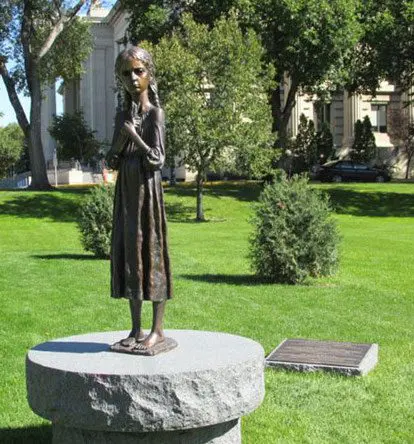
In this country, Canada, there is a very large Ukrainian population as many Ukrainians arrived as refugees after the Holodomor so it is not surprising that Canada has stood with Ukraine for decades. On September 21, 2014, a statue entitled “Bitter Memories of Childhood” was unveiled outside the Manitoba Legislative Building in Winnipeg, Manitoba, Canada, to memorialize the Holodomor was erected and there are similar statues in other parts of Canada.
“Dust thou art and to dust thou shalt return” is a reverberating reality in Ukraine and in the hearts of many around the world who ache for Ukrainians.
May no one ever take the precious gift of life for granted. May we uphold all who work and fight for freedom and democracy. If you observe the Season of Lent with the imposition of ashes, may gratitude be yours for the life you experience.
This prayer which I’ve adapted from the Alternate Lord’s Prayer found in A New Zealand Prayer Book might be of help as you think of Ukrainians today and in the coming days and of ourselves.
“Eternal Spirit, Earth-maker, Pain-bearer, Life-giver, Source of all that is and that shall be … in times of temptation and test, strengthen them and us; from trials too great to endure, spare them and us; from the grip of all that is evil, free them and us.” Amen. So be it. Amen.
Whatever way each of us chooses to observe Ash Wednesday, may we enter with reverence, humility and gratitude.
Why do we let others fill our lives with negativity which only serves to cause stress?
Why do we continue turn on the tv and see, over and over and over, eruptions of anger and hatred?
Why do we allow fear to reign and not make choices that would place us in the company of people whose energy is loving and gentle and kind?
I wish I had the answers. I do not. I don’t know ‘why’ we do those things, but this I do know: we are responsible for making choices … choices about our friends – our tv and movie viewing – and yes, there are times when we even make choices about our families.
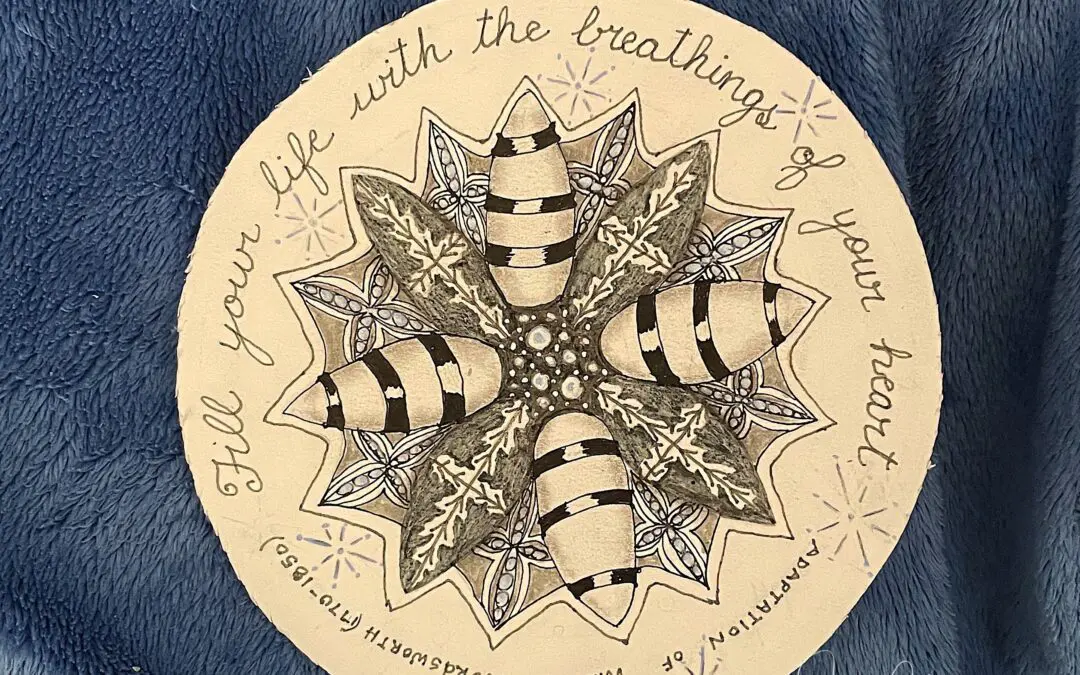
The British poet William Wordsworth once wrote (which may have been a mantra to himself as he faced a blank piece of paper and was about to construct a poem) these words: “Fill your page with the breathings of your heart.”
Not everyone is a poet and so not all of us sit before a blank piece of paper waiting for words to tumble forth. But each of us is an artist – an architect – a writer … of our own life.
What do we need as an artist of our life to draw a life of harmony? What do we need as an architect of our life to design a life that would lower stresses caused by things out of our control? What do we need as a writer of our life to consider words to live by which would be encouraging of positive action, nurturing of our soul, energizing to our body?
Each of us gets to determine those answers.
Perhaps we might begin by considering this adaptation of Wordsworth’s words and substitute his word “page” with this word – “life” and consider each day, which things, which people, which ways we can “fill our life with the breathings of our heart.”
Perhaps each of us can consider our answers to these questions: * What are the “breathings of your heart”? * What can you do to bring one of those ‘breathings’ into reality in your life in the next seven days? * Who can help/encourage/support you as you bring one of the ‘breathings’ into reality in your life? * What is stopping you from starting a reflection of these questions into action today? * How will your life change for the better when you begin to “fill your life with the breathings of the heart”?
If – when – we fill our lives in such a way, how can our world not be better? safer? kinder?
We say it often.
We hear it often.
But do we really know what we’re saying
when we say “good morning”?
Yesterday may have had ‘broken pieces.’
Yesterday may have brought disappointment.
Yesterday may have planted fear deep inside
But today is not yesterday.
Today is a new day.
This morning is a new morning.
And it can be a ‘good’ morning
… if only for a split second.
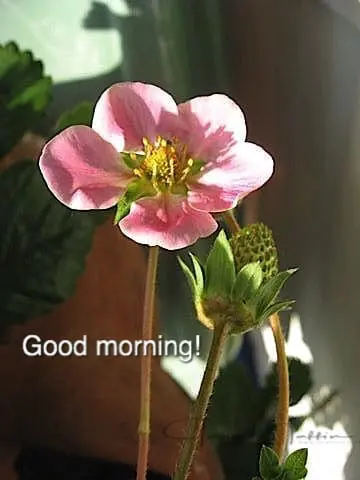
As I swept the leaves covering the front entrance to the house, I noticed a little bit of ‘good’ growing in a very protected place by the front door … a strawberry flower!
The birds had given an unexpected gift … a gentle reminder that every morning can offer an unexpected gift of goodness.
Thanks to the little lesson from the strawberry, I will smile and say “Good morning” to people I encounter this morning, whether I feel like it is a ‘good’ morning or not. As I smile and wish others “Good morning”, I will try to remember that each morning is the first day of the rest of their life, just as each morning is the first day of the rest of my life.
I want every day to be a day that holds to the promise of the strawberry growing unexpectedly in the front yard, bringing a “Good Morning!” wish to my soul. The unexpected gift is a reminder to share goodness with others in whatever ways I can, every day.
“Good Morning!” May this be a ‘good’ morning for you in some way. 🙂
Many people around the world are using the Advent Calendar in the coming weeks, to ‘countdown’ to Christmas. What about Ukrainians? An artist friend lives in Kyiv, Ukraine and posted the following this night. It is shared with a gentle prayer and hope that in our own preparation / ‘countdown’ to Christmas this Advent, we will not forget the people of Ukraine. ~~~~~~~~~~~~~~~~~~~~~~~~~~~~~~~
“Now there are many who are not in Ukraine have started writing about the Advent calendar – countdown to Christmas. We have our own countdown – light outages, planned and emergency. We plan our lives in such a way that we make the most of it in five hours. And then, in the dark, counting the minutes until the next opportunity to do something … along with electricity, the heating is turned off. Connection and Internet disappear for many. I have no hot water, along with electricity. Stores, banks, post office, those nearby do not work. But I don’t allow myself to whine. I think of our boys and girls in the trenches protecting us on the front lines. About the boys and girls who are captive. They have their own countdown.”
(Used with permission by the author who remains nameless for security reasons.) ~~~~~~~~~~~~~~~~~~~~~
My friends, as the world prepares for and ‘counts down’ to Christmas, safe in our homes with electricity, heating, internet access, food, safety, freedom, may we remember those in Ukraine who join in the ‘countdown’ to Christmas in a different way. Slava Ukraini!
“Baby, it’s cold outside!” And it’s going to get colder – and colder – and the snow that began falling earlier today is still falling and apparently is going to continue throughout the night.
When it began, it was just frost – making lovely patterns on the wooden fence on the back deck. Then the tiny snowflakes began to fall – creating a winter wonderland. And then the fat, wet snow filled the sky and quickly covered everything in sight.
It’s cold outside. Gratefully, I am warm, inside this little home. But so many in this community are not.
My heart doesn’t understand … why our local community centre can’t be opened so that warm shelter can be provided for those on the street.
My mind understands … that “it’s complicated” because of issues of who’s going to pay for it; who is going to staff/volunteer the facility; sanitation; meals and more. And then there’s the concern about COVID (people are still in hospital, fighting for their lives), the flu and the respiratory virus that’s affecting many children (and lately, seniors), as well as questions, raise their controversial head: … will those who will use the facility be fully vaccinated? … will those who staff/volunteer be fully vaccinated? … will everyone wear a mask? … what if violence erupts – will there be police/RCMP present? … will medical staff be present? … what about insurance issues? … what about overall security/safety concerns? … and, who organizes such a plan – municipality? province? federal government?
Some are posting on social media that “churches should open their doors.” They would love to, but If they do, the same questions above need to be answered.
But there are no easy answers. The homeless this night will sleep curled up on a sidewalk, in a doorway, huddled under a tree, as the snow falls and the wind howls. And some won’t wake up in the morning.
No answers. Just deep pain in my heart, my soul, my mind.