This morning was an “M” morning … a Magical … Mystical … Mysterious … Marvellous … Memory-Making … Morning!
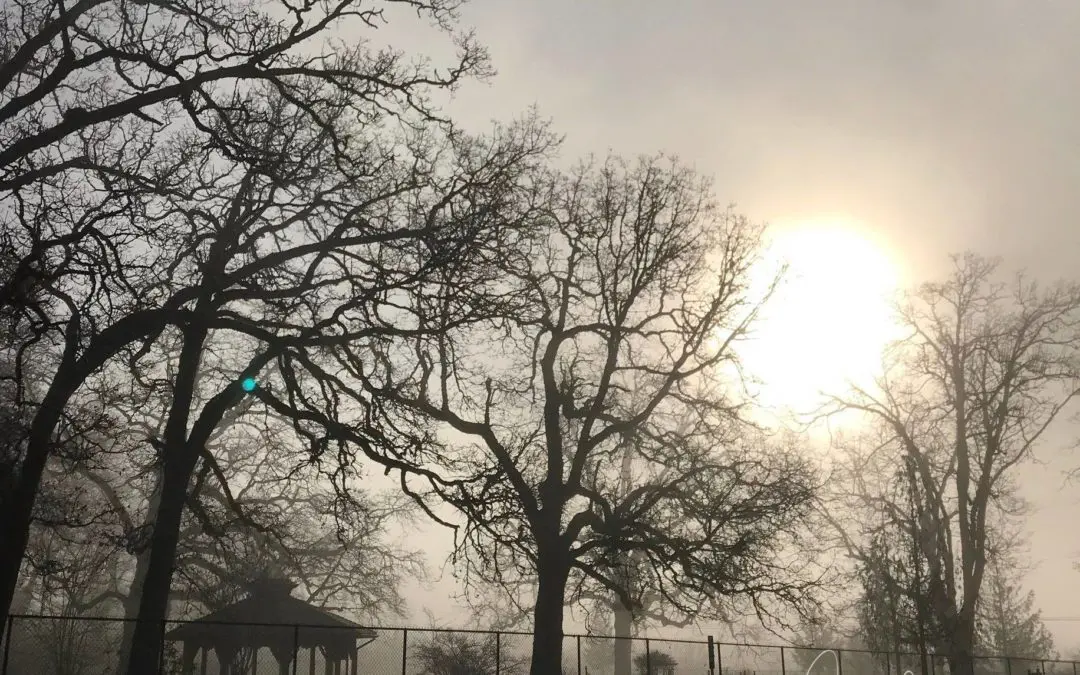
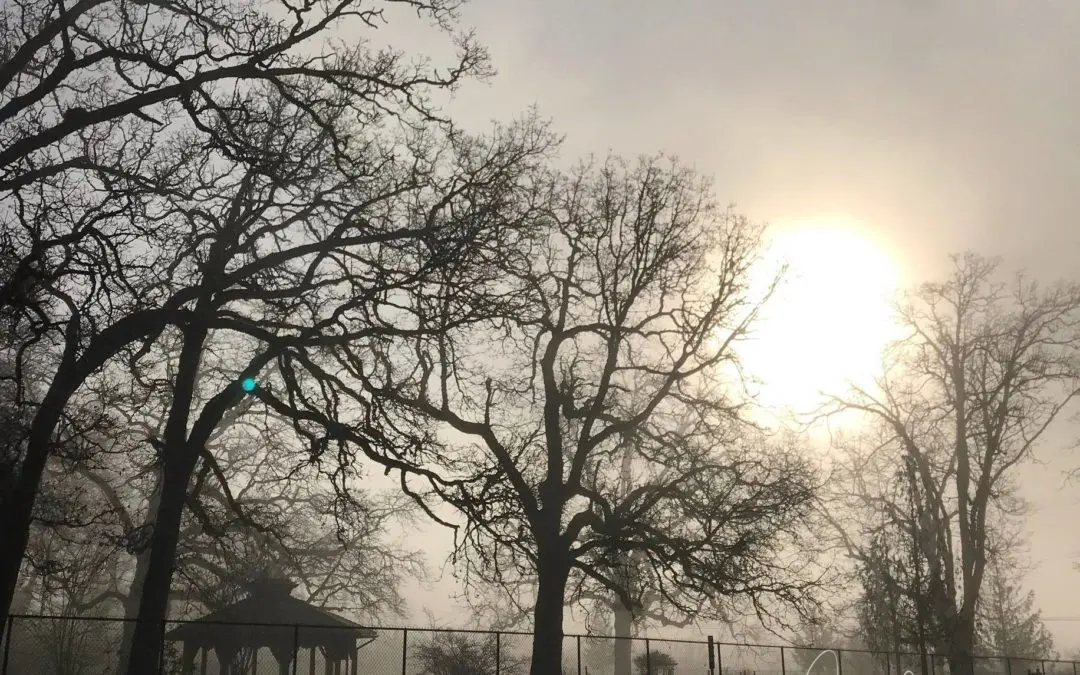
As I entered the roundabout, the sight before me was so lovely that I drove all the way around the roundabout, parked in the school’s parking lot across the street, and snapped this photo to remember what had captured my attention.
And then, within minutes, the fog had lifted and the beauty of the moment was gone.
But not forever, thanks to my little camera and the availability of the school parking lot.
And thanks to the gift of memory, the photo will continue to remind me for years to come of an MMMMM.
In the midst of a pandemic, where mask-wearing, social-distancing, curtailed family and friend visits/activities are commonplace, it’s not always easy to recognize the MMMMM … magical, mystical, mysterious, marvellous, memory-making moments before and around us.
But they’re there in the fog in the twinkling and smiling eyes of another in the “may you stay safe” in the beauty of the world in the giggle of a child in the wag of a tail and the cuddle of a feline in the daffodil trying to surface in the breath of fresh air in the first step of the morning in the comfort of a steaming cup of tea in the warmth of bed in the …
Hope your morning, afternoon, evening, day for whatever reason, is (was) lovely … MMMMM Magical … Mystical … Mysterious … Marvellous … Memory-Making!
The month of January is two weeks old today. The new year has begun and the door is open to the future.
What does the future hold for us … as individuals? family members? community members? society in general? religious organization? country? world?
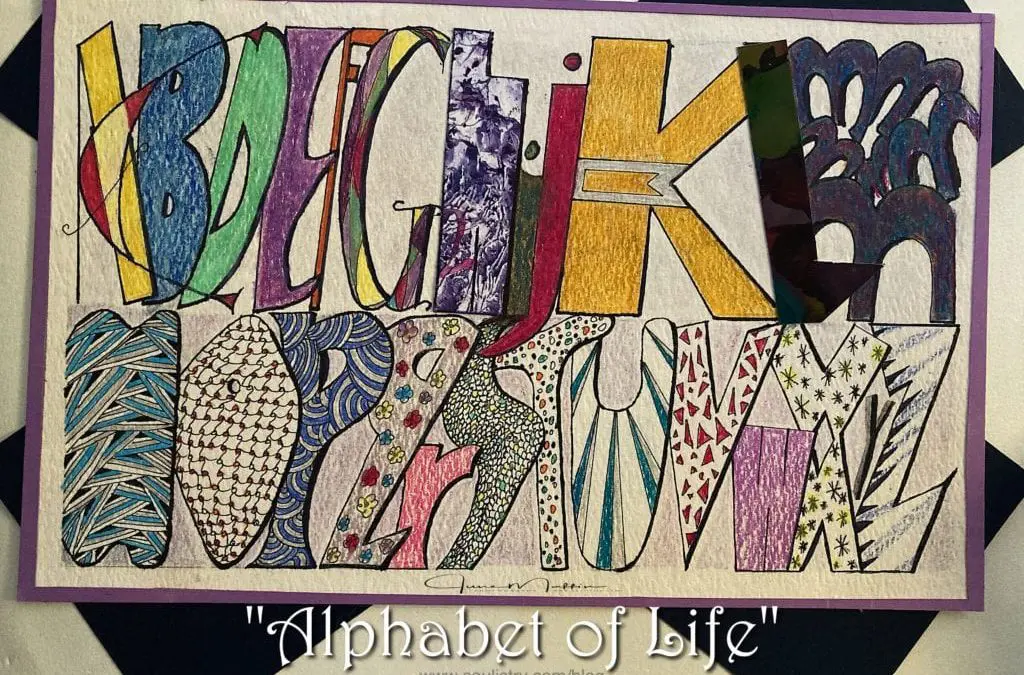
Perhaps this Alphabet of Life can give guidance if each letter of the alphabet is a gentle reminder of how we can be good-to-ourselves … aka “love ourself” and in doing so, contribute in positive ways to wellness in our families, communities, society in general, religious organization, country, world?
A Accepting of self B Be-ing, not do-ing C Creating something each day D Drawing on our inner resources E Elevating our thoughts to new heights F Feeding our soul G Graciously accepting compliments H Hitting goals I Initiating contact with a friend J Joyfully receiving the gift of life K Keeping our head while the world seems out-of-whack L Loving our neighbour as ourself M Mirroring the goodness we admire in others N Nourishing our spirit O Opening our heart to receiving love in new ways P Paddling through each day in spite of the blocks Q Questioning the imponderables R Realizing our potential S Smiling when we meet a stranger T Treasuring the precious moments of each day U Understanding that we don’t have all the answers to life V Valuing our education and those who have been/ are our mentors W Weaving experiences of life through a loom of learning X Xtracting information from the Universe so we grow in wisdom Y Yielding to the holy, however we understand that term Z Zeroing in on the truly important things of life
I had fun creating this little alphabet sampler in the photograph as it gave me an opportunity to play with some new art tools and techniques and consider phrases to go with the letters of the alphabet (okay, “x” was a stretch <g>).
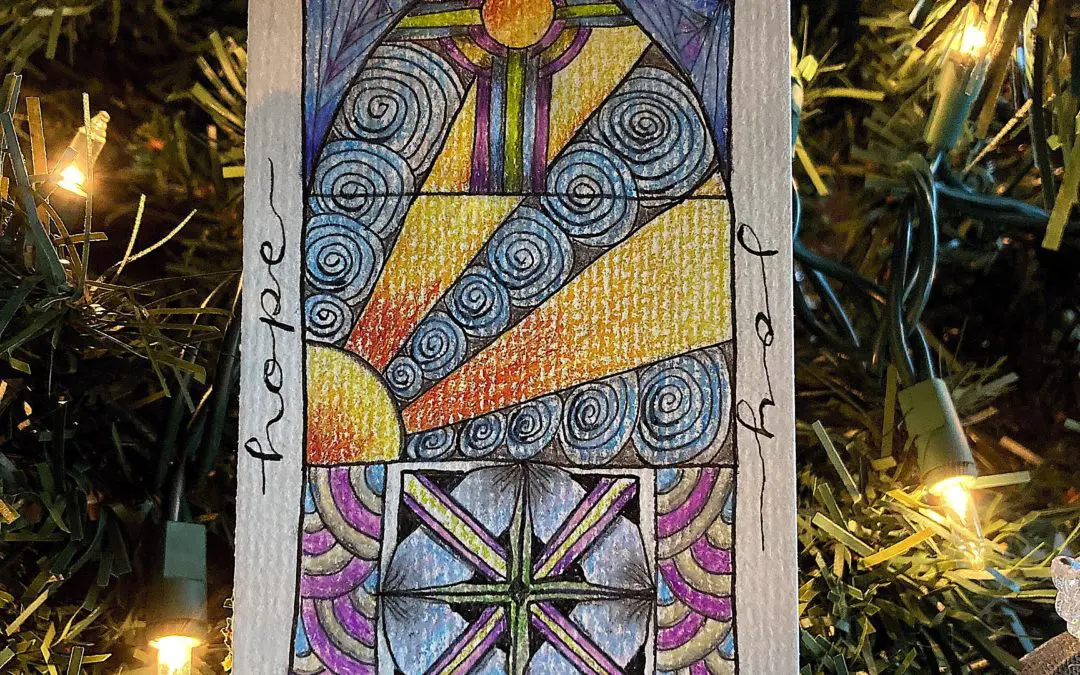
Here we are – in the middle of the Season of Advent. Advent greetings to all, whether you follow the Season or not … welcome ritual … find Light in creativity, family, friendship, respect, integrity.
As I worked on making this Advent card, I prayed that peace, hope, joy and love would permeate infill, inspire and encourage our hurting world and its inhabitants. And, I prayed for all those who follow and support the ‘Soulistry’ ministry, including this blog and the various Facebook groups under the ‘Soulistry’ umbrella – with deep gratitude.
May this Season of Advent bring an unexpected blessing to all. May we have healthy eyes to see the blessing, healthy ears to hear the blessing, healthy hands to touch the blessing, healthy legs to walk towards the blessing, and a healthy heart to recognize and receive the blessing.
If the fwiw department, here are some of those Facebook ‘Soulistry’-related groups noted above. If you’re curious, you are welcome to join any of them after answering all of the security questions. Btw, even if I know you – we are friends, neighbours, family – the security questions help confirm that FB accounts have not been compromised. Thanks for helping to keep these groups safe.
A young man was declared “Not Guilty” in a U.S. court yesterday, in spite of the fact that last year, when he was 17, he carried a rifle into a crowd, shot and injured one man and killed two others.
There are some who believe the Judge was wrong when he threw out the ‘possession of a dangerous weapon by a minor’ charge; that if the defendant had been any race other than Caucasian, he would have been found ‘Guilty’; that the defendant should not have been involved in picking names for the jury who would try his case; that the Prosecution was incompetent.
But at the end, it was up to the members of the jury. At the conclusion of the trial, they believed that the accused was “Not Guilty.” He is now free and can never be tried for this crime again.
Declared “Not Guilty.” Does ‘Not Guilty’ mean ‘Innocent’? Conversely, does ‘Innocent’ mean ‘Not Guilty’?
Two men are dead because a young man killed them with a rifle he never should have been given … let alone carried into the crowd that night … let alone used.
Anger escalates. And fear. And hatred … surfacing in social media, daily conversations darkening thoughts and words and possibly more actions.
Something has to be done so that hope can enter, fear can lighten, hatred can begin to dissipate, and the slippery slope can straighten out.
Where to begin? Surely it begins with each of us
Register our outrage? Yes. “Name” our fears? Yes. Recognize and acknowledge our own prejudices and biases? Yes
And do what we can to bring about a Spirit of Gentleness into the world around us … and not just around us … but within us.
Time will tell … if Civil charges are brought. Time will tell … if the slippery slope that the United States is on will result in civil war – or even the ending of democracy in that country. Time will tell.
And in that time, may there be moments of gentleness may we be gentle – gentle with ourselves – gentle with our children … partners … other family members … neighbours … tradespeople … store clerks … gas station attendees … medical professionals …
May a Spirit of Gentleness flow through hallways, homes, offices, classrooms, social media, governments … in me … in you … in us all.
Last night, the Aurora Borealis was expected to make an appearance in this part of the world. News told us that might even see them from our own back yard. I was excited! I’ve only seen the Northern Lights once and that was long ago in the Okanagan of British Columbia while camping. It was such an incredible experience that night! I woke my son so he could see the magnificence of the colours streaming across the sky. Last night, I waited – and waited – and waited.
But, in spite of a clear sky, no rain and news media postulating such a sighting might be possible, no Northern Lights. I even set the alarm to get up and see them!
Long ago, while doing consulting work in Alaska, my Alaska friend, Scott, took me out to a field, far away from any lights for several nights. Each night we waited and waited and waited in his truck for the Northern Lights to appear. He kept telling me they were magnificent – stunning! – and often appeared there. Nope. Not one sighting. Any night.
When I got home, there was a message from Scott … the night I left, the Northern Lights appeared and “they were incredible!” One more night – if I had just delayed my flight home one more night – but, I didn’t and have been dreaming of seeing them again one day. Last night, I came sooooo close.
While I may never see the Northern Lights in person, those nights sitting out in the Alaska field with Scott, waiting for the Northern Lights to make an appearance, and last night waiting at home, offered opportunities to pray for and think about the environment – and play.
Photos I’ve seen of the Northern Lights show them as multi-coloured, but I decided to play only with blues and purples, just for the fun of it. Some day, I hope I get to see the Northern Lights in person again, but in the meantime, I’ll continue to dabble in watercolour, enjoy Scott’s Facebook photos of the Northern Lights that regularly appear in his part of the world, and reflect on the environment and my role in keeping it healthy.
Shine on, beautiful skies above this world! May you be a reminder to all human beings of the role we play in the existence of a healthy world of clean air. And may those beautiful skies bring solace and hope where grieving, fragmentation and fear about the future of this world prevail.
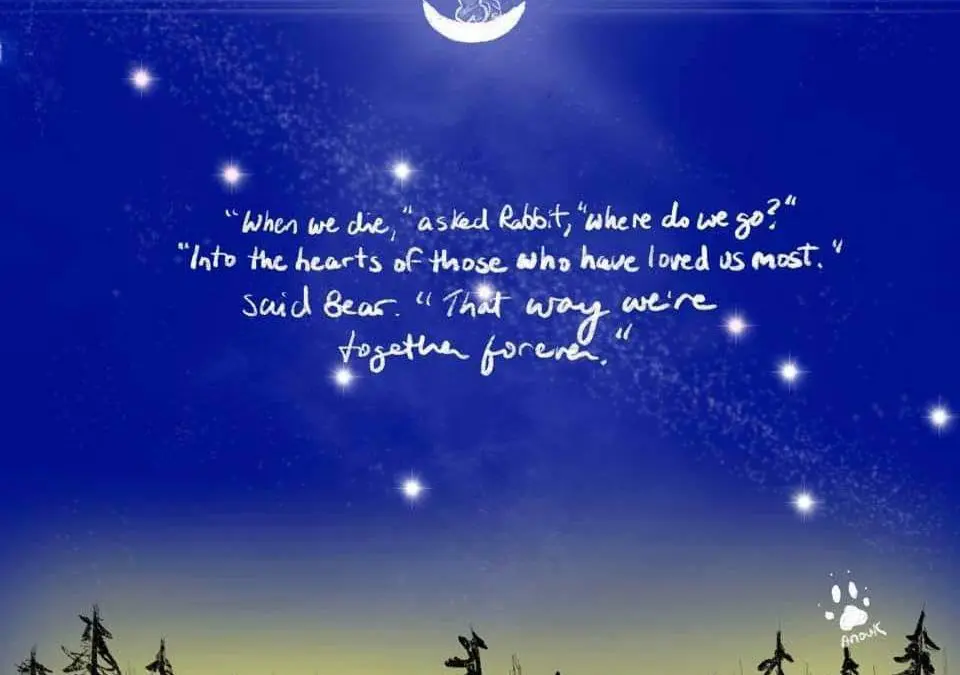
To have this pop up in my Facebook newsfeed today, October 17th, of all days (it would have been our 12th wedding anniversary) well, you both said it all.
When my husband Hans died 5 1/2 years ago, a part of me died too. But knowing what the future would have been like for him (skin cancer, then colon cancer, then esophogeal cancer diagnoses) and seeing him literally waste away, be unable to eat, live in constant pain, be unable to speak and knowing it would only get worse, as difficult as it was to accept, there was a deep sense of gratitude that his suffering was over and an inexplicable awareness that finally, he was at peace and that we would be “together forever” some day.
Thank you, Rabbit and Bear and especially Canadian artist Tara Shannon who created this lovely image.
When we die …. ahhh. When each of us dies, may we go into the hearts of those who have loved us so that “we’re together, forever.”