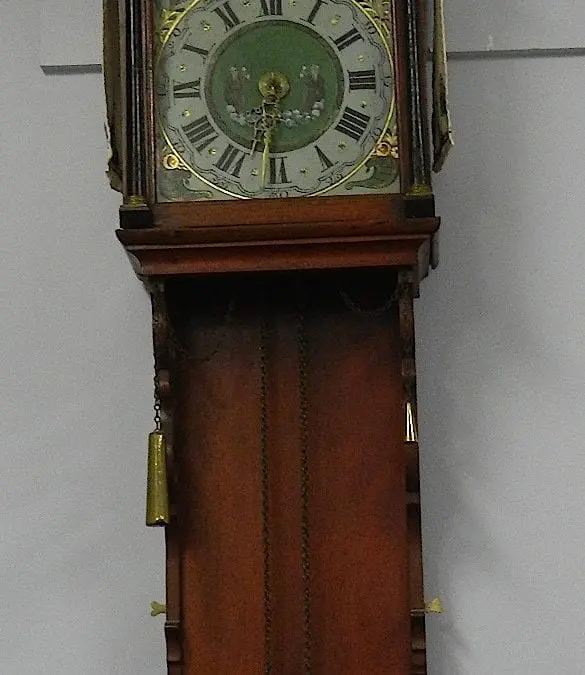
I love stories of “new beginnings” and this is one such story … and a true story at that! It is a story about a clock, a very old clock that began its journey long, long ago, in the province of Friesland, the Netherlands (birthplace of my late husband Hans van der Werff) where tradition had it that when a couple married, an integral part of their home furnishings was a Friesland clock.
Hans’ grandparents (Pake and Beppe) bought such a clock at public auction and even though it “was terribly dirty and did not work,” Pake loved it. Determined to get it back to its original working order, he patiently and gently cleaned it, working countless hours on it and finally, the timepiece worked again and the clock became a focal point of pride in the family home for decades.
When Pake and Beppe died, the clock Pake had lovingly brought back to life, was given to Hans’ parents. Hans remembered it “always being in our home” when he was growing up and it was a lovely memory of his childhood. But when WW11 interrupted their lives and the Nazis began to realize that there could be value in Fryslan clocks, homes were raided and clocks were stolen unless they had been hidden. Not surprisingly, when it was learned that the van der Werff family clock was on the Nazi’s acquisition desirable list, the clock was quickly dismantled and hidden.
Gratefully, it was never discovered during WW11. But after the war, it was still considered to be a valuable commodity, so the family decided that it would be best to get it out of the country for safekeeping. The clock was taken out of hiding and stored until Hans was next in Holland … he had moved to Canada as a young man but often travelled back to Holland as part of his work in those days.
Together, the brothers made a solid wooden box into which they gently placed the clock. Shipping to Canada was arranged, the clock safely arrived and over the decades, Hans lovingly cared for the clock and proudly displayed it in every home in which he lived, cherishing the memories of his childhood, his parents, siblings and grandparents.
When Hans and I married, the clock came to live with us. I was delighted, for its presence was a wonderful connection both to Hans’ Dutch roots and now ‘our’ Dutch family. Hans and I often talked about the clock and he spoke of wanting it to stay with me in our home (should he die before I did), where it was loved and its history was respected. That was the plan.
Well, it was the plan until one morning, about six months after Hans died. During my Quiet Time one morning, an image of the clock being packed up and heading across the ocean back to Holland, filled my thoughts. I lived with that possibility for several weeks and each time I thought about it, peace filled my heart and mind. I wrote Hans’ brother and wife, their daughter and son in law, sharing what I was thinking of doing with the clock … send it back to his homeland – in the Netherlands – and was gratified by the response of them all.
As a result, I contacted a shipping company and the clock began its journey. And here is where a miracle/mystery enters the story. Soon after Hans died, the clock that his brother Peter and his wife had in their home, stopped working. No reason – it just stopped! Peter tried to fix it, but he wasn’t able to. One day, he found a clockmaker who was able to repair it, but the cost was too high to be considered, so Peter headed home knowing that the clock would not be repaired.
As it happened (nawww, not a coincidence <g>), the Friesland-Canada clock was being picked up that very day (!) at the Rotterdam dock, and the moment Peter got the phone call saying that the clock had arrived safely and had been picked up, his wife noticed that the clock in their home began to work! No one had touched it. It just started … miraculously/mysteriously. Each one of us, independently, agreed: “Hans fixed it and is telling us that he is so very happy that the clock has returned back to Holland.”
So the ending of this story is that the clock has returned from whence it came. Or is it really ‘the ending’? The clock is safely back in the Netherlands, proudly displayed in the home of Hans’ brother and his wife’s daughter, our niece, her husband and daughter, our great-niece. When the clock arrived in their home, she proudly remarked that she will pass the clock on to her children and their children with a copy of this story tucked into the clock for generations to know its history for she knows that in time, she will inherit the clock. I know that the future of the clock is secured … and that’s a happy ‘ending’ … a happy ‘beginning’ to this story.
(P.S. I took the photo of the clock, but it’s a very large clock and I couldn’t step back far enough to get all of it in the photo. The length of the chain is really long!)
The words are often sung prior to and at Christmas but … the words are words for all times: “Do you see what I see? Do you hear what I hear? Do you know what I know?” And those words invite reflection:
Do we really see what others see?
Does everyone see the pain of the homeless – their fear? their confusion? their helplessness?
Do we really hear what others hear? Does everyone hear the cry of the abused? the lonely? the angry? the addicted? the powerless?
Do we really know what others know? Does everyone know the authentic, real truth? Was American politician, (sociologist, diplomat, member of the Democratic Party who served as an adviser to Republican President Richard Nixon), Patrick Moynahan, correct in thinking that “everyone is entitled to his/her own opinion, but not to his/her own facts”?
These questions likely began to slowly form when a young French-born musician found himself, against his will, drafted into the German army when France was overwhelmed by Nazi troops during WW11.
Noel Regney endured the horrors of war as a young man. He hated every moment of it and many years later, he moved to the United States. When the Cuban Missile Crisis brought a sense of despair to the United States in October 1962, he was devastated. Again. When he was asked by a record producer to write a Christmas song, he struggled to find anything that would give a sense of Christmas hope and peace.
One day, he noticed two babies in strollers, looking at one another and smiling, and thought of newborn lambs. Before he knew it, a first line had been written and the rest of the lyrics quickly followed. When he shared his words with his pianist and composer wife, Gloria Shayne, a gentle and haunting melody quickly appeared and between them “Do You Hear What I Hear” was born and became a well-known song at Christmas. Regney’s favourite version was sung by Robert Goulet though the most well-known version was sung by Bing Crosby. Sadly, its message of global peace was initially lost on many. Perhaps it is time to have it surface again, and not just at Christmas time?
Hope … intangible hope evidenced in the presence of a lamb in the image of a Child in hearts, in minds, in spirits.
A child asks the everpresent question and the parents try to respond.
Sarah: “Daddy, Mommy, I don’t understand why some of the kids are so mean to Juanita and Shiandra. They say it’s something about them not being really part of our country because they don’t have the right skin colour.”
Daddy: “Well, Sarah, some people think that skin colour determines the goodness of a person and they don’t think these children are good.”
Sarah: “But they are! They’re good and kind and fun and I like them! I don’t understand.”
Mommy: “We don’t either, Sarah. Like these three eggs – each of you is different on the outside, but on the inside, you’re all the same … same colour blood, same organs, same ability to laugh and hurt and feel compassion and know what is right from wrong and …”
Sarah: “If only we could all just have our insides be our outsides.”
A letter to my American neighbours, sisters and brothers
Dear friends,
What has been happening in your country is beyond imagining: the hatred
the fear; the bomb scares this past week; this morning’s deadly shooting at the Tree of Life Synagogue in Pittsburgh; the lack of concerned / caring / pastoral response by your leader in the White House.
You may feel alone. You may feel helpless. You may feel frightened as you have never felt before. You may not have the strength or courage to face “the next.” Please be assured that there are people around the world who are holding you all in the Light; are praying for you; are “with you” in spirit; are hoping and praying and encouraging you to vote in your mid-term elections in numbers your country has never seen before.
May you vote with hope. May you vote love, not hate. May you vote.
June Maffin, a friend and one of your northern neighbours who aches with you and prays for you all.
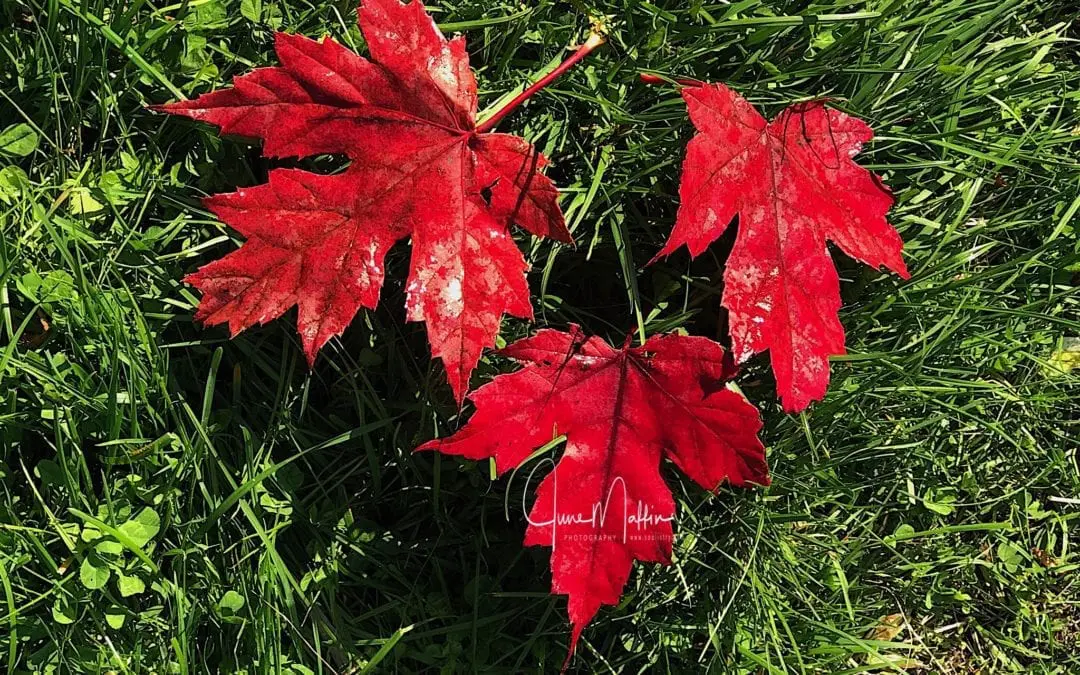
Today. Today I took a photo of three red maple leaves, prepared the garden for winter, went to our local Farmer’s Market, visited a friend who is recovering from surgery, went to a fun community sing-a-long of the Mary Poppins movie, and voted in our local elections.
Today was a day like many others. And yet it was different. It was different because (as well as being blessed by all of the other things I did), I was blessed by living in this country where I am free … free to garden … free to shop … free to visit friends … free to join in community activities … and free to vote. Free to vote without fear – fear … of harassment … of recrimination … of violence … of interference. Free to research the issues and the candidates. Free to vote the way I choose. Not everyone can do that.
Some may say that it was co-incidental that today was the day I ‘happened’ to see the red maple leaves on the ground, ‘happened’ to take their photo, and that it all ‘happened’ on the day of our municipal elections. Nope – nothing ‘happenstance’ about it. There aren’t many maple trees with bright red leaves where I live, and seldom have I seen them up close, still vibrant in colour. As I bent down to see the three red maple leaves, and take their photo, I remembered something I’d learned a long time ago … a history lesson which told about a time (long before the first European settlers arrived in Canada) when Canada’s aboriginal people (our First Nations people) had discovered the food properties of maple sap which they gathered every spring and how that discovery of the importance of the maple leaf deeply affected Canadian history.
While many historians trace the maple leaf’s service as a Canadian national symbol as early as 1700, its first official recognition was 1867 when Alexander Muir composed the unofficial anthem in English-speaking Canada, ‘The Maple Leaf Forever.’ Not surprisingly, the Canadian flag has a lovely bright red maple leaf in its centre. Raised on Parliament Hill in Ottawa for the first time on February 15, 1965, the red maple leaf has since become the most-recognized symbol of Canada, symbolizing unity, tolerance and peace. Voting today, and all that the privilege, responsibility and blessing of voting means to me, was graphically illustrated in those three bright red maple leaves I ‘happened’ to see.
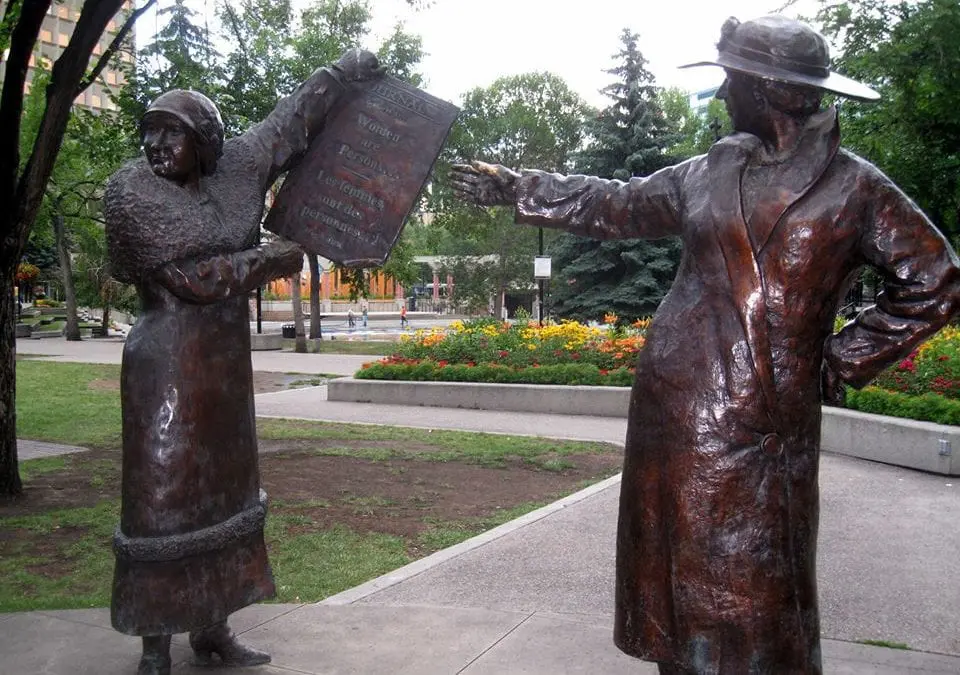
I am a person. That may seem to be a rather strange thing to post, but before October 18, 1929, in Canada, women were *not* persons.
But on October 18, 1929, Canadian women were declared “persons” under Canadian law. And for that, I give thanks to five ‘persons’… the Famous Five: Henrietta Muir Edwards, Nellie Mooney McClung, Louise Crummy McKinney, Emily Murphy, Irene Marryat Parlby … and the men who “stood with them.” (http://www.famou5.ca/the-persons-case/)
I am a person. And I will vote – with gratitude (after familiarizing myself with the candidates by reading their literature, asking them questions, participating in all-candidates meetings) in local elections, provincial elections, federal elections. I hope that all other ‘persons’ will, too.
(When were women declared to be persons: The last line of the judgement reads, “Understood to mean ‘Are women eligible for appointment to the Senate of Canada,’ the question is answered in the negative.” This judgement was overturned by the British Judicial Committee of the Privy Council on October 18, 1929. This case came to be known as the “Persons Case”).