Once upon a time, a donkey fell down a well. The animal cried and cried and cried – for hours. The farmer tried to help but … he decided the animal was old and it wasn’t worth his time and energy to save the donkey. So he and his neighbours began to throw dirt into the well.
When the donkey realized what was happening, he cried and cried and cried. Then he quieted down.
The farmer and his neighbours continued to throw dirt into the well. When the farmer looked down the well, he was surprised at what he saw! With every shovel of dirt that fell on his back the donkey was doing something amazing! He was shaking off the dirt and taking a step up. As the dirt continued to be shovelled on top of the donkey, he would shake it off and take another step up.
Everyone was amazed as the donkey stepped up over the edge of the well and trotted off!
We all get dirt shoved on us and sometimes we even shovel the dirt on ourselves. Each time we say “I can’t … I can’t do this. I can’t try that. I can’t go there,” we are shovelling dirt on ourselves. That’s when we need to get out of the deep well we’re in … the well of self-pity … blame … low self-confidence.
We need to shake off the dirt, take a step up, not give up, let every adversity become a stepping stone to positive change.
We *can* get out of the deep wells – whether our well includes feeling lonely, feeling anxious about upcomingassignments, not making friends, frightened about the future, worried about upcoming medical tests, dental treatment, surgery, finances, politics, an upcoming meeting, COVID19, exams, whatever!
When dirt falls on your back, remember the donkey, shake it off and take a step up!
Have you ever wondered how to make a wise decision? how to know which direction to go when faced with more than one possibility? how to discern the will of God? how to determine the way to go re: medical decision? possible move? job? vote? finances? relationship? health issue?
You’ve reasoned. You’re sought the advice of others. You’ve prayed. You’ve done your research. You’ve brainstormed – looked at every angle you could possibly think of. Still, you’re not certain.
Which is the right answer for you at this particular time? Which road will be the wisest choice? What decision would be the best?
Like everyone, I’ve found myself in situations seeking wisdom, hoping to discern wisely. Whether the situations have been simple or complex, each time, here’s what I’ve learned. ‘Listening’ is the key. Listening to my body; listening to my mind; listening to spirit – that “still, small voice within.”
The next time you are faced with a decision, checking things out with your body, mind and soul could provide the answer.
Listen to your body.
If it is relaxed about going in one direction, it’s a possible “yes.”
Listen to your mind.
If it is at peace and you are not still trying to “figure it out,” it’s a possible “yes.”
Listen to your heart.
If it soars with openness, enthusiasm, joy, curiosity, anticipation, it’s a possible “yes.”
When all three are a “possible yes,” then harmony is evident: harmony of body, harmony of mind, harmony of spirit and could be showing you a good road to take, a gentle path to journey, a wise decision to make.
Her face lit up when we shared a moment-in-time today.
She, in her mid 70’s, was looking at summer tops and slacks.
She was wearing beige slacks, beige top and black jacket with black purse and black shoes.
The clothing she was looking at? Black sweater, beige slacks, black top.
I could “see” her in lovely pastels but all she was looking at was … black, beige and more of the same.
I quietly asked “What do you think of this colour?”
Her reply – “So lovely for you, dear. But not for me.”
She had given me an opening – and so I gently asked – “Why not?”
Her reply – “I’m old.”
I picked up two pastel blouses – lilac and peach – and asked her to come with me to the mirror. I think she thought I was going to try them on and wanted her opinion. She was half right. I wanted her opinion … but not for me – for her.
I tucked them under her chin and she smiled – and looked at me and said “I’m too old.” And then she looked again. And smiled.
We chatted a bit. She confided that she hated wearing black and beige, but those were what old people wore and she didn’t want to have people think she was trying to be young again.
And then, after she held up the coloured shirts a few more times and could see they brought colour to her face and (maybe it was my imagination, but she stood straighter when they were under her chin), before I knew it, she had purchased them both. As she went out the store with a lovely, big smile on her face wearing the peach-coloured shirt, she said “A difference – you have made a difference.”
Nawww, it wasn’t me – it was her. For in that moment, she decided to wear colour and enjoy her life … every moment of life. And yes, I’m *sure* she was walking straighter as she walked out of the store. Those colours really suited her.
She took a risk – and made a difference.
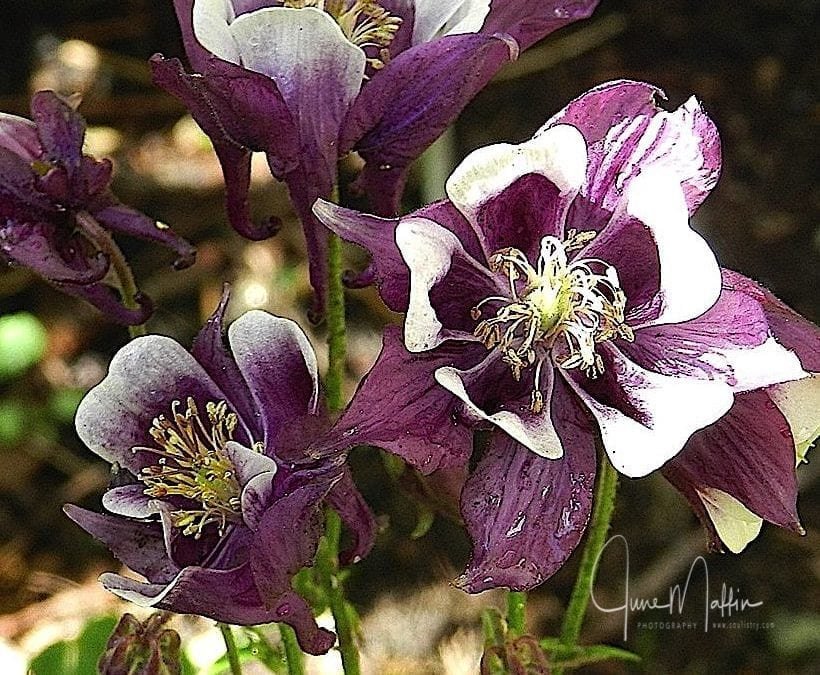
<update: The story is true. The photo is not of the woman in the story but permission has been granted to use the photo for this story by a lovely septuagenarian (75 years young!) woman who loves colour – and life!>
It’s spring in many parts of the world and both flowers and weeds are growing in abundance.
Mother Nature provides a challenge – which do we allow to grow most in our mind, in our heart, in our soul? Flowers (seeds) or weeds?
Thanks to the birds who deposited the seed-treasures this spring, there are lovely columbines growing in the garden, Mother Nature provides a wonderful challenge for soul-reflection.
Our mind is like a garden and our thoughts are the seeds. We can grow flowers or we can grow weeds
Do we allow seeds to grow flowers in our mind, heart, soul, in our words, thoughts about others/about ourselves. Or do we allow weeds to grow in our thoughts about others/ourselves?
In many parts of the world, it’s springtime – a season when nature wonderfully presents symbols of life, birth, beginnings.
In spite of that, dear ones have died, are dying, been institutionalized, diagnosed with major illness and we too face our own mortality in new ways.
May we never forget the cycle of the Seasons – never become so entrenched in ‘deaths’ that we forget the wonder of the ‘births.’
The Seasons are a gentle reminder of the continuity of life which bring wonder and awe, for even as death approaches, life begins again … in a new way.
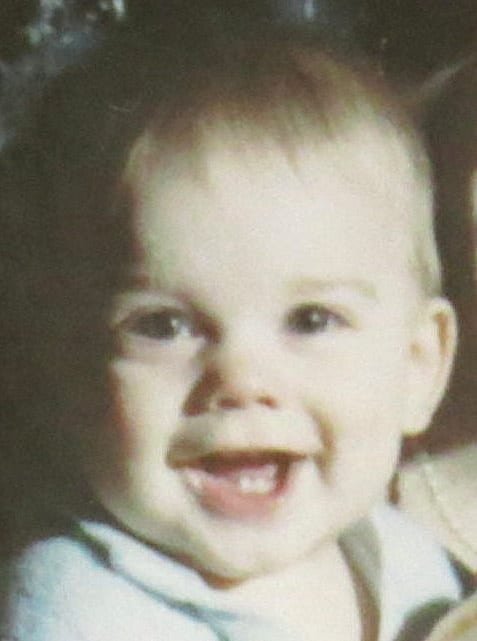
Congratulations to Vanessa, Jonathan, big brother Cohen and Great-Opa (eight times over!), Hans. Welcome to this world, Caleb! We are delighted to welcome you to our family, and look forward to meeting you, your big brother, Mom and Dad in person, soon! 🙂
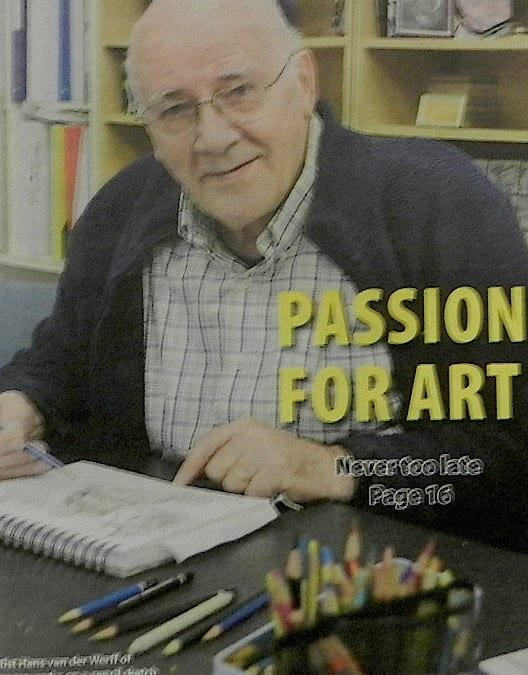
As his wife, I’m claiming “bragging rights” today about Hans.
When our local paper learned of his recent two-page feature article in the March edition of the national magazine “More Of Our Canada”, they sent a delightful young man, Paul Brian to interview Hans. While we knew that Paul’s article about Hans would appear in the March 23 “Citizen” paper, here in the Cowichan Valley, we had no idea his photo would be on the front page … but it is (!)
While the actual article (a couple of informational-errors but what-the-heck <g>) is inside the paper on page 16 it and the “More of Our Canada” feature article about him are early birthday presents for my artist-husband. 🙂
walking on the boardwalk of life
i wonder “where am i”
is the road ahead straight or curved or
narrow or up a hill or in a valley
or like a circular staircase
it really doesn’t matter because this is
the road we are on
and if we come to a junction
where two roads converge
we will make a choice
and it will be the correct road
the right road
for us at that time
it will be a road where we will learn and grow
and cry and rejoice and forgive and be forgiven
and be hurt and be happy and grieve
and laugh and wonder – again –
“where am i”
for in the wondering
there are new opportunities
and in time we will recognize that
we are where we need to be
at that moment
The Season of Wonder brings the wonder of magic the wonder of gratitude the wonder of peace and joy, love and hope. May we all enjoy the Season of Advent the Season of Wonder.
I’ve been reading Soulistry for five days now, and I am only on the second page. I think this little book is bigger than it looks! I have read many good books on creativity, inspiration and spirituality, but this one is different. It’s a guide, but not a how-to book of activities and projects. Journaling is strongly suggested, but not required. The format is simple: a quote (journal prompt) followed by questions to ponder.
A myriad of topics from aging to mystery to God are touched upon. The book can be read in a day, or it might take a year to get through it. Every prompt with its set of questions stands on its own. I would suggest that the reader become familiar with the back of the book which contains the epilogue and the appendices before reading and working with the prompts and questions.
June Maffin knows that a good teacher does not give students answers, but instead poses questions that will lead the students to the answers.
Personally, I find journaling to be a powerful tool as a prelude to doing art especially if it incorporates calligraphy. The quotes (prompts) and Soul-Questions of Soulistry become a vehicle for transforming the written word into a visual concept. Journaling facilitates the transformation with deep personal meaning.
So, the journaling becomes imagery, a sketchbook. Soul + Artistry = Soulistry. (Amazon review)
Unlike far too many books on spiritual matters, “Souistry” offers all comers a cordial and restorative way into the exploration and care of the interior life.
www.phyllistickle.com Phyllis Tickle is the founding editor of the Religion Department of PUBLISHERS WEEKLY and was Academic Dean to the Memphis College of Art before entering full time into writing and publishing.
June Maffin delivers what the subtitle of her book promises, “Creative Ways to Nurture Your Spirituality”.
Starting with the invention of a new word “SOULISTRY,” she guides her readers through the creation of a journal and lets them find their own “answers within”. She brings to the writing of this book an impressive educational background (ordained Anglican priest, PhD in pastoral theology among others) and a wide range of experience. However, the impact of an illness she suffered and the process of her healing became the primary impulse for writing this spiritual autobiography. Her approach combines spirituality and creativity.
The structure of the book offers a step-by-step guide to spiritual journaling. It is complex, yet easy to follow. The main and most important step is to move through the Journal Prompts and their Soul-Questions. This step is the crux and the purpose of the book.
The 86 Journal Prompts are inspirational quotations from extraordinary people from different centuries. Among those represented are priests (Herbert O’Driscoll), writers (Mark Twain), poets (Rainer Maria Rilke), philosophers (Lao Tzu), mystics (Julian of Norwich), monks (Thich Nhat Hanh), artists (Michelangelo), as well as proverbs. Some of the quotations and their authors are well known, others less so. All of them prompt a thought provoking response. Each quotation has a title such as Mystery, Faith, Happiness, Peace Within. The following Chinese proverb prompts the feeling of happiness. “If you want happiness for an hour, take a nap. If you want happiness for a day, go fishing. If you want happiness for a lifetime, help someone else.”
Each Journal Prompt is accompanied by Soul-Questions. Together they are meant to stimulate the reader’s spiritual response and awareness. The title Happiness, for example, with its Chinese proverb prompt is followed by these Soulistry Soul-Questions: * Do “being happy” and “being joyful” have the same meaning for you?
* If not, what is the difference?
* What contributes to your happiness?
* In your Soulistry Journal, reflect on a time in your life when you were happy. What was the occasion/circumstance? How did you feel?
* How can helping another bring happiness to the helper?
* What can you do to “help someone else” on a regular basis?
* Are there individuals, or community/environmental/political/religious organizations you might help? Journal who they might be and how you might be able to offer to help them.
In Dr. Maffin’s own words her book will encourage the readers to connect more intimately with their spirituality and offer new ways to nurture their spirit. In the Epilogue she asks the last question: “ Who are you?” Having journaled through the prompts and questions, the answer(s) may surprise the reader.
The remaining parts of the book provide biographies of the quotation authors, listing of the prompts and soul-question titles, the Soulistry story and Soulistry retreats and workshops.
Dr. Maffin’s book is useful even for those who are not able to journal. It can be used at any time, any place, on any page at any prompt and it will immediately lead the reader to a moment of spiritual calm.
SOULISTRY should be kept as a guide for contemplation. And that is where the value of this slender volume lies.
Hana Komorous, Librarian, Christ Church Cathedral, Victoria, BC
Soulistry is a simple book yet incredibly complex. It is a small book but hugely big. You can read it in an afternoon yet it can take a lifetime (or lifetimes) to fully absorb.
There is a saying that there is only one thing you can take with you – your evolution – and one thing you can leave behind – your art. Thanks to June Maffin, the wisdom is this book is something you can take with you and what ‘soul-full’ art she has brought to the planet.
I gasped in delight as I pulled Soulistry from its shipping envelope and saw the delicate image of dandelion seeds drifting on a gentle breeze. I smiled at an image of June Maffin’s thoughts wafting like the seeds of that dandelion, and wondered if they would sprout and multiply like the humble dandelion in souls around the world.
I was not disappointed. The slender volume packs a virtual universe into 144 pages. The seeds are contained within 80 quotations and the probing questions that follow each. These pages contain enough journaling prompts to keep a person writing for years, exploring and expanding with each small thought. The source quotations demonstrate the expansiveness of Maffin’s personal spirituality, including Christian classics such as St. Augustine and Thomas Merton and branching out into the whole world — American Indian, Chinese proverbs, Lao Tzu, Buddha, Michelangelo, Mark Twain, Anaïs Nin, Desmond Tutu, Dalai Lama, Jesus … Without an overt word, she demonstrates that faith and spirit transcend boundaries of limiting belief structures.
The quotations and question-prompts would be a rich meal unto themselves, but she doesn’t leave it at that. The book begins with a brief Preface explaining how to get the greatest benefit from the book and a short Prologue that gently nudges anxiously questioning minds into soothing channels of encouragement. Any reader will appreciate at least a couple of her six appendices. She gives simple instructions for making your own Soulistry Journal volume and tells the inspiring story of the health affliction that led her to discover the combination of soul and artistry. Two more appendices will appeal to the inner organizer or librarian within many readers. She gives brief background sketches of each quoted person and lists the quotations alphabetically by the titles she assigned.
Even if you never write a word, this uplifting volume will give you plenty to think about, but your life will be much richer if you do record your responses to prompts. Orderly souls may prefer to begin with the first and work their way through in an orderly fashion. Free Spirits may pick and choose, selecting those quotes and prompts that resonate most strongly on any given day. Some may prefer to write simple, spontaneous answers and move on. Others may spend hours over a period of days or weeks drilling deeply into specific questions, fully mining their riches. However you use this book, your life will be richer for letting Maffin’s simple seeds take root in your soul.
Sharon Lippincott
StoryCircle Book Reviewer
http://www.storycirclebookreviews.org/reviews/soulistry.shtml
Those familiar with the Artist’s Way or with popular modern therapies, know well the importance of journaling. Morning pages, the stream of consciousness daily deposit advocated by Julia Cameron, reveals to those who write them the mysteries of their moods and an eventual break to inner chatter. Many authors, inspired by Cameron’s effective system for breaking creative blocks, take Cameron’s wisdom and embellish it with their own methods, giving Artist’s Way travelers and their ilk next steps after the prescribed twelve weeks of creative focus pass.
June Mack Maffin’s own spin on creative recovery poses questions to the reader; Socrates himself might crib notes. The book consists of a series of questions to prompt creative journaling and intense introspection. An explorer of the inner planes face puzzles such as “Loving Your Enemy” and “Peace Within” followed by questions that rifle memories for the birthplace of attitudes and open doors to ideas unconsidered.
Soulistry takes the work of Cameron and pushes the borders: many of the questions reveal details about the soul a journaling person might feel unprepared to receive. A person needing inner work can get much out of this book; Maffin’s questions lead to deeper personal questions that delve into hidden aspects of self.
~review by Diana Rajchel
“Facing North: A Community Project”
Author: June Mack Maffin
Circle Books
pp. 132, $13.95
I have written daily in a spiritual journal for more than thirty years. It began in response to an invitation – not unlike the one June Maffin extends here – only it was a different time and place for me. Still, her welcome encouragement speaks to me after all these years.
The author offers both excitement and adventure in new spiritual growth that continues to intrigue me. That is the thing about real spirituality – the possibilities for internal renewal continue to be limitless – whether you are a beginner, or a person with considerable experience.
—
As I engage this book, I see quickly that it is the product of a good deal of faithful living and spiritual investment. From her experience has come a rich harvest of understanding that is readily evident in the material. June has known some difficult challenges in her spiritual journey, but from what I know of her, I have always admired the balance and equanimity with which she faces life’s problems.
—
A point about the 80 Soulistry Journal Prompts and Soul-Questions that constitute almost 90 pages of the book. She includes the wisdom of a wide-range of spiritual guides – some of whom are Christian and some of whom are not. In this, she shows that the spirit of God is not limited or confined to a particular faith. But at the same time – she reveals through such quotes – the broadness and depth of her own Christian life.
She demonstrates that one can grow in spiritual maturity only if one has a solid grounding upon which to stand. That maturity is not always found today but when she quotes persons I know personally or with whom I have had a long-standing reading acquaintance, I realize that she is not simply ‘spiritual name-dropping’ but has solid reasons for quoting such people. They have become intimate partners in her own spiritual quest. She includes a biographical listing of all her contributors, which I found helpful – especially for the less familiar names.
Don’t read this book because you want to collect a string of quotes or impress people with your literary prowess. Read it because you sense a depth and quality in the person quoted. For example, one of her subjects is also a person to whom I owe a great deal of respect and appreciation. Herb O’Driscoll, a colleague of this list and a retired priest of the Anglican Church of Canada is a wonderfully creative preacher and writer. The author quotes these words from him: “Come and journey, journey upward. Sing God’s praises. Offer prayer. In the storm and in the stillness. Find God’s presence everywhere.” (pp. 36-7) This is but one example of many I could mention; but why not secure the book and meet other inspiring mentors and guides in the process?
Thanks, June, for creating this very fine spiritual reading-companion. I will treasure and return to it often; and am sure that many others will do the same.
Soulistry. In case you’re wondering, “soulistry” is a neologism coined by the Rev. Dr. June Mack Maffin as shorthand for artistry of the soul. Her new book of the same name, published April 29 and subtitled “Creative Ways to Nurture Your Spirituality,” is a spring tonic that speaks to the very essence of us. It’s trip into the élan vital.
The book guides readers through soul journeying and soul journalling, prompting them to have profound written conversations with themselves and with the mystery that lies at the heart of existence. Keeping a spiritual diary as a tool of self-discovery, soul travellers work their way through a series of Journal Prompts—inspiring quotations that lead to Soul-Questions. Their responses to those questions are designed to help them know themselves more intimately, to clarify what they really believe about life, relationships and important issues, and to help them grow fully into their humanity.
The almost 80 catalyst quotations harvest the wisdom of sage minds from different walks, faiths and ages—pebbles for the spiritual pocket that can be taken out and appreciated at any time, in any order. Slake your spiritual thirst on topics ranging from faith and hope to goodness, mystery and wisdom with citations from ancient Chinese proverbs, Buddha, Christ, Navajo chants, Khalil Gibran, and Dag Hammarskjöld. Each quotation is followed by thought-provoking questions. Here are two of many that got my attention.
The whole secret of the spiritual life is just this painful struggle to come awake, to become fully conscious.—Gerald Heard
“What does ‘to come awake, to become fully conscious’ mean for you? Have your life, your spiritual journey as ‘struggle’ as ‘painful’? If so, how?”
Humankind has not woven the web of life. We are but one thread within it. Whatever we do to the web, we do to ourselves. All things are bound together. All things connect. — Chief Seattle
“Reflect on the ‘web of life’ metaphor. How do you see yourself as ‘but one thread within’ the web of life?”
Maffin, an ebullient Anglican priest and spiritual workshop director based in Duncan, B.C., on Vancouver Island, began working on this soul-soothing book a few years ago when her body was racked with pain from mercury poisoning, her muscles atrophying and her mind foggy, unclear and incapable of concentration. “For a year, even reading was a challenge,” she says.
The Montreal-born Maffin’s career path has been more varied than most. Sent to elocution class to cure a stutter, the young Maffin was discovered by a producer and became a teenage TV personality, which parlayed itself into her appointment as Canadian editor of a U.S. teen magazine. She studied sociology at Concordia University, taught high school in Montreal and was considering law but digressed into seminary and the priesthood. She holds a PhD in pastoral theology and is the author of an earlier book Disturbed by God. Nowadays, Maffin focuses principally on her ministry of Soulistry, acting as a workshop and retreat leader to help people make the connection between creativity and spirituality, thereby nurturing their souls.
Asked how spirituality differs from emotionality and intellectuality, Maffin replies, “Spirituality gets at the very essence of who and what you really are and what you believe about the important things in life.”
Soulistry Circle Books, 2011, $13.95. Available from Amazon, Barnes & Noble, The Book Depository and local bookstores.
Many of us yearn for spiritual connection or, once connected, spiritual growth, but don’t know how to begin on that path. Some of us don’t know how to look at our lives, without automatically seeing only the negative — the imperfections and what hasn’t been accomplished. Others of us have done some spiritual work and then stopped — uncertain how to continue.
Many of us strive for greater understanding of how the spirit operates in our lives and how to nurture that spirit. Or, we feel stuck and yearn to become unstuck and to develop a practice to follow. For seekers such as these, The Rev. Dr. June Maffin’s Soulistry — Artistry of the Soul, will be a great gift.
The practice Maffin outlines begins with buying or creating a Soulistry Journal (instructions provided), and writing in it.
Journal entries are personal, not necessarily to be shared. The practice includes considering quotations from individuals whose wisdom Maffin has found useful (called Journal Prompts) and Soul-Questions which, together with the Prompts, can spark a thought, a memory, a question, together challenging the seeker to connect more intimately with one’s spirituality. The act of responding to the Prompts and Soul-Questions is itself a spiritual task, for Maffin states that order is not important. Find a Soul-Question that “speaks” to you, she says. Journaling these responses may be a new experience or something you’ve done before, perhaps under other circumstances or with other intentions. “Soulistry” is a coined word combining two words — soul and artistry — and was created by Maffin together with her son, hence the references to Soulistry Journal, Soul Space, and Soul-Questions. Some will find these words helpful, others, incidental. What all will find nurtures the spirit is the prompting of the quotations, and — especially for those who were feeling stuck, the list of Prompts/Questions already prepared for consideration.
The care with which Maffin has developed the series of activities is made evident by the instructions for making a Soulistry Journal: she describes what’s required, what’s optional, where to cut, fold or sew, and how to complete the Journal. Even those who consider ourselves inept will discover how easily we can accomplish this task. Since journal writing is meant to be a personal conversation with oneself and God, writing responses to the Journal Prompts and Soul-Questions help clarify what you believe. Even here, Maffin offers options to consider. It’s not obligatory that journal writing be solely personal; some might find it helpful to seek guidance from a counselor or spiritual director, she writes. The sources of the quotations — what Maffin refers to as Journal Prompts — are wide-ranging, some from the Christian tradition, others not; some names known to all, others, less familiar. These include spiritual leaders such as Thich Nhat Hanh, philosophers Martin Buber and Gerald Heard, Chief Seattle, poets Anne Sexton, Robert Frost and Langston Hughes, thinker/educator Confucius, Francis of Assisi, Julian of Norwich, Gandhi, Gordon Light, Thomas Merton and Herbert O’Driscoll. And Jesus. And many others.
My efforts with the practice Maffin has outlined taught me that the Prompts do indeed prompt reflection. And the Soul-Questions do cause one to dig deeper.
A final gift to the reader is Maffin’s description of how this book came to be. Illness, healing, ‘stepping out in faith’: lived experience.
Book Review by Brenda Berck


St. Mary’s Kerrisdale


Published in TOPIC, Diocese of New Westminster newspaper    www.vancouver.anglican.ca (click on left side of screen for PDF link to the Summer 2011 issue of TOPIC where the above book review can be found.
Dr. June Maffin has marked the trail for all of us seeking a deeper, creative and more meaningful life. Amazon has released, artid member June Maffin’s guide to the within. Entitled Soulistry, Artistry of the Soul. June has thoughtfully structured the book in such a way that the outcome of each person’s journey will be different depending on one’s answers. The questions are both road map and compass to an often overlooked destination — the elusive “within.”
“Making changes in your life is difficult and requires work, so much so that many people are not willing to make the effort.”
Like so many explorers who kept a diary of their adventures, this guide to journal- keeping gently asks the questions that only the traveler can answer. A thoughtful read and a gentle gift for someone you love who is struggling with life’s questions.
Mary Lawler Artist, Marketing Director for ArtId (www.artid.com)