Finally we have come to the end of Lent, the end of Holy Week. It is Easter! “Alleluia! Christ is risen.” “He is risen indeed! Alleluia!” Huh? What? He is risen? The Resurrection was real?
Proof! We want proof that is tangible, reliable, trustworthy. Heck, we NEED proof! These are scary times. Children are frightened there may be a shooter at their school … or their parents may be picked up by ICE. When we think about things, we realize that there may not be enough water or air or land to live on if climate change isn’t dealt with quicklym and soon. Youth and adults are terrified that more and more young people will be sent to a foreign land to fight in a war that wasn’t sanctioned by their government … the democracy they take for granted is being eroded and may soon be gone.
And then what? Proof! We want proof!!
One little girl had the proof. And she not only told her friend, but stuck out her tongue at the other little girl to emphasize her proof, as she exclaimed “So there! I told you so! I was right! My mother said that the earth is round and if she said it’s round, then that proves it!”
Ahhh, if only proof were that simple. But then again, maybe it is! Maybe the proof of Easter is that it is here … all around us. Not in the physical resurrection appearance of Jesus, but in the hands and feet of Jesus’ followers today.
If we want proof of the Resurrection, maybe we simply need to look around – look around our community, religious group, neighbourhood, local community centre/library/school. TV personality Mr. Rogers said his mother helped him respond to scary news when he was a child, by telling him,“Look for the helpers.”
The proof we want and need is in the selfless action of those who staff the pharmacies, grocery stores, hardware stores, gas stations, car repair shops ,,, in the daily routine done by garbage collectors, street cleaners, ferry workers, truck drivers ,,, in the dedication of educators, health care workers, first responders, physicians, funeral attendants, nursing home workers, journalists, librarians – it’s in all professions and trades.
The proof is in the kindness of volunteers … picking up groceries for the elderly, self-isolating and immuno-compromised, cutting flowers from their garden and taking a bunch to a neighbour recovering from surgery, illness, who is grieving … putting together meals for the homeless, for the shut-ins, lunches for school children, Food Banks … tutoring new immigrants in the English language … sitting on community, school, church committees … mowing lawns and doing some handywork for those less-abled and/or elderly … standing up/speaking out for justice by picketing, peaceful participation in rallies and protests, writing politicians.
There’s the proven that Christ is risen. Christ is risen in you. Christ is risen in me. Christ IS risen! “He is risen, indeed! Alleluia!”
We’re almost at Easter! The end of a difficult week is in sight for countless people around the world who are observing Holy Week. But, we’re not at Easter yet. We’re not at the end of Holy Week.
This day, known as Holy Saturday, is one last nudge – one final reminder – of the fragility of the human being.
Holy Saturday might be likened to a “Morning-After” situation. You know, the “Morning-After” when the worst thing that could possibly have happened, happened – such as … ~ when you received the devastating medical diagnosis ~ when you were fired ~ when you realized that a brutal war was happening – when you discovered yourself on a ‘deportation list’ ~ when your spouse confessed to cheating ~ when you were at a great party, woke up with a doozy of a headache learned that you had driven your car the previous night, and had injured or killed someone ~ when your beloved spouse, child, parent, friend, pet died and you realize it actually happened and was not just a bad dream ~ when you discovered fire, a tornado, hurricane, or war had ravaged your home and there was nothing left – no photo, no computer, no important documents, no clothes, no furniture, nothing ~ when you discovered your dreams about a special job or school or retirement were shattered.
We likely all have a story we can relate to when we were ‘beyond-beyond’ comprehension. And if we can’t think of anything, the threat of chemical/nuclear, cyber war, the everpresent threat of climate change, the reality of ICE kidnapping people in the streets, is our ‘Morning-After,’ and it’s difficult to see very far into the future.
Our Holy Saturday morning experience could be described as being similar to that of the disciples when they couldn’t see beyond the tomb of Jesus … when they couldn’t see beyond the reality of His crucifixion and death. The Holy Saturday of long ago and the Holy Saturday of today, have similarities. Between tonight’s Holy Saturday sunset and tomorrow’s Easter Sunday sunrise, we wait. We keep vigil. We observe the Liturgy of the Great Vigil of Easter which begins in darkness, then a fire is lit and is symbolically brought into the sanctuary/home by a candle.
As the service of prayerful watching continues, Scripture is read, prayers are offered, the Exsultet is sung, holy Baptism or the Renewal of Baptismal vows happens, and the first celebration of Holy Communion begins the glorious Season of Easter … with light throughout the room/sanctuary along with joyful music, colourful flowers, great smiles and the exuberant shouting of “Alleluia! Christ is Risen!” by all who are present. A sense of unbridled joy fills hearts as the wilderness of Lent, the Cross, the empty tomb move us from death to life.
But in these days, when images of death fill the airwaves and people are still deeply concerned about a future without democracy, a future of unknown consequences – or our reality is a present when we can’t be with others to share the good news that “Christ is risen,” what then?
We could do what many in this community did at 7:00 pm each night at the beginning of the COVID:we could sing out loud in our homes, our streets … we could bang our pots and pans … we could joyfully proclaim that the Great Vigil of Easter is over! On this night, Holy Saturday, in the liturgy of the Easter Vigil, hope and possibility are ignited!
“Alleluia! Christ is Risen. He is risen, indeed!Alleluia!“
When you woke up this morning, did you say “TGIF – Thank God it’s Friday!” as many have done over the years on Fridays when they were looking forward to the weekend?
But this Friday isn’t just “any” Friday. It’s different. It’s Friday in Holy Week. A Friday that many refer to as Good Friday. That’s a strange way to talk about a day when Jesus the man, raw from the lashes of a whip, was laid out, arms stretched and bound with ropes to the rough surface of a wooden cross beam, wrists pierced with sharp spikes, feet nailed on a wooden beam, his exhausted body craving release from his suffering, his spirit grieving by the rejection and betrayal of others? What could possibly be “good” about any of that?
It would be a lot easier to forget the relevance of this day in general. And it would be a lot easier, in light of the political upheavals around us, to say that there’s little or nothing “good” about this day.
Perhaps an answer lies in the word ‘good’? Other parts of the world have different words for this day – some Germans refer to today as ‘karfreitag,’ (the ‘kar’ being an obsolete ancestor of ‘mourning’). Elsewhere, some parts of the world call today “Mourning Friday,” putting attention on the disciples who grieved and mourned. And then there are those who follow the belief that this day was originally called “God Friday,” hypothesizing that today is “good” because Jesus was demonstrating his love for humanity by offering his life.
But if that is so, why die in such a brutal manner? Why die so young? Why take on the sinfulness of all humanity on a deathbed after a fruitful life of showing and teaching people the way to God?
Good Friday is unresolved. It’s a tragic and terrible day. War, threat of the loss of democracy and personal crises make today even more terrible and tragic. But, regardless of what we call this day, it is a day when we face reality head-on … when we are fully conscious that the Christian walk is seldom easy, and at the same time, are aware of Grace in God’s unconditional love.
Titus Brandsma was a university President in the Netherlands during WW11. Arrested by the Nazis, placed in a concentration camp, isolated in an old dog kennel, tortured daily, his guards amused themselves by ordering him to bark like a dog when they passed by him. Eventually Titus died from the torture. What the Nazis didn’t know was that Brandsma kept a diary during that time, writing between the lines of print in an old prayerbook. It was there that his poem to Jesus was found: “The lovely way that you once walked has made me sorrow-wise. Your love has turned to brightest light this night-like way of mine. Stay with me Jesus, only stay. I shall not fear if, reaching out my hand, I feel that You are near.”
Perhaps Good Friday can be a day when we remind ourselves that ,in the Christian understanding of hope, nothing, not even death, can overwhelm the love God has for each person.
Perhaps then, this day is not an ending. Rather, it is a day of a new beginning. TGIF. Thank God It’s Friday.
Americans have been experiencing a lot of intense days. And a growing number of Americans are realizing that they were duped by their incumbent President … betrayed by him – someone they thought cared about them and would make America great.
Many years ago, on this day, known in the Christian tradition as Maundy Thursday, the man named Jesus of Nazareth, was about to be betrayed … betrayed by someone who said he cared about, ‘loved’, him. That man, Judas, betrayed his friend, his mentor, his rabbi – Jesus. What drove Judas to such action? What drives anyone to betray another?
Perhaps those questions give rise to another question: “When someone is betrayed, has God been betrayed?” Perhaps reflecting on these questions may help get to the answer.
… When a desire for wealth or fame has overwhelmed the call to be persons of justice and mercy – has God been betrayed?
… If we name ourselves Christian, yet think unloving thoughts about another, act in ways that are not compassionate or kind or just – has the Holy One been betrayed?
… When selfishness prioritizes ‘wants’ before the ‘needs’ of others – has the Creator been betrayed?
… When we refuse to be uplifted, enabled, and transformed by the wisdom or experience of another – have we rejected gifts given by the Creator
… When we only see how right we are and ignore the learning that comes in acknowledging that we have made a mistake – have we betrayed the Source of All Being?
… When we will not accept God’s support and grace, strengthening us for the tasks we have been asked to undertake, or the new ministry roles we are challenged to experience – have we betrayed the Beloved Rabbi?
… When we say we love God, yet have answered ‘yes’ to any of the above – is our connection to the man known as Judas, tangible?
While today, Maundy Thursday, is a day to feel the pain and shock of Judas’ betrayal, it can also be a day to reflect on moments in our own lives … when we have betrayed God … when we have not forgiven another … when we have spoken, or thought unkindly of another, betraying our common humanity by our words, thoughts, tweets, texts, social media comments.
On this holy day, whether or not we ascribe to the Christian faith, may we receive the story of the man, Jesus, in a spirit of humility, and draw closer to one another, mindful of the ways betrayal has been part of our life. And, in spite of it, may we know that we are loved by the One who always loves unconditionally and who invites us to do likewise to others by expressing kindness, compassion and justice.
This night at sundown, a question was asked by the youngest child present at a special dinner – a Seder – in Jewish homes: “Why is this night different from other nights?” The child asks the same question that has been asked for centuries by Jewish people in times of despair, in times of joy, in times of knowing, in times of unknowing.
Then the same child asks Four Questions which emerge from that first question: * Why is there no leavened bread, only matzoh (unleavened flatbread)? * Why are only bitter herbs eaten this night? * Why are the vegetables dipped twice, not once, in salt water? * Why is eating done, reclining on one elbow?
And each of the answers to those questions on this night every year, explains why things are done differently that night: * Matzoh – because there was no time for the dough to rise * Bitter herbs – as a reminder of the bitterness of slavery * Vegetables dipped in twice – as a reminder of tears shed * Eating while reclining on one elbow – to symbolize freedom.
While I am not of the Jewish faith, I have often been intrigued by this tradition and wondered if Passover can offer lessons to people of other faiths and to those of no particular religious faith. And, if so, what could those lessons be?” Over time, some answers began to emerge.
First – we can learn to ask questions.
I love the tradition of having a child begin the Passover Seder with a question. Children love to ask questions (oh wow, do they ever!), but as we grow older, many stop asking questions and take what others believe to be their truth. Not asking questions has sometimes led to broken relationships, illness, political uncertainty and war. Why don’t we ask more questions? Curiosity is a wonderful attribute!
When I had questions of the teachers at the church my family attended, I heard the same response, over and over again: “All answers are in our books. Look – the answers are there.” I did look, over and over, but I didn’t see answers. What I saw, was more questions. But every time I had a question, the response was the same – year after year, after year. When I was fifteen, I spoke with my parents, telling them that I wanted to leave that church. “Why?” they asked. I told them that not only wasn’t I finding the answers I was seeking in the two books that undergirded that faith, I was not being allowed to question – at all.
My parents told me in later years that, when they heard me say … that I believed I had been given a brain to use … that because I wasn’t allowed to question anything in the church beyond what was in one of the two official books, I was refusing a gift (my intellect), and I couldn’t believe God wanted me to refuse that gift but use it and ask questions and more questions – after talking it over, they agreed, and I was given permission to leave that church – and religion. Even though my mother continued as a leader in that church for many years afterward, neither she nor my father expected me to be part of it. How blessed I was to have them both as parents – parents who invited conversation — who let me “think for myself.”
I have never stopped asking questions. I hope I never will. My sense of curiosity and of asking questions has led me on an exciting – and challenging – journey. I ask questions about religion, history, the Bible, politics, God, the environment, the war in Ukraine, the situation in the Middle East, the situation in the United States, here in Canada as well as in Panama and Greenland and Cuba. And, I ask questions of myself.
I ask questions to political leaders, religious leaders, social media journalists. Sometimes I get answers. Sometimes my questions lead me to more questions. And sometimes, my questions lead me to answers. But without the questions …
So, I love the Passover tradition of having a child ask the question.
Second – we can learn to face life’s challenges.
The Christian Season of Lent and the Jewish observance of Passover speak of people long ago who faced challenges. As difficult as those challenges were then, they were profound teachers. Today, each of us faces challenges in our lives. As difficult as they are for us, they too can be profound teachers. Facing challenge is not always easy, but it can be a profound way to learn about life, ourselves, God, this world where we live.
Third – we can learn to take action.
The Israelites left Egypt in such haste that they could not wait for their bread dough to rise, so they took action with the dough they had, and created unleavened bread – the matzoh – which sustained them. Action! The life and story of Jesus in Christian belief, is a motivator of action of a literal understanding of ‘love of neighbour’ by those who followed the man Jesus. That story continues to motivate people today into ‘love of neighbour’ … in advocacy, action and justice-seeking.
Fourth – we can learn to share.
Whether it’s food for the body with a meal – or food for the soul with wisdom – the story of a wide table open to all at a Passover Seder nd for those who follow the story of Jesus (the sharing of loaves and fishes), can be gentle reminders of the importance of sharing what we have with others.
Fifth – we can learn to be grateful.
Many religious teachings undergird the importance of having an attitude of gratitude and not take our precious life for granted. May we be willing to learn from other religions and other peoples.
So on this, the first night of Passover, to those who follow the path of Judaism, may the miracle of Passover live in your hearts forever. Chag Pesach Sameach!
In today’s intense world where alternative facts masquerade as truthful statements … where Executive Orders bring confusion and fear … where outrage is commonplace … where inner peace is quickly disappearing … where concerns and fears about compromised health, terrorism, disasters, broken relationships, economic crises, political harangue and other stressors bring confusion, frustration, anger, and fear, a Spirituality of Play may seem to be a curious matter.
But, more than ever, I believe that a Spirituality of Play” is an attitude that needs to be cultivated in society, in educational systems, in families, by seniors and adults and by children and youth so they can become adults who live balanced lives where laughter, joy and hope are intrinsic throughout their adult life.
And that brings up the subject of today known by many as April Fool’s Day. Where did that begin and what’s it all about? Some link it to the 1564 adoption of the Gregorian calendar which moved New Year’s Day from late March/early April to January 1st and those who clung to the original date were mocked as ‘April fools’ (poisson d’avril in French, meaning “April fish,” a symbol of gullibility). Before that, the Roman Hilaria and the Hindu Holi festival (spring equinox) involved pranks and revelry, and Medieval Europe’s Feast of Fools featured role reversals and mischief.
From the Greek word selig (which means blessed) comes the English word silly. I like to think that there is something sacred about the ability, to be silly, to play, to laugh, to be child-like.
Many faith traditions (Christian and Hasidic storytellers, Zen masters, Taoist sages) encourage us not to take ourselves too seriously. These prophets have an important role in the spiritual life because they espouse the spiritual practice of play. Ralph Waldo Emerson wrote “It is a happy talent to know how to play.” Author Margaret Guenther wrote “When we play, we also celebrate holy uselessness. Play, in its disinterestedness and self-forgetting, can be fruitful.”
When we play … when we enjoy the fullness of life with its curiosities, frivolities and insensibilities … when we don’t take ourselves too seriously, play (like prayer), can be healing: healing to the body, mind and soul.
Interesting fact — when Hindus speak of the creation of the universe, they don’t call it the ‘work’ of God, they call it the ‘play’ of God … ‘play’ being sacred and holy.
When we play, we leave behind the daily stressors and allow our spirit to breathe and re-create. Literature, the arts, various traditions and holidays remind us of the importance of play of giving ourselves permission to be silly and foolish. And Russian artists from the 15th century often featured the yurodivy, a kind of “holy fool” in their paintings.
April Fool’s Day is a day for laughing, for playing gentle jokes and for trying to trick friends. For example, in some places in Europe, paper fish (poisson d’avril) images are put on people’s backs and play pranks on one another … in the UK, Ireland, the US and Canada, people play pranks until noon shouting “April Fool”, stopping their pranks at noon because after that is considered to be bad luck … in Scotland, there’s the two day tradition of “Hunting the Gowk” – sending people on fake errands … in Brazil, there’s Dia da Mentira (“Lie Day”) with the telling of jokes and fake news … Japan adopted western-style pranks in the 20th century … and in Iran, Sizdah Bedar (April 1–2) involves outdoor picnics and playful deceit. On the last day of the nature festival ‘The Hill’ in India, people have fun by sending friends on impossible errands such as finding a stick with only one end … in Native American traditions, Coyote is the Trickster … while in the Aztec tradition, Coyote is referred to as ‘God’s Dog’ … and in Hollywood, Wil E. Coyote always played tricks on the Roadrunner.
Modern twists on April Fool’s Day have brought media and brands embracing the tradition of hoaxes along with social media which seems to have an increase in memes for fun and play, not for real.
A Spirituality of Play helps us live with mystery, paradox and absurdity. It can open doors of flexibility, intuition, vulnerability, and doors of child-like innocence and spontaneity. If we can believe that the Creator created anteaters, duck-billed platypuses, giraffes clownfish, pink flamingoes, and us (!), surely it’s not surprising that the Creator has a great sense of humour and encourages us to laugh – and play!
It’s true – age creeps up, surprises us, reminds us of our mortality. Chronological aging is one thing. And growing old is another thing.
Perhaps many grow old because they stop playing? Play comes in many forms: laughter, dancing, doodling, board games, running with the dog along the beach, playing bridge, engaging in a sport, playing an instrument, creating anything … a shed, a dress, a poem, a painting, a piece of calligraphy, a meal, a book, a piece of pottery, a magazine article, a computer program, a piece of sculpture, a photograph, a monogram, a garden, a scrapbook, a bookcase …
I may be aging more quickly than I would like, and my body may be showing its age a bit more every day, but I refuse to grow old. Even if it’s only a bit each day, I try to play a little each day. This week I’ll be playing with paper products to create a handmade card for a friend who is unwell. When it’s cooler outside, I’ll be playing in the garden. And then there’s the recipe book I borrowed from the library that is inviting me to play in the kitchen and try out some new recipes. I suppose I could look at these three ‘play’ activities and see them as ‘chores.’ But I don’t. Perhaps ‘attitude’ is an important role in the aging process?
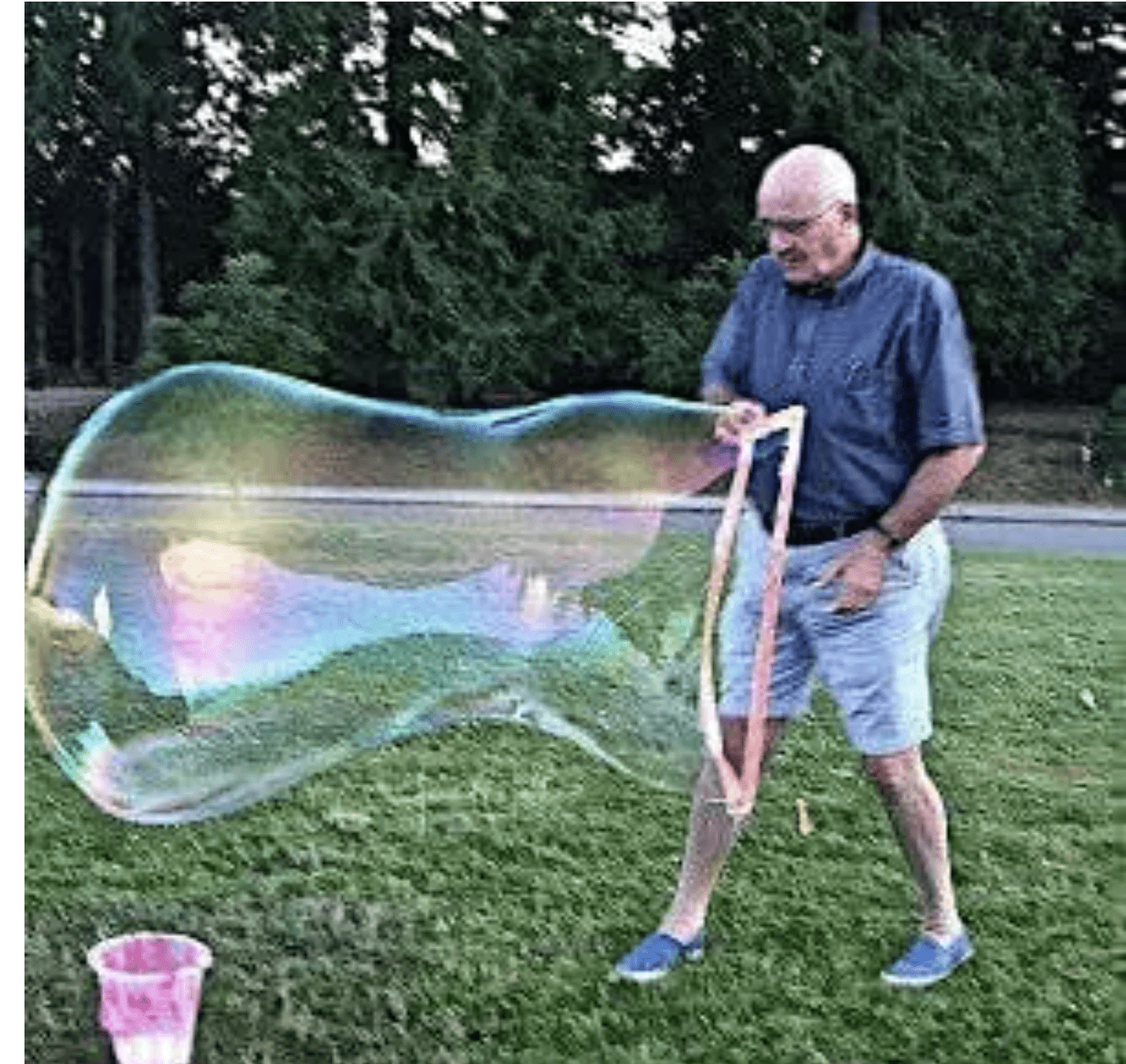
My beloved husband, Hans, was 85 (!) years young when I took this photo of him playing with bubbles in a local park. Hans was a pen and ink artist, calligrapher, retired engineer – a serious intellect who spoke many languages, read, discussed, imagined. Truly a Renaissance man. In his later years, he grew to understand the importance of incorporating a Spirituality of Play in his life and joined me in a daily mantra “Each day, I ‘age’, but I don’t ever want to ‘grow old.
If I reach Hans’ age, I want to still be incorporating a “Spirituality of Play” every day, in some way. What about you?