It’s Thanksgiving weekend in Canada. Happy Thanksgiving!
For many, the “How do we give thanks” question arises. Especially the *how* do we give thanks … when there is unemployment or illness in our family? … when there are senseless deaths caused by terrorists, drunk drivers, those wielding machine guns, war? … when abusive substances continue to attract and ruin lives? … when we feel depressed, spiritually dry, lonely, are grieving? … when hurricanes, tornadoes, typhoons, earthquakes, famine, mass shootings, violence, “isms” are prevalent? … when abductions happen and people of all ages are forced to become sex slaves? … when we don’t know if … war will be stopped tomorrow … if peace will come to Ukraine, Palestine, Israel and more … if war will come to our own country via drones or something else … if nuclear energy will be unleashed? … when hackers, scammers, spammers disrupt our lives with growing frequency? … when we don’t know when/if another nasty virus will attack with even more fury? … when we are uncertain about the future of democracy … when we don’t know if there will be a tomorrow?
History shows that there are always people who give thanks in good times and in bad times … like Henry. Who is Henry?
Henry was a farmer from a very remote area where people could only gather for worship at great intervals.On those occasions they would witness to the blessings in their lives since the community had last assembled.
At one such meeting, Henry stood and addressed the people in halting and simple speech:“It’s been a powerful difficult year out there. The fever took our eldest daughter. Then my wife took ill and is still in bed. The spring wheat crop was mostly ruined by floods.And, oh yes, praise God from whom all blessings flow.”
Then Henry sat down.In the midst of personal disaster, Henry paused and gave thanks.
Being thankful each day, takes discipline, especially when there are financial stresses, medical concerns, family problems, scary political tactics, environmental devastations, unrestrained viruses, war and more. How can we be thankful where there is too much that distracts us from living a life of gratitude?
Maybe it is because we are looking for the “BIG” blessings to be grateful for, when there are many “LITTLE” blessings each day? Think of all the gifts that come absolutely free to most of us. * If you had to pay for the oxygen you breathe at the rate oxygen cost in a hospital, how long could you continue breathing? * If you had to pay for the sun’s heat at the rate of today’s heating bills, how long could you stay warm in winter in the western hemisphere? * If you had to pay for each of your eyes, at the rate eye damages are awarded in court (about $50,000 for the loss of sight in one eye), how many eyes could you afford? * And the list goes on.
While I believe that the Henry’s of this world live ‘thankful Living’ lives, I also believe that there are more Henry’s than we know! At Graduation ceremonies several years ago, almost a hundred students filed into their High School auditorium. Speeches were offered, but because of legal issues and court decisions at the time in their area, no prayers or blessings were allowed to be offered in the school.
When the last student came to the microphone, he looked at the students, smiled, and sneezed. And then clearly, slowly and confidently, a friend shouted “GOD BLESS YOU!” The audience exploded into applause. The point had been made.
May each of us “sneeze our way” through our Thanksgiving (whenever they happen), and realize, that in spite of the angst and fear and unknown in the world, in own personal stuff) there is always something for which we can be thankful and experience at least one little blessing.
Aaaaaccchhhooo!
Happy Thanksgiving! *************************
You are welcome to share this reflection and as always, share all Soulistry reflections with others. And you are welcome to subscribe to the blog:https://soulistry.com/blog
A kaleidoscopic tumbling of emotions pierces conversations, thoughts and social media as words are spoken, written, texted and issues of racism, colonialism, fear and hatred surface far too often.
While we know that words can wound … we sometimes forget that words can also heal. While we know that words can cause confusion … we sometimes forget that words can also bring hope. While we know that words can bring division … we also forget that words can also bring reconciliation.
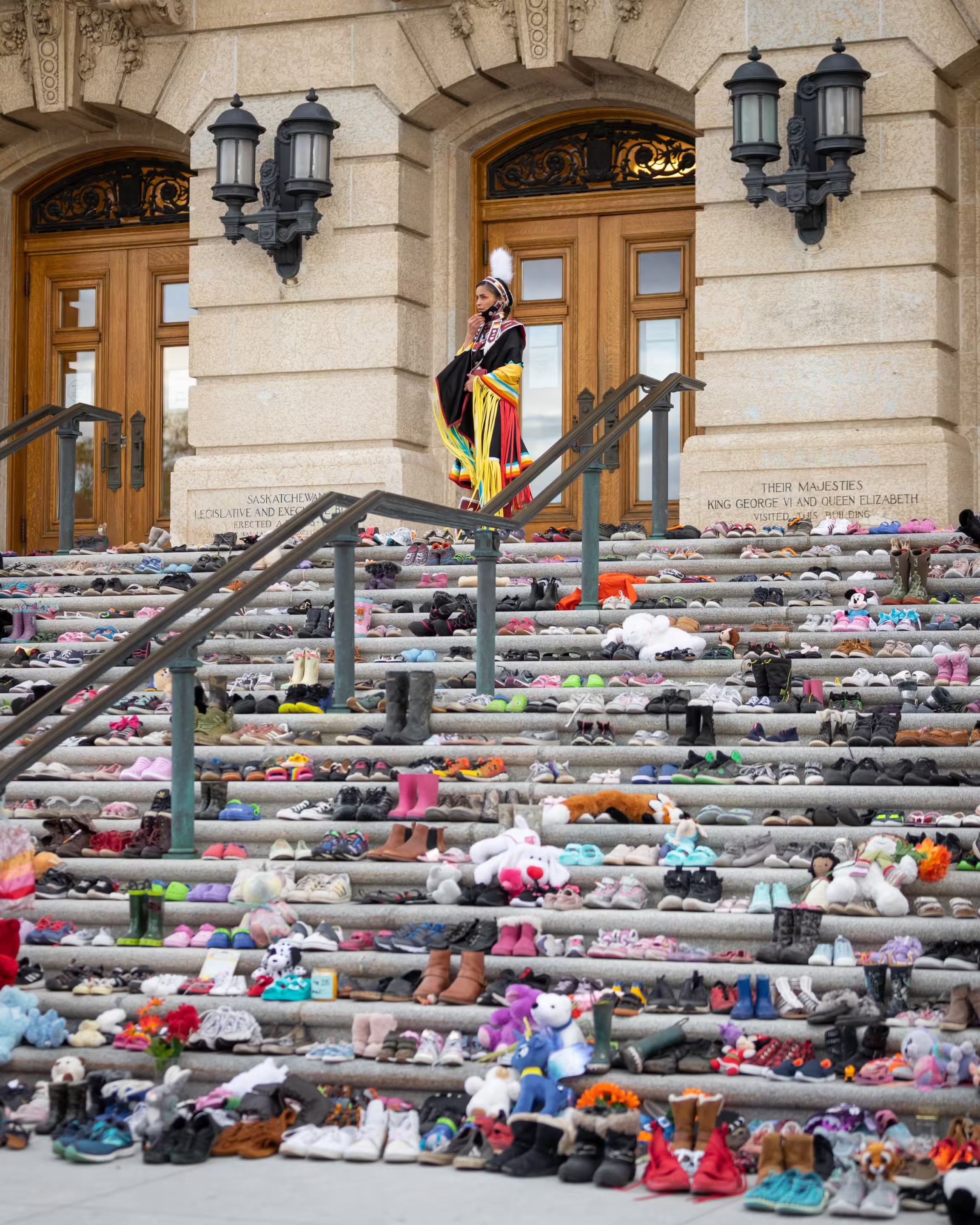
Reconciliation … a much-talked-about word in many places and is a word that has begun to be put into action. This day is a national holiday in Canada. Every year on September 30th, the “National Day for Truth and Reconciliation” is marked to encourage Canadians to engage with their colonial history, to raise awareness of indigenous cultures, and to honour the survivors of the Canadian Residential School system. That system forcibly removed more than 150,000 First Nations, Inuit and Métis children from their families, subjected them to assimilationist policies, as well as other broader injustices faced by indigenous peoples under colonial rule. This day, Orange Shirt Day, many wear orange-coloured shirts as a reminder of the missing children.
When apartheid ended in South Africa, the government sought to transform December 16th into an annual symbol of unity rather than division, creating the National Day of Reconciliation to reflect on the country’s progress in overcoming its painful past, to promote social cohesion across racial and cultural divides, and to raise consciousness about historical injustice.
As issues of racism and colonialism are rising throughout the world, giving fear and hatred through words., the word ‘reconciliation’ must become a reality – within our families, communities, countries, globally – for we all share this planet Earth.
In the exchange of words, may there be sensitivity to those whose opinion differs from our own. May we be empowered with compassion for those who are hurt by the opinions of others.
May we be enabled to move beyond woundedness, confusion, and fear, and not retaliate with words that wound, confuse, and instil even more fear.
And may we be energized with hope … hope that gives life … hope that encourages … hope that empowers reconciliation in word and action.
May we “find the courage to look at our past with eyes wide open, unafraid to see our country at its worst and then humbly, take steps to heal the damage done.” (Globe and Mail)
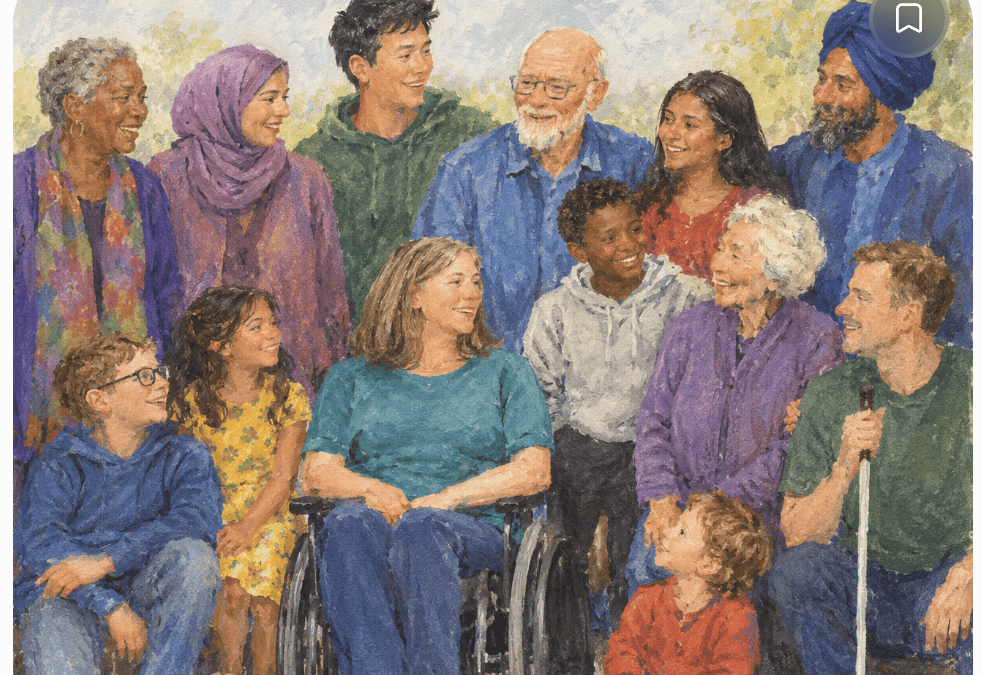
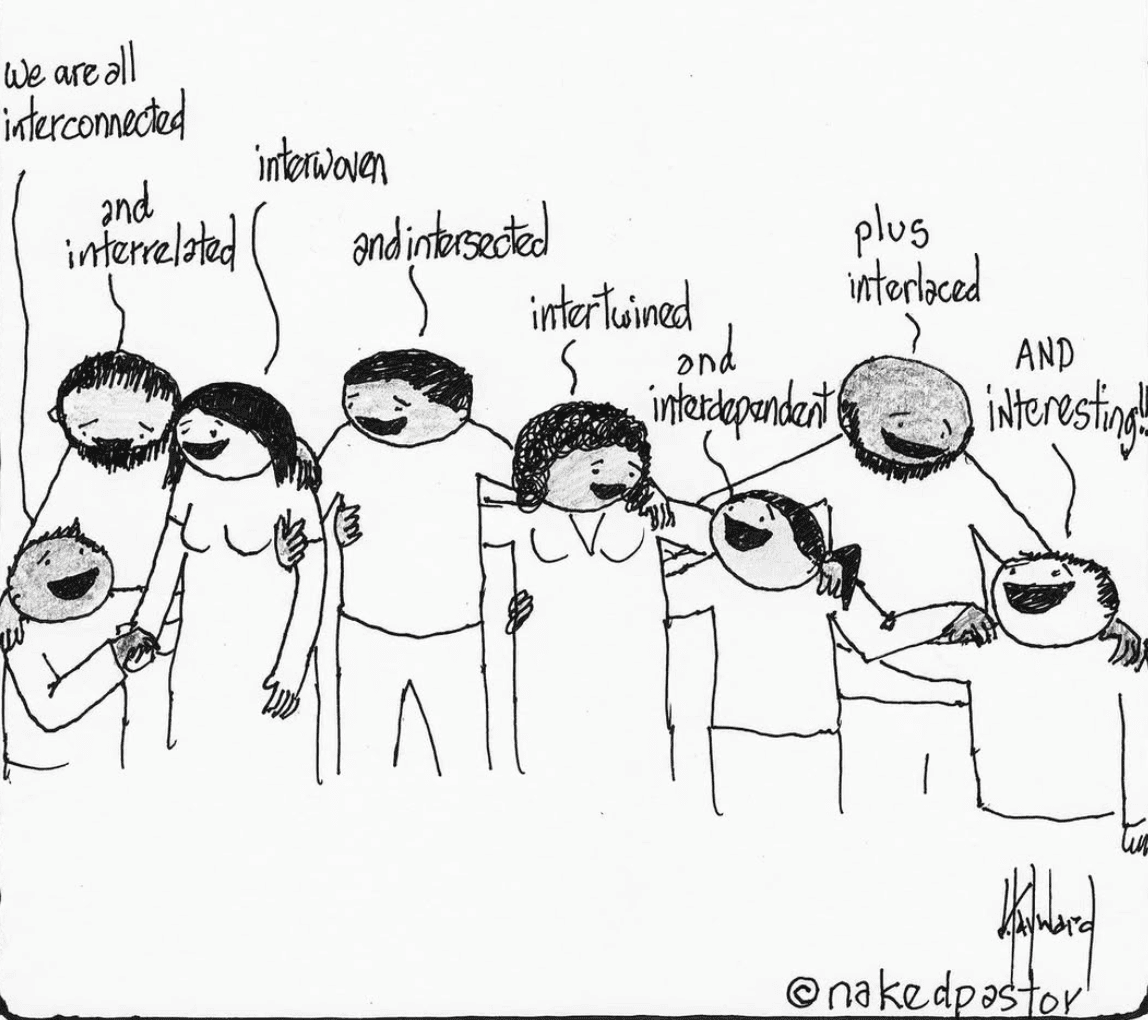
We’re all different. But we’re all IN – a part of – the human race. We are INterconnected INterrelated INterwoven INtertwined INterdependent INterlaced … and INteresting.
Thanks to Canadian artist, David Hayward, for the cartoon artwork and Caterine Hancock for her words: “May we never forget that the geography of our birthplace is simply luck and that is all that stands between falling asleep to the sweet sound of car horns and wind whistling and not the death dirge of warplanes whirring and bombs falling.”
Other things (AI, Robots, Space Aliens) along with differing political views may try to separate us. Ten years ago, those things, AI, Robots, Space Aliens were in the science fiction category. With recent news, they may be more science than fiction – and sooner than anyone anticipates.
But, together, remembering our common/shared humanity, regardless of our political preferences, regardless of our physical, emotional and faith differences, the human race can survive … and survive well, especially if we treat one another with respect, kindness, compassion.
The wise words of my parents “You were given a brain, use it” often surfaced throughout my life.
At the age of fifteen, I decided to leave the church of my youth which seemed to expect me to leave my brain at the door. When I would ask a question I was told “Do not question” and read the books of our faith.”
I did. And then I had more questions and continued to be told “Don’t question.”
“Don’t question”??? Isn’t that why I was given a brain? … to ask questions … to doubt … to consider possibilities … to challenge situations of injustice … to think for myself … to come to my own opinion?
When I became a parent. I intentionally taught my son to think … research subjects … be open to learning from others … discuss what he was learning … listen to the opinions of others … come to his own independent opinion.
In other words, he was raised to be a thinker – not simply go with the crowd … not to agree with my views – but to come to his own opinions about … politics … truth … relationships … religion … abortion … euthanasia … capital punishment … sexuality … and more.
I like to think that reading and doing research, becoming informed, respectfully listening to the opinions of others, discussing and debating and eventually coming to our own opinions is a responsibility.
If you/I were given a brain, surely the Giver of the Gift expects us to use the gift at all times and particularly in these difficult days of elusive truth. So, we must seek truth … we must pursue truth, even if it alienates us from loved ones, from political party adherence, from religious tenets. We must think. Think For Ourself. It is our responsibility
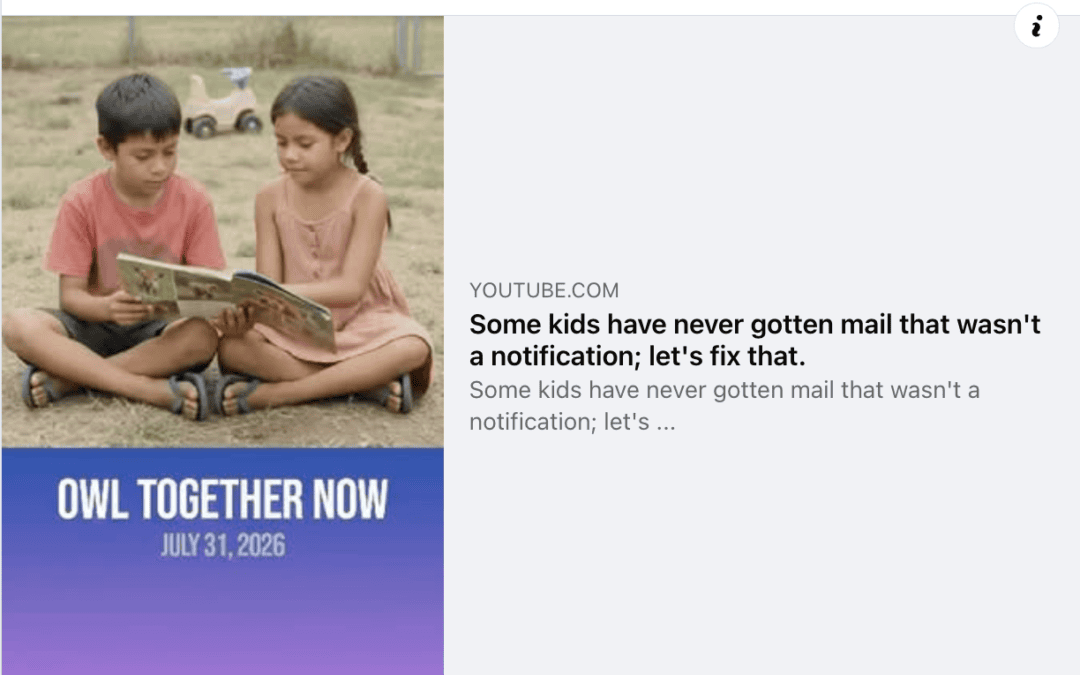
My son Tod LOVED “OWL” magazine when he was growing up. It was a great magazine then and is today! It’s a great way to help kids realize there are more things in life than the social media algorithm.
The back-story of how the magazine came into existence, who now publishes it (and their philosophy about its purpose and the condition of the sale) is a great story. And now, the little boy who loved the magazine so much, has grown up. He has been working for several month that OWL magazine can find its way into the hands of some of today’s underprivileged Canadian children. Here’s more info: https://www.youtube.com/shorts/wqw2iUeGGb8
Needless to say, I immediately followed through and a child somewhere in Canada will be getting a year’s subscription to OWL magazine, for free.
Yes, I LOVE this! Thanks to … Tod … the original women who came up with the original concept … the Assumptionists (who insisted that a condition of the sale was that the magazine must stay non-religious) … and First Book Canada.
You can help make a difference too! Hope you’ll check out the above link and help get this wonderful magazine into the hands of an underprivileged Canadian child.
Tomorrow is July 4th. Americans will be marking its adoption of the Declaration of Independence in 1776 which includes this phrase: “We hold these truths to be self-evident, that all men <sic> are created equal, that they are endowed by their Creator with certain unalienable Rights, that among these are Life, Liberty and the pursuit of Happiness.”
Really? “All are created equal… have certain unalienable Rights”.
Think about this time last year when – Medicaid was about to be slashed, leaving 17 million people without health care – rural hospitals were about to be closed – nursing homes devastated – nutrition assistance for poor children curtailed – trillions added to the U.S. national debt – pregnant women were about to be prohibited from abortions – farmers (and food chain) were about to be seriously compromised
And this year, more. Much more as ICE did stood by its cruel unconscionable actions; people were kidnapped, deported, locked into buildings without adequate food, water, air, space, medical care. And more. Much more.
Have you heard the phrase “bleeding hearts,” referencing people who speak out to support those in desperate situations? On this July 4th weekend, I remember and pray for ‘bleeding heart’ Americans.
I remember and pray for those who have been and continue to speak out … against Project 2025 … against the big bad bill … against the injustices of SCOTUS decisions; who are talking about Project 2025 and acknowledging that it is real, against the man in power and those who support him.
I remember and pray for those who are holding rallies in support of minorities who face racism, hatred, victimization, migrants who have done nothing illegal … who are in solidarity with women who have been told that even if their pregnancy were caused by incest or rape or that their life were in danger, there would be no health care for them … who feel and express compassion for children whose parents can’t provide for adequate housing, medical/dental care, nourishing food, schooling, socialization.
I remember and pray in support of physicians who follow the principles of medical ethics (including medical confidentiality and non-maleficence i.e. not to inflict harm), yet who are forced to break medical confidentiality by revealing the names of women seeking abortions … who are allies of LGBTQ2S+ whose lives will be dramatically changed if draconian laws are implemented. I remember and pray for those who stand up for, stand beside, and stand with people of differing ethnicities, skin colours, sexualities, abilities, religions who are mocked, ridiculed, harassed, physically attacked, kidnapped, killed.
It is difficult to wish “Happy July 4th” when so many are not equal, even though the United States Declaration of Independence notes that its citizens “are endowed by their Creator with certain unalienable Rights, that among these are Life, Liberty and the pursuit of Happiness.”
They may be “endowed by their Creator with certain unalienable Rights,” but those Rights are eroded more and more each day and particularly a year ago today, July 3, 2025, when the House of Representatives voted to support what was known as the Big Beautiful Bill … when Republican politicians forgot or chose to ignore, the oaths they took to “support and defend” the Constitution of the United States.
It is difficult to wish Americans “Happy July 4th”. So I remember and pray for the people of the United States – that they have courage and strength, vision and persistence to “Keep on, Keeping On” in the pursuit of their unalienable rights by speaking out, speaking up and voting in the mid terms for people who will bring the country back to the democratic vision of the founding fathers.
Read the Declaration of Independence and see if you recognize the United States today, the way it was intended. I don’t.
“It’s hopeless. You just have to accept that. Your child will never be a contributing member of society. I can make arrangements for him to be institutionalized. It’s all for the best.” Those were the words the doctor spoke, telling the young mother that her son was “hopeless.”
Hopeless? There are many situations that many think of as hopeless … a marriage on the verge of collapse … a relationship that was desperate for reconciliation … war … a family that was estranged … a body that had run a good race for decades … corrupt politicians –
When human problems beset us … when personal lives disintegrate … when the world seems as if it has gone crazy, it seems that many seek answers from every other physician, before daring to “let go” and “let God/Higher Power/Possibility/Spirit” – before putting prejudices, loneliness, anger, frustrations, pride, hatred, fears into the transforming hands of G_d, the Holy One, the Creator, the Personification of Love, the Bearer of Hope.
How long will it be before reaching out, like the woman with the hem who touched Jesus’ garment or like Jairus, the ruler of a synagogue,= who was searching desperately for some hope. Jairus had tried everything and now, one last attempt. When he finally found the man Jesus, he fell on his knees and repeatedly cried … “My little daughter is at the point of death. Come and lay your hand on her so that she may be made well and live.” Without a word, Jesus went with Jairus. And while that’s all that Matthew’s Gospel tells, the story appears in Mark’s Gospel as well and carries the story further as a messenger from Jairus’ home comes and says “Your daughter is dead. Why trouble Jesus any further?” To the messenger, the little girl’s death was the end of the story. There was no hope. There was no point in trying to go further. It was hopeless. Fear set in.
Like the day a phone call brought fear to a priest who, the evening of the phone call, wrote about The Not-Knowing-Time: “An ordinary medical test was done. Anticipating nothing unusual, and yet there was. “Redo the test” said the physician. “Nothing to worry about – but let’s rule out …” So, the test was redone and there it was. Again!“A specialist. I want you to see a specialist” she said. The rest of that day was a blur other than the ugly FEAR.“Get me to the specialist. Now! Let me know what I’m dealing with, so decisions can be made and life can be planned. The fear is not of dying. The fear is of the not-knowing.”
When we are in such fearful and seemingly hopeless situations, is the God-of-All-Knowing the first we consider turning to? Or turn to at all?
Then there’s the story of the woman who touched the hem of Jesus’ garment. The social context of the time was a significant factor. Because she was bleeding, she would have been looked upon as ‘unclean’. And as such, she was a woman, a person with no rights, and would have been shunned, at the very least, for daring to be in the company of the men who surrounded Jesus, and to touch the hem of his garment. Perhaps she prayed/hoped that her fears would be relieved.
What of the priest who wrote about “The Not-Knowing Time”? A week after the phone call, another entry in her journal: Unraveling the Not-Knowing Time. “Sunday night I wanted to stay home, curl up in bed and watch some inane television program, but I couldn’t. I had responsibilities. In that moment, I hoped that no one would show up at church that evening and I could go home. But, there they were … the two of them. I couldn’t go home. I remembered the phrase: “When two or three are gathered together, there am I, in your midst” and hoped/prayed that something happened for the two who came to church that evening and would happen for me. But, nothing happened for me. I felt no relief – no peace. “The Unknown” still haunted me as walked home. Home at last. A cup of hot tea brought solace, but no relief from the Fear of the “Not-Knowing Time”. The phone rang the next morning with a message “Your appointment with the specialist is scheduled.” The “Not-Knowing Time” had begun to unravel.”
~~~~~~~~ Many others have desperate situations. Perhaps they are facing a seemingly hopeless financial crunch … a marriage that is on the rocks … a teenager or toddler that you can’t handle … a parent who no longer can communicate with anyone in ways others remember … a spouse who is imprisoned either in body or mind … living in poverty and/or war, addicted with nowhere to turn … grieving over the death of someone loved very much …the thought of losing medical coverage – house – job – freedom … a child/spouse/partner/parent who is ill or dying … dealing with their own medical crisis … and the list goes on.
There are countless stories that remind us that no situation is hopeless. But does this mean that if there is enough faith, every dead person will be raised to life on earth? … that money for every financial need will appear?… that everyone who is terminally ill will be cured? … that a job will be provided for all the unemployed? No. It means is that we will be met in our fears and uncertainties and comforted in our Not-Knowing-Times.
Like the true story, long ago, of a wealthy woman, an atheist, who lived in Hanover, Germany. She wanted to prove to the world that there could be no resurrection. She gave orders to those who were to take care of her money after she died, to build a tomb of stone around her, so strong that her body could never rise out of it. Since there was nothing illegal about her request, the men built her a great tomb, and around it, they built an iron fence. What the builders didn’t notice was that a tiny seed fell into a crevice between two of the massive stones and one spring some years later, it sprouted. As the seedling grew into a tree, it pushed aside the heavy stones and the unbreakable tomb was cracked open.
If you go to a place in Hanover, Germany called Gartenfriedhof (Garden Cemetary), ask to be shown the Geoffnetes Grab (the grave that was opened). You’ll have no trouble finding the tomb, because out of its great crack grows the finest tree in the garden. ~~~~~~~~~~~~~~~~~~ Her grave was opened. Hope stepped into Jairus’ life … stepped into the life of the woman with the hemorrhage and healed her body … stepped into the life of the child whose doctor pronounced him to be hopeless … stepped into the life of the priest who wrote “Knowing Time … Holy Refuge”: “Procedures have begun. Nothing untoward showing up so far. Other complications on the horizon. Getting older and having the body not move as it once did is not fun. I must try to “let go and let God.” The talk about the “peace that passes understanding” isn’t just ‘talk.’ It really exists. Should fear well up within me again… should the unknown frighten me … should the “Not-Knowing Time” seem to engulf and entrap and overwhelm and I can’t move beyond it, I hope/I pray I will relax into the gentle, caring, loving hand of Hope – of Love – of the Creator – and allow myself to move into “Knowing-Time” which, from God’s perspective – from Hope’s perspective – from Love’s perspective – from the Creator’s perspective is “Knowing-Time.” Kairos … not Chronos. “Knowing-Time” exists … whether I feel it or not. ~~~~~~~~~~~~
No matter what situation you may be in now – or you may have to face in the future – with God, there are no “Not-Knowing-Times.” There is always hope! Consider these …
—- on a wall in Dachau prison, these words were scratched: I believe in the sun even when it isn’t shining. I believe in stars even when I see them not. I believe in God even when God is silent.”
—- In a tiny room in a refugee camp in Sri Lanka, four women were teaching songs to barefoot, dirty, scantily-lad children. Since there was no room to sit, they all stood for this brief respite from the noisy, hot, humid, dusty and impossibly crowded communal living area. On the door, crudely printed, were these words “Life is a gift from God.”
The refugees in war-torn Sri Lanka, the concentration prisoners in Dachau – they knew Hope – they knew Love – they knew another word for Hope, for Love – they knew the Creator, God, By Whatever Name … even in the midst of a terrifying yesterday, a bleak and often hungry today, and a potentially fearful tomorrow.
May we never forget that even sturdy tombs crack open! … that Hope/Love/God enters lives, enters the “Unknown Times”), enters the moments of apparent hopelessness.
“Mother’s Day” (a secular celebration) in North America is not the same as “Mothering Sunday” which is a Christian celebration, celebrated on the 4th Sunday in Lent in the UK and Ireland since the 16th century. Mother’s Day is being marked today … or avoided …
Whichever it is, With Mother’s Day may we be mindful that there are women who will be celebrating and giving thanks, while at the same time, there will be women who will be grieving, hurting, in pain. All on the same day.
With Mother’s Day I think of and pray forexperiencing a wide range of emotions … the women who never birthed a child … the women who miscarried … the women who were infertile (or their partner was) … the women who had an abortion … the women whose child was stillborn … the women whose child had serious health issues … the women whose child ran away and put into custodial care … the women whose child was raped … the women whose child was taken away at birth by authorities … the women whose child was kidnapped, arrested, deported … the women whose child died due to the pandemic, accident, overdose, illness, murder … the women who began life as male, but knew they were not … the women whose child lives in fear … the women whose child became alienated from them and there is little or no communication … the women whose adoptions fell through … the women whose artificial insemination didn’t work … the women whose surrogate changed her mind & kept the baby … the women whose child is in prison … the women whose child had a debilitating physical/mental disability … the women whose child committed suicide … the teachers who ‘mothered’ the children in their classrooms … the women who were surrogate mothers, carried the child to term, but who never became that child’s parent. … the mothers have died … the women in countries at war, trying to be strong for their children while separated from their partners, families, country and living with explosions, food shortages and the threat of rape, annihilation.
With Mother’s Day, I think of, and pray for those who are rejoicing because … they gave birth to a healthy child … their child had children and they became a grandmother … they adopted a child … each of us – for we all had a biological mother and were given life.
With Mother’s Day, I think of and pray for those who are mothers, but who may not see their role to be one of mothering: foster moms, spiritual moms, mentor moms.
With Mother’s Day, I think of and pray for those who lost their mother through death or alienation or deportation and all who suffered abuse from their mother.
This year, with the reality that Roe v Wade was overturned in the United States, I think and pray for the countless woman who will be forced to carry a child to term … regardless of rape, incest, age, or their own death.
May acknowledgment of Mother’s Day, be done with sensitivity, compassion and kindness in faith groups/religions, families, social media and law courts.
~~~~~~~~~~~~~~~~~~~~~~ Remembering Joy (Gene Dolores) … mother to June and Gerry; step-mother to Lois, Fran and Eric; grandmother to Tod, Christopher and Tracy; step-grandmother to Grace, Brenda, Glen, Jeff and Danae … and giving thanks. May you continue to rest in peace, Mom. Thank you – for oh, so much.
Do you remember Yoda from Star Wars? A legendary Jedi Master, Yoda may have been small in size, but he was quite the theologian, philosopher and poet.
Yoda said “Do or do not. There is no try.” In those two short sentences, Yoda extended a call to *do.” *Do* kindness. *Do* acts of justice. *Do* speak up for … the bullied … the disabled … the environment … the mentally ill … the lonely … the impoverished … the victimized … the grieving … the homeless … the abused animals … the frightening slippery slope that has followed the abolition of Roe v Wade … the elderly … the frightened … the planet … the chronically ill … the addict … the growing tension on university campuses … the addicted … the war in Ukraine and the Middle East and Africa … the political situations in the United States, Hungary, Canada … and
We’re going down the Rabbit Hole and further down the Slippery Slope because …
“First they came for the women who decided abortion was the best response to their pregnancy and I did not speak out because I was not pregnant. Then they came for the LGBQT+ and I did not speak out because I was straight. Then they came for those who were not Caucasian and I did not speak out because I was Caucasian. Then they came for me and there was no one left to speak for me.” June Maffin – based on Martin Niemöller: “First they came for the socialists, and I did not speak out because I was not a socialist. Then they came for the trade unionists, and I did not speak out because I was not a trade unionist. Then they came for the Jews, and I did not speak out because I was not a Jew. Then they came for me—and there was no one left to speak for me.”
Yoda set a challenge and put forth a reminder that … change *can* begin … peace *can* appear … joy *can* be experienced … hope *can* be rekindled … voting *can* bring about change …
Perhaps only in oh-so-small steps, perhaps only in oh-so-small glimpses, but change *can* happen when a Yoda Attitude begins in our heart, in our mind, in our spirit, in our action.
Change might not happen in the ways we want … or expect … or in the time frame we need. But change *can* happen. “Do or do not. There is no try.” (Yoda).
On this, the fourth day of the month of May, may we have a Yoda Attitude. And may the Fourth/Force be with us all.
It’s a new month … the month of May has begun. HAPPY MAY DAY!
Summer is on its way. And in Celtic tradition, the beginning of summer is known as Beltane (Gaelic May Day festival) with celebrations which include the decoration of homes with flowers, bonfires, feasting, making of May bushes. In France May 1st (known as the “worker’s holiday”), branches of Lily of the Valley are given as tokens of good luck.
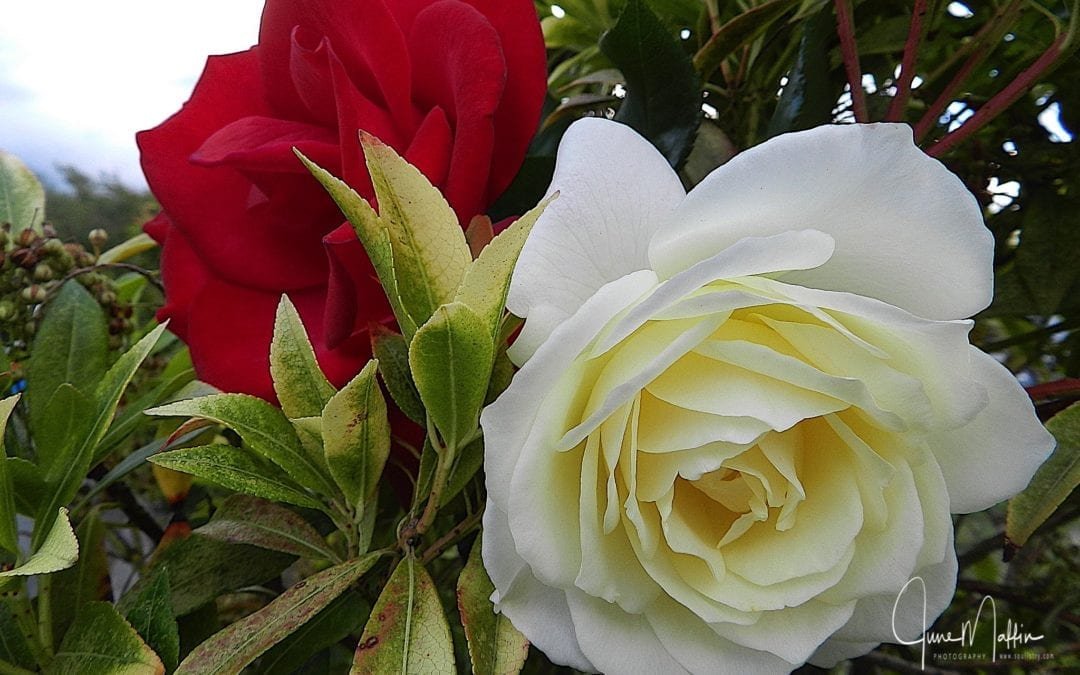
Somehow, with the way things are unfolding politically in many countries, it seems strange to be thinking of “celebrations” and “festivals” and decorating with flowers. But, then I think of the roses that are beginning to open and their blossoms bringing colour, sweet aroma and joy!
And yet – and yet, I remember that their thorns prick and can cause pain. Like roses, life brings joy and can cause pain. But even with the pain, in the midst, there is hope. Look for it. It’s there. Look for it. It is here.
Where?
While it may be difficult to see, sometimes even more difficult to experience, there is hope as a new month begins. … hope – that life will return to some semblance of political normalcy … hope – that people will think, speak and act with kindness … hope – that peace will come to Ukraine, the Middle East, the United States, the other countries facing fear … hope – that this planet will survive climate change … hope – that neither nuclear nor chemical warfare will ever be used … hope – that A.I. will slow down its rapid development in unsafe ventures
Hope … because it’s the beginning of a new month. And with beginnings, there are possibilities!
Let’s not focus on the fear, but on the ‘possibilities.
Every time we “think fear,” let’s find something for which we can be grateful. Just one. … one thing that equalizes the impact of the negative. … one person that puts a smile on our face. … one action we did that made us proud of ourselves.
Just one thing so we can say/think … Happy Beltane! Happy Month of May!
It’s April 22nd – Earth Day – a global annual event celebrated in more than 190 countries to show support for the environment. Words by Thich Nhat Hanh are poignant and critical for us all to remember: “The earth is not just our environment. We are the earth and the earth is us.”
Earth and human beings are inter-related. We can not … we must not … ignore the cry from the earth … the cry of the birds and the bees and the shrubs and the vegetables and the animals and the children and …
For this planet earth to survive we must care for Mother Earth. We must consciously work towards making Planet Earth sustainable for generations to come.
As the wee bird in the magnolia tree says “Please save this earth … for you … for me … for us all.”
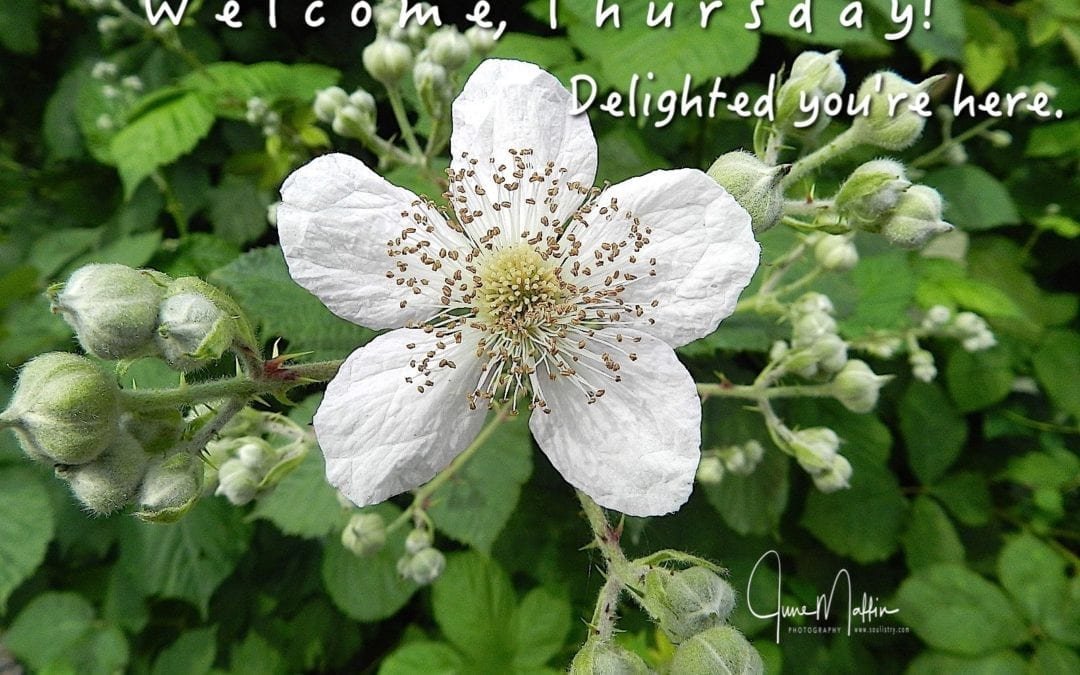
Whenever you find a Thursday that is sad Whenever you find a Thursday that is lonely Whenever you find a Thursday that is difficult in any way how about welcoming it?
How about letting it know you’re delighted … it is here? How about expressing gratitude that … you’re here?
Gratitude – because you are here. Existing. Surviving. Living. … “in spite of.”
Thursday is not just another day of the week. It’s a day that looks to tomorrow and is a reminder, as Annie sang, “The sun will come up, tomorrow.”
Today, Thursday, helps us look to tomorrow … with anticipation.
The days are difficult, seemingly getting more difficult. We’ve got to remember to breathe.
This simple message may not be earth-shattering but it is important, especially when we are stressed, confused, angry, hurting, feeling hopeless or frightened.
So … a reminder: to breathe and inhale ruach – calm – peace – hope.
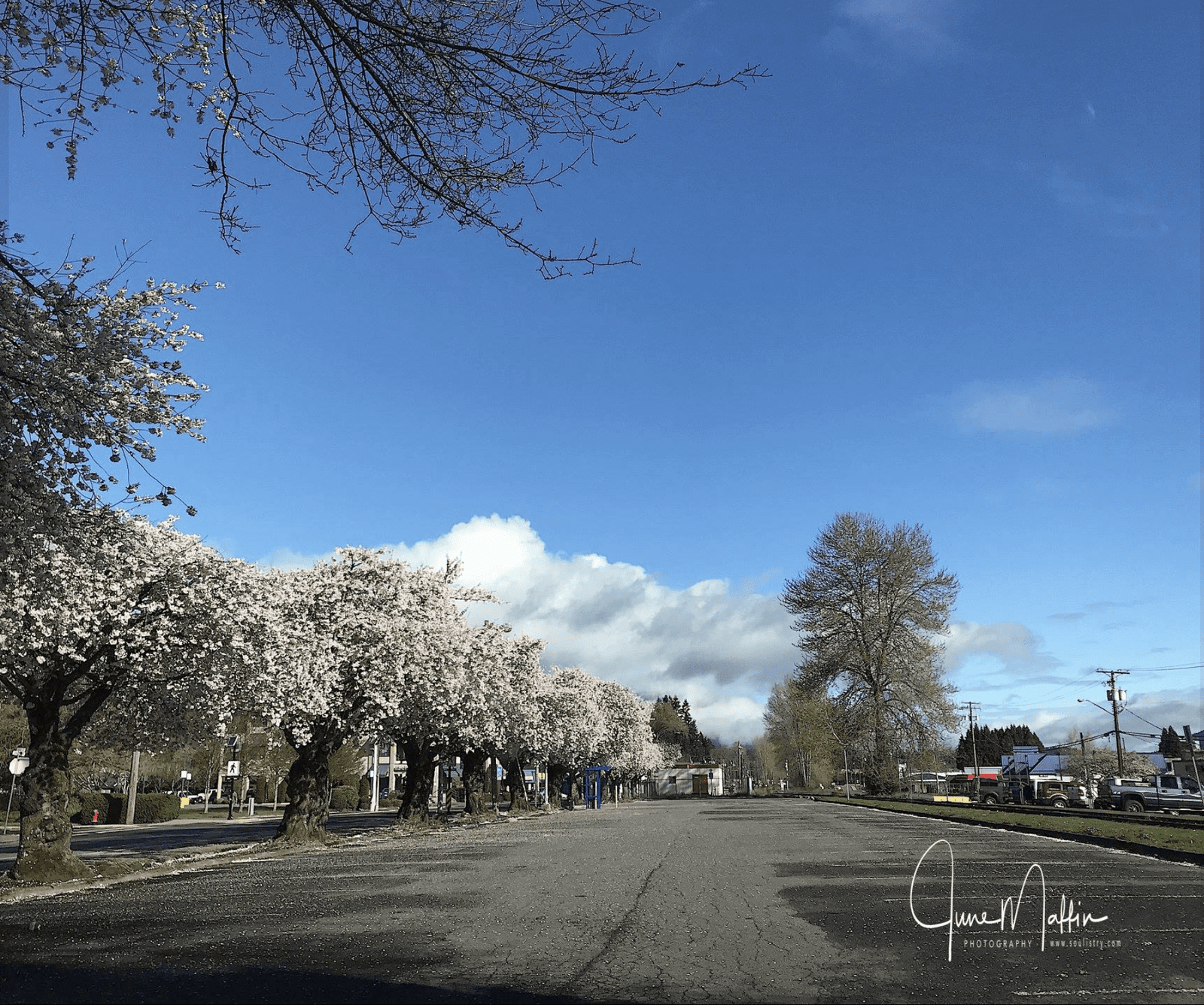
May these beautiful in-bloom cherry trees with clouds in the background gently ambling across the blue sky help us focus on possibilities, beauty, hope.
Today’s Soulistry reflection is a simple message: … remember to breathe.
Finally we have come to the end of Lent, the end of Holy Week. It is Easter! “Alleluia! Christ is risen.” “He is risen indeed! Alleluia!” Huh? What? He is risen? The Resurrection was real?
Proof! We want proof that is tangible, reliable, trustworthy. Heck, we NEED proof! These are scary times. Children are frightened there may be a shooter at their school … or their parents may be picked up by ICE. When we think about things, we realize that there may not be enough water or air or land to live on if climate change isn’t dealt with quicklym and soon. Youth and adults are terrified that more and more young people will be sent to a foreign land to fight in a war that wasn’t sanctioned by their government … the democracy they take for granted is being eroded and may soon be gone.
And then what? Proof! We want proof!!
One little girl had the proof. And she not only told her friend, but stuck out her tongue at the other little girl to emphasize her proof, as she exclaimed “So there! I told you so! I was right! My mother said that the earth is round and if she said it’s round, then that proves it!”
Ahhh, if only proof were that simple. But then again, maybe it is! Maybe the proof of Easter is that it is here … all around us. Not in the physical resurrection appearance of Jesus, but in the hands and feet of Jesus’ followers today.
If we want proof of the Resurrection, maybe we simply need to look around – look around our community, religious group, neighbourhood, local community centre/library/school. TV personality Mr. Rogers said his mother helped him respond to scary news when he was a child, by telling him,“Look for the helpers.”
The proof we want and need is in the selfless action of those who staff the pharmacies, grocery stores, hardware stores, gas stations, car repair shops ,,, in the daily routine done by garbage collectors, street cleaners, ferry workers, truck drivers ,,, in the dedication of educators, health care workers, first responders, physicians, funeral attendants, nursing home workers, journalists, librarians – it’s in all professions and trades.
The proof is in the kindness of volunteers … picking up groceries for the elderly, self-isolating and immuno-compromised, cutting flowers from their garden and taking a bunch to a neighbour recovering from surgery, illness, who is grieving … putting together meals for the homeless, for the shut-ins, lunches for school children, Food Banks … tutoring new immigrants in the English language … sitting on community, school, church committees … mowing lawns and doing some handywork for those less-abled and/or elderly … standing up/speaking out for justice by picketing, peaceful participation in rallies and protests, writing politicians.
There’s the proven that Christ is risen. Christ is risen in you. Christ is risen in me. Christ IS risen! “He is risen, indeed! Alleluia!”
We’re almost at Easter! The end of a difficult week is in sight for countless people around the world who are observing Holy Week. But, we’re not at Easter yet. We’re not at the end of Holy Week.
This day, known as Holy Saturday, is one last nudge – one final reminder – of the fragility of the human being.
Holy Saturday might be likened to a “Morning-After” situation. You know, the “Morning-After” when the worst thing that could possibly have happened, happened – such as … ~ when you received the devastating medical diagnosis ~ when you were fired ~ when you realized that a brutal war was happening – when you discovered yourself on a ‘deportation list’ ~ when your spouse confessed to cheating ~ when you were at a great party, woke up with a doozy of a headache learned that you had driven your car the previous night, and had injured or killed someone ~ when your beloved spouse, child, parent, friend, pet died and you realize it actually happened and was not just a bad dream ~ when you discovered fire, a tornado, hurricane, or war had ravaged your home and there was nothing left – no photo, no computer, no important documents, no clothes, no furniture, nothing ~ when you discovered your dreams about a special job or school or retirement were shattered.
We likely all have a story we can relate to when we were ‘beyond-beyond’ comprehension. And if we can’t think of anything, the threat of chemical/nuclear, cyber war, the everpresent threat of climate change, the reality of ICE kidnapping people in the streets, is our ‘Morning-After,’ and it’s difficult to see very far into the future.
Our Holy Saturday morning experience could be described as being similar to that of the disciples when they couldn’t see beyond the tomb of Jesus … when they couldn’t see beyond the reality of His crucifixion and death. The Holy Saturday of long ago and the Holy Saturday of today, have similarities. Between tonight’s Holy Saturday sunset and tomorrow’s Easter Sunday sunrise, we wait. We keep vigil. We observe the Liturgy of the Great Vigil of Easter which begins in darkness, then a fire is lit and is symbolically brought into the sanctuary/home by a candle.
As the service of prayerful watching continues, Scripture is read, prayers are offered, the Exsultet is sung, holy Baptism or the Renewal of Baptismal vows happens, and the first celebration of Holy Communion begins the glorious Season of Easter … with light throughout the room/sanctuary along with joyful music, colourful flowers, great smiles and the exuberant shouting of “Alleluia! Christ is Risen!” by all who are present. A sense of unbridled joy fills hearts as the wilderness of Lent, the Cross, the empty tomb move us from death to life.
But in these days, when images of death fill the airwaves and people are still deeply concerned about a future without democracy, a future of unknown consequences – or our reality is a present when we can’t be with others to share the good news that “Christ is risen,” what then?
We could do what many in this community did at 7:00 pm each night at the beginning of the COVID:we could sing out loud in our homes, our streets … we could bang our pots and pans … we could joyfully proclaim that the Great Vigil of Easter is over! On this night, Holy Saturday, in the liturgy of the Easter Vigil, hope and possibility are ignited!
“Alleluia! Christ is Risen. He is risen, indeed!Alleluia!“
When you woke up this morning, did you say “TGIF – Thank God it’s Friday!” as many have done over the years on Fridays when they were looking forward to the weekend?
But this Friday isn’t just “any” Friday. It’s different. It’s Friday in Holy Week. A Friday that many refer to as Good Friday. That’s a strange way to talk about a day when Jesus the man, raw from the lashes of a whip, was laid out, arms stretched and bound with ropes to the rough surface of a wooden cross beam, wrists pierced with sharp spikes, feet nailed on a wooden beam, his exhausted body craving release from his suffering, his spirit grieving by the rejection and betrayal of others? What could possibly be “good” about any of that?
It would be a lot easier to forget the relevance of this day in general. And it would be a lot easier, in light of the political upheavals around us, to say that there’s little or nothing “good” about this day.
Perhaps an answer lies in the word ‘good’? Other parts of the world have different words for this day – some Germans refer to today as ‘karfreitag,’ (the ‘kar’ being an obsolete ancestor of ‘mourning’). Elsewhere, some parts of the world call today “Mourning Friday,” putting attention on the disciples who grieved and mourned. And then there are those who follow the belief that this day was originally called “God Friday,” hypothesizing that today is “good” because Jesus was demonstrating his love for humanity by offering his life.
But if that is so, why die in such a brutal manner? Why die so young? Why take on the sinfulness of all humanity on a deathbed after a fruitful life of showing and teaching people the way to God?
Good Friday is unresolved. It’s a tragic and terrible day. War, threat of the loss of democracy and personal crises make today even more terrible and tragic. But, regardless of what we call this day, it is a day when we face reality head-on … when we are fully conscious that the Christian walk is seldom easy, and at the same time, are aware of Grace in God’s unconditional love.
Titus Brandsma was a university President in the Netherlands during WW11. Arrested by the Nazis, placed in a concentration camp, isolated in an old dog kennel, tortured daily, his guards amused themselves by ordering him to bark like a dog when they passed by him. Eventually Titus died from the torture. What the Nazis didn’t know was that Brandsma kept a diary during that time, writing between the lines of print in an old prayerbook. It was there that his poem to Jesus was found: “The lovely way that you once walked has made me sorrow-wise. Your love has turned to brightest light this night-like way of mine. Stay with me Jesus, only stay. I shall not fear if, reaching out my hand, I feel that You are near.”
Perhaps Good Friday can be a day when we remind ourselves that ,in the Christian understanding of hope, nothing, not even death, can overwhelm the love God has for each person.
Perhaps then, this day is not an ending. Rather, it is a day of a new beginning. TGIF. Thank God It’s Friday.
Americans have been experiencing a lot of intense days. And a growing number of Americans are realizing that they were duped by their incumbent President … betrayed by him – someone they thought cared about them and would make America great.
Many years ago, on this day, known in the Christian tradition as Maundy Thursday, the man named Jesus of Nazareth, was about to be betrayed … betrayed by someone who said he cared about, ‘loved’, him. That man, Judas, betrayed his friend, his mentor, his rabbi – Jesus. What drove Judas to such action? What drives anyone to betray another?
Perhaps those questions give rise to another question: “When someone is betrayed, has God been betrayed?” Perhaps reflecting on these questions may help get to the answer.
… When a desire for wealth or fame has overwhelmed the call to be persons of justice and mercy – has God been betrayed?
… If we name ourselves Christian, yet think unloving thoughts about another, act in ways that are not compassionate or kind or just – has the Holy One been betrayed?
… When selfishness prioritizes ‘wants’ before the ‘needs’ of others – has the Creator been betrayed?
… When we refuse to be uplifted, enabled, and transformed by the wisdom or experience of another – have we rejected gifts given by the Creator
… When we only see how right we are and ignore the learning that comes in acknowledging that we have made a mistake – have we betrayed the Source of All Being?
… When we will not accept God’s support and grace, strengthening us for the tasks we have been asked to undertake, or the new ministry roles we are challenged to experience – have we betrayed the Beloved Rabbi?
… When we say we love God, yet have answered ‘yes’ to any of the above – is our connection to the man known as Judas, tangible?
While today, Maundy Thursday, is a day to feel the pain and shock of Judas’ betrayal, it can also be a day to reflect on moments in our own lives … when we have betrayed God … when we have not forgiven another … when we have spoken, or thought unkindly of another, betraying our common humanity by our words, thoughts, tweets, texts, social media comments.
On this holy day, whether or not we ascribe to the Christian faith, may we receive the story of the man, Jesus, in a spirit of humility, and draw closer to one another, mindful of the ways betrayal has been part of our life. And, in spite of it, may we know that we are loved by the One who always loves unconditionally and who invites us to do likewise to others by expressing kindness, compassion and justice.
This night at sundown, a question was asked by the youngest child present at a special dinner – a Seder – in Jewish homes: “Why is this night different from other nights?” The child asks the same question that has been asked for centuries by Jewish people in times of despair, in times of joy, in times of knowing, in times of unknowing.
Then the same child asks Four Questions which emerge from that first question: * Why is there no leavened bread, only matzoh (unleavened flatbread)? * Why are only bitter herbs eaten this night? * Why are the vegetables dipped twice, not once, in salt water? * Why is eating done, reclining on one elbow?
And each of the answers to those questions on this night every year, explains why things are done differently that night: * Matzoh – because there was no time for the dough to rise * Bitter herbs – as a reminder of the bitterness of slavery * Vegetables dipped in twice – as a reminder of tears shed * Eating while reclining on one elbow – to symbolize freedom.
While I am not of the Jewish faith, I have often been intrigued by this tradition and wondered if Passover can offer lessons to people of other faiths and to those of no particular religious faith. And, if so, what could those lessons be?” Over time, some answers began to emerge.
First – we can learn to ask questions.
I love the tradition of having a child begin the Passover Seder with a question. Children love to ask questions (oh wow, do they ever!), but as we grow older, many stop asking questions and take what others believe to be their truth. Not asking questions has sometimes led to broken relationships, illness, political uncertainty and war. Why don’t we ask more questions? Curiosity is a wonderful attribute!
When I had questions of the teachers at the church my family attended, I heard the same response, over and over again: “All answers are in our books. Look – the answers are there.” I did look, over and over, but I didn’t see answers. What I saw, was more questions. But every time I had a question, the response was the same – year after year, after year. When I was fifteen, I spoke with my parents, telling them that I wanted to leave that church. “Why?” they asked. I told them that not only wasn’t I finding the answers I was seeking in the two books that undergirded that faith, I was not being allowed to question – at all.
My parents told me in later years that, when they heard me say … that I believed I had been given a brain to use … that because I wasn’t allowed to question anything in the church beyond what was in one of the two official books, I was refusing a gift (my intellect), and I couldn’t believe God wanted me to refuse that gift but use it and ask questions and more questions – after talking it over, they agreed, and I was given permission to leave that church – and religion. Even though my mother continued as a leader in that church for many years afterward, neither she nor my father expected me to be part of it. How blessed I was to have them both as parents – parents who invited conversation — who let me “think for myself.”
I have never stopped asking questions. I hope I never will. My sense of curiosity and of asking questions has led me on an exciting – and challenging – journey. I ask questions about religion, history, the Bible, politics, God, the environment, the war in Ukraine, the situation in the Middle East, the situation in the United States, here in Canada as well as in Panama and Greenland and Cuba. And, I ask questions of myself.
I ask questions to political leaders, religious leaders, social media journalists. Sometimes I get answers. Sometimes my questions lead me to more questions. And sometimes, my questions lead me to answers. But without the questions …
So, I love the Passover tradition of having a child ask the question.
Second – we can learn to face life’s challenges.
The Christian Season of Lent and the Jewish observance of Passover speak of people long ago who faced challenges. As difficult as those challenges were then, they were profound teachers. Today, each of us faces challenges in our lives. As difficult as they are for us, they too can be profound teachers. Facing challenge is not always easy, but it can be a profound way to learn about life, ourselves, God, this world where we live.
Third – we can learn to take action.
The Israelites left Egypt in such haste that they could not wait for their bread dough to rise, so they took action with the dough they had, and created unleavened bread – the matzoh – which sustained them. Action! The life and story of Jesus in Christian belief, is a motivator of action of a literal understanding of ‘love of neighbour’ by those who followed the man Jesus. That story continues to motivate people today into ‘love of neighbour’ … in advocacy, action and justice-seeking.
Fourth – we can learn to share.
Whether it’s food for the body with a meal – or food for the soul with wisdom – the story of a wide table open to all at a Passover Seder nd for those who follow the story of Jesus (the sharing of loaves and fishes), can be gentle reminders of the importance of sharing what we have with others.
Fifth – we can learn to be grateful.
Many religious teachings undergird the importance of having an attitude of gratitude and not take our precious life for granted. May we be willing to learn from other religions and other peoples.
So on this, the first night of Passover, to those who follow the path of Judaism, may the miracle of Passover live in your hearts forever. Chag Pesach Sameach!
In today’s intense world where alternative facts masquerade as truthful statements … where Executive Orders bring confusion and fear … where outrage is commonplace … where inner peace is quickly disappearing … where concerns and fears about compromised health, terrorism, disasters, broken relationships, economic crises, political harangue and other stressors bring confusion, frustration, anger, and fear, a Spirituality of Play may seem to be a curious matter.
But, more than ever, I believe that a Spirituality of Play” is an attitude that needs to be cultivated in society, in educational systems, in families, by seniors and adults and by children and youth so they can become adults who live balanced lives where laughter, joy and hope are intrinsic throughout their adult life.
And that brings up the subject of today known by many as April Fool’s Day. Where did that begin and what’s it all about? Some link it to the 1564 adoption of the Gregorian calendar which moved New Year’s Day from late March/early April to January 1st and those who clung to the original date were mocked as ‘April fools’ (poisson d’avril in French, meaning “April fish,” a symbol of gullibility). Before that, the Roman Hilaria and the Hindu Holi festival (spring equinox) involved pranks and revelry, and Medieval Europe’s Feast of Fools featured role reversals and mischief.
From the Greek word selig (which means blessed) comes the English word silly. I like to think that there is something sacred about the ability, to be silly, to play, to laugh, to be child-like.
Many faith traditions (Christian and Hasidic storytellers, Zen masters, Taoist sages) encourage us not to take ourselves too seriously. These prophets have an important role in the spiritual life because they espouse the spiritual practice of play. Ralph Waldo Emerson wrote “It is a happy talent to know how to play.” Author Margaret Guenther wrote “When we play, we also celebrate holy uselessness. Play, in its disinterestedness and self-forgetting, can be fruitful.”
When we play … when we enjoy the fullness of life with its curiosities, frivolities and insensibilities … when we don’t take ourselves too seriously, play (like prayer), can be healing: healing to the body, mind and soul.
Interesting fact — when Hindus speak of the creation of the universe, they don’t call it the ‘work’ of God, they call it the ‘play’ of God … ‘play’ being sacred and holy.
When we play, we leave behind the daily stressors and allow our spirit to breathe and re-create. Literature, the arts, various traditions and holidays remind us of the importance of play of giving ourselves permission to be silly and foolish. And Russian artists from the 15th century often featured the yurodivy, a kind of “holy fool” in their paintings.
April Fool’s Day is a day for laughing, for playing gentle jokes and for trying to trick friends. For example, in some places in Europe, paper fish (poisson d’avril) images are put on people’s backs and play pranks on one another … in the UK, Ireland, the US and Canada, people play pranks until noon shouting “April Fool”, stopping their pranks at noon because after that is considered to be bad luck … in Scotland, there’s the two day tradition of “Hunting the Gowk” – sending people on fake errands … in Brazil, there’s Dia da Mentira (“Lie Day”) with the telling of jokes and fake news … Japan adopted western-style pranks in the 20th century … and in Iran, Sizdah Bedar (April 1–2) involves outdoor picnics and playful deceit. On the last day of the nature festival ‘The Hill’ in India, people have fun by sending friends on impossible errands such as finding a stick with only one end … in Native American traditions, Coyote is the Trickster … while in the Aztec tradition, Coyote is referred to as ‘God’s Dog’ … and in Hollywood, Wil E. Coyote always played tricks on the Roadrunner.
Modern twists on April Fool’s Day have brought media and brands embracing the tradition of hoaxes along with social media which seems to have an increase in memes for fun and play, not for real.
A Spirituality of Play helps us live with mystery, paradox and absurdity. It can open doors of flexibility, intuition, vulnerability, and doors of child-like innocence and spontaneity. If we can believe that the Creator created anteaters, duck-billed platypuses, giraffes clownfish, pink flamingoes, and us (!), surely it’s not surprising that the Creator has a great sense of humour and encourages us to laugh – and play!
It’s true – age creeps up, surprises us, reminds us of our mortality. Chronological aging is one thing. And growing old is another thing.
Perhaps many grow old because they stop playing? Play comes in many forms: laughter, dancing, doodling, board games, running with the dog along the beach, playing bridge, engaging in a sport, playing an instrument, creating anything … a shed, a dress, a poem, a painting, a piece of calligraphy, a meal, a book, a piece of pottery, a magazine article, a computer program, a piece of sculpture, a photograph, a monogram, a garden, a scrapbook, a bookcase …
I may be aging more quickly than I would like, and my body may be showing its age a bit more every day, but I refuse to grow old. Even if it’s only a bit each day, I try to play a little each day. This week I’ll be playing with paper products to create a handmade card for a friend who is unwell. When it’s cooler outside, I’ll be playing in the garden. And then there’s the recipe book I borrowed from the library that is inviting me to play in the kitchen and try out some new recipes. I suppose I could look at these three ‘play’ activities and see them as ‘chores.’ But I don’t. Perhaps ‘attitude’ is an important role in the aging process?
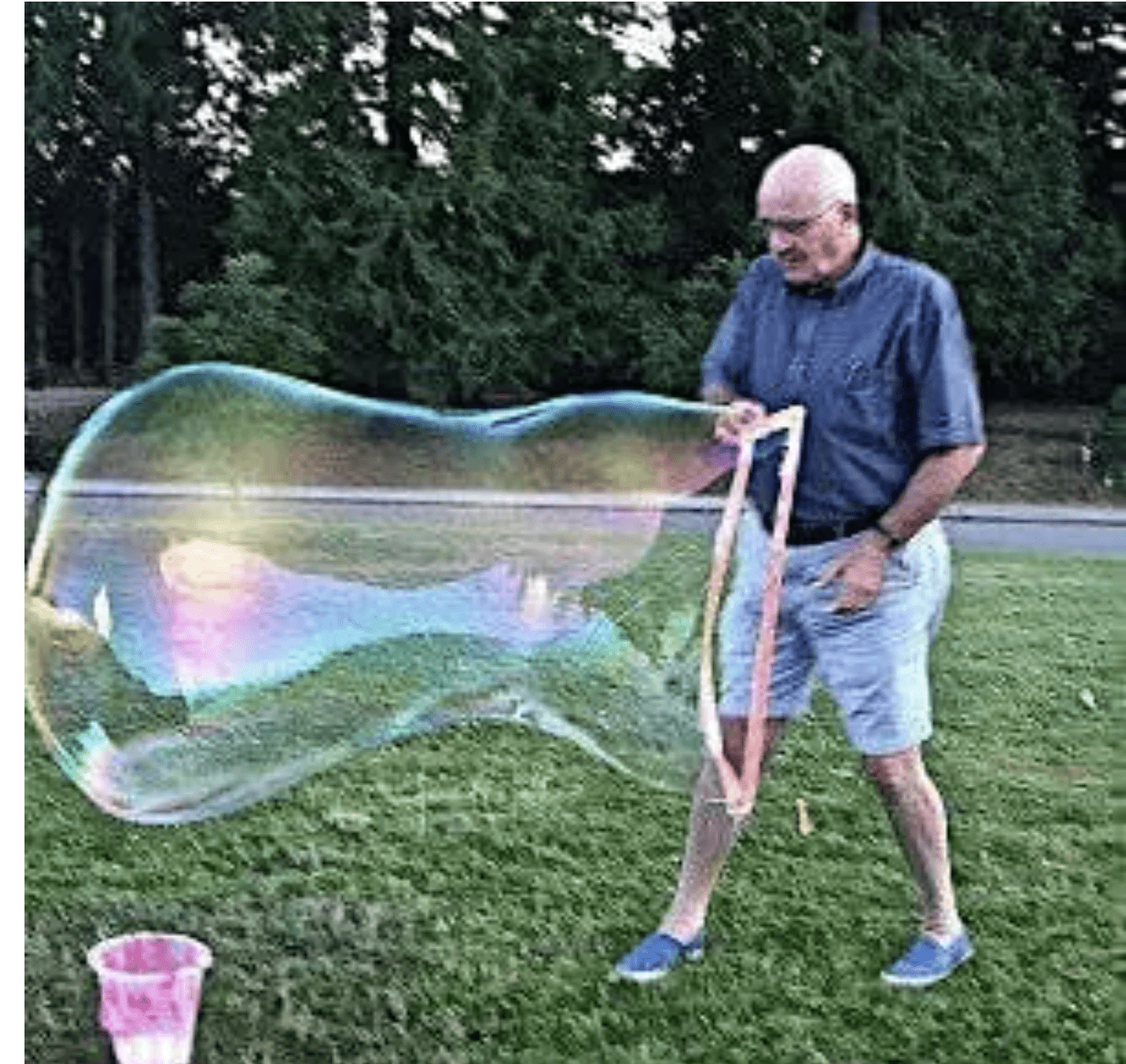
My beloved husband, Hans, was 85 (!) years young when I took this photo of him playing with bubbles in a local park. Hans was a pen and ink artist, calligrapher, retired engineer – a serious intellect who spoke many languages, read, discussed, imagined. Truly a Renaissance man. In his later years, he grew to understand the importance of incorporating a Spirituality of Play in his life and joined me in a daily mantra “Each day, I ‘age’, but I don’t ever want to ‘grow old.
If I reach Hans’ age, I want to still be incorporating a “Spirituality of Play” every day, in some way. What about you?
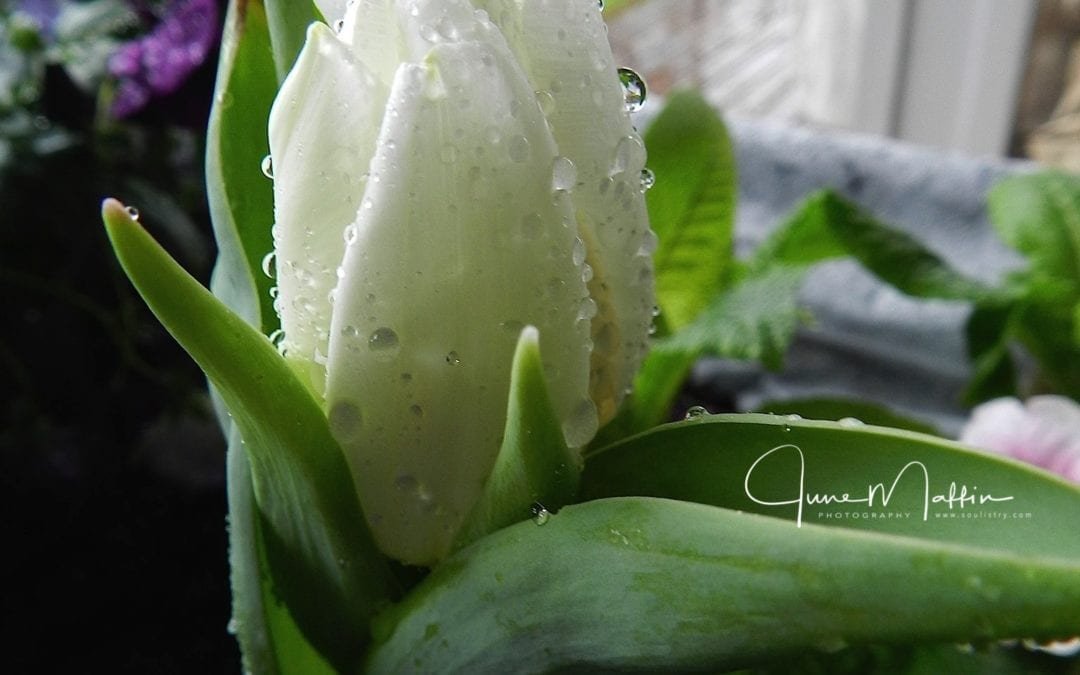
Balance is important for us and important for tulips, too.
Too much sun and they die prematurely. Not enough rain and same thing happens. But when Mother Nature provides a lovely balance of sunshine and rain … ahhhh, beauty.
Today, a rainy day and the tulips are loving every single drop. Capturing this almost-blossoming-tulip in the back yard, seemed to serve as an illustration of this Soulistry blog about balance.
When the busyness of life grabs us, or when we think we have no time, energy, creative juice or zest for life, perhaps it is time to ask ourselves “Where’s the balance?” Maybe we don’t allow ourselves to simply “be” and instead, we focus on ourselves as a “human do-ing” rather than a “human be-ing.”
Instead of doing things which drain us to the point that the passion-to-create or the desire to spend quality time with self/family/close friends is no longer paramount (or maybe even existent) in our daily activity, maybe it’s time to give ourselves the gift of Presence … a time when we nurture our Spirit … are gentle with ourselves … breathe in calm, peace and healing … breathe out anxiety, fear and pain.
Maybe it’s time to recognize that we don’t have to “do it all” … that saying “no” or “not at this time” is exercising wisdom … that acknowledging our vulnerability isn’t weakness, but strength in self-awareness.
Giving the gift of Presence to ourselves can become the catalyst for the precious balance s o necessary to a life where the spirit grows, personhood evolves and healing, health and wholeness can emerge.
May we give ourselves the Gift of Presence this coming week.